
Why Trust Matters More Than Follower Count
Wade through any list of “top book influencers” and you’ll land on familiar names: reviewers with six-figure followings, brand deals, and a mountain of publisher gift boxes stacked in the background of posts. We love these reviewers and they’ve earned their reach! But today, we’re singing the praises of the micro-influencers whose impact often exceeds their follower count.
What Is a Micro-Influencer?
A micro-influencer is generally defined as someone with a following under 100,000 people. In the book reviewing community specifically, the number isn’t as significant as the influence. Trust is the foundation of a literary micro-influencer’s success rather than size.
Micro-influencers’ followers choose to stick around because they consistently deliver authentic, personal, and relevant recommendations. Think of the romance reviewer with 4,200 followers, whose readers pre-order everything she recommends. Or the horror BookToker with 18,000 followers whose stitch-duets move backlist titles years after publication. Post after post, these influencers prove they understand a specific genre, subgenre, microtrope, or reading mood better than almost anyone else.
Their Role in Helping Books Succeed
While scale has been, and always will be, a carrot that book publicists chase for book marketing, scale isn’t the same thing as conversion, and conversion is what actually sells books.
Micro-influencers tend to outperform on the metrics that matter most: click-through rates, saves, and comments that become actual conversations. They’re also great at one of our favorite metrics of interest: the word-of-mouth effect that gets people in a certain community talking, recommending, and buying.
Arcadia Publishing recommends following this formula to calculate an influencer’s level of engagement with their community: “Take the median number of engagements (likes, comments, etc.) across all the influencer’s posts on a particular profile, divide by the total number of followers, then multiply by 100. So if an influencer has 10,000 followers and averages 300 likes and comments per post, their engagement rate is 3%.”
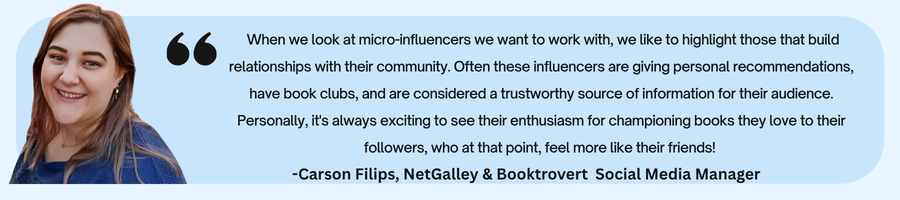
How to Find Your Micro-Influencers
Modern book discovery isn’t a single funnel built on traditional media gatekeepers. It’s a network of overlapping, trust-based communities—but where do you start, and how do you reach these micro-influencers?
- Look beyond follower counts.
Prioritize engagement and audience fit. - Search by genre or niche, not just “book influencer.”
Hunt through hashtags and social groups for influencers that specialize in your book’s area. Similarly, you may find your Non-Fiction influencers in podcast circles, rather than on Instagram. Get to know these communities and encourage your author to join in! - Look at who’s engaging (and how)
The comments can tell you almost as much as the account itself. Are readers asking for recommendations? Tagging friends? Discussing similar books? Or are they mostly posting emojis and generic comments? - Start early.
Build relationships well before launch. ARCs are key here! - Give them something worth talking about.
Exclusive material, author Q&As, behind-the-scenes content, comp titles you’ve seen on their platforms, etc. The goal isn’t simply to get them to post, it’s to give them a reason to want to talk about the book.
For marketers and publicists building a promotional strategy, micro-influencers are more than a nice-to-have. They’re a strategic way to build awareness within the communities most likely to care about your book. A launch strategy built entirely around scale can miss the readers who are only ever going to trust a familiar, specialized voice.
So here’s to the micro-influencers! We celebrate those who build engaging genre communities one post at a time. “Smaller” numbers are doing some of publishing’s biggest work!
