Coping with Critical Reviews

When you put your book out into the world you are hoping to find its biggest champions and most devoted fans. But, of course, no one book will appeal to everyone. Especially for first-time authors, receiving critical reviews and feedback can be frustrating and disheartening. It never feels great to read a critical review of your work, but there are some important things to keep in mind to help you consider critical reviews in a constructive and level-headed way.

Look at reviews for similar titles

Photo via Upsplash

If you want to get a sense of what kind of feedback you can expect for your book, take a look at how NetGalley members and consumer reviewers have responded to similar books. Browse the catalog to find these and you’ll start to get a qualitative idea of the spread of opinions when looking at comparative titles to your book. Make sure that when you are looking at reviews of comp titles – either on NetGalley or elsewhere – that you are looking at books in a similar genre and from a similar author or publisher. For example, if you are a debut thriller author working with an indie publisher, try looking at thrillers from other indie publishers rather than books written by well-established authors at the biggest publishing houses. Plus, for an extra reminder that even the most beloved books still get critical reviews, check out these one star reviews of The Great Gatsby

Remember that star ratings are relative

Star ratings are entirely subjective. For some reviewers, a 5 star review might be reserved for their absolute favorite books – the ones they’d bring to a desert island and the ones that they give as gifts to friends year after year. For others, the same star rating might that a book was an enjoyable afternoon diversion. The same general principle should be applied to lower star ratings, as well. A 3-star review might be a positive review in the eyes of the reviewer, full of thoughtful and useful observations about your work. 

We know it’s hard not to get hung up on these numbers when ratings may affect algorithms for discovery on certain platforms (this is not the case on NetGalley), but keep in mind that reviews and ratings are not something you can police. Since they are subjective, each reviewer has to make this decision for themselves. 

Resist the urge to respond

When you read reviews, you might be itching to reach out the reviewer and tell them why their interpretation is misguided or to defend your book. This is a perfectly natural desire, but we recommend resisting the impulse. We all know that tagging authors in critical reviews is poor internet etiquette, but it does happen. If you get tagged in a negative review on social media, the reviewer who is tagging you is more likely to be looking for some social media attention rather than providing you with meaningful feedback. Don’t feed the trolls. Plus, when authors try to defend their work on social media, it often ends up reflecting poorly on the author, rather than prompt a thoughtful consideration from the reviewer. This urge affects established authors as well as debut authors. Even Zoë Heller, author of Notes on a Scandal wrote in the New York Times that she has mentally composed replies to the critics who she feels have slighted her. But, crucially, she has never sent them. 

Glean valuable data in critical reviews

Sometimes critical reviews can help you better target the right kinds of readers, or tweak your marketing copy. For example, if you have been promoting your book as YA, but critical reviews are saying that it’s too young for a teen audience, consider positioning it as a Middle Grade book instead. Or, if reviewers are expressing surprise at the content, consider revising the way you are describing your book. You want to entice readers, but you also want to find the readers who are most likely to enjoy your book as it is. 

DNF reviews contain valid feedback

NetGalley Sales Associate Katie Versluis works with our community of self-published authors. She has seen first-hand how authors have responded to DNF reviews (Did Not Finish reviews). She told NetGalley Insights that while DNF reviews “may sting after the years of work you just put into this book, they can actually be quite useful to you as you position yourself in the book world.” She advises authors to think about why a reviewer decided not to finish their book. “[Your book] may simply not have been their cup of tea, but [a DNF review] may also bring an entirely new understanding to your book that you hadn’t thought of yourself. In the past, I’ve worked with an author who did a complete re-editing on their book because an early DNF review alerted them to language they didn’t realize was offensive. The review certainly wasn’t “nice” to receive, but it became a blessing in disguise.”

At NetGalley, we recognize that DNF reviews can be valuable, but that they don’t always provide the same kinds of intel as regular, full reviews. That’s why if a NetGalley member does not finish a book, they can close the feedback loop by selecting the Will Not Give Feedback option. This allows them to move a title off their Shelf and give authors and publishers the reasons why they did not finish a given book.

Give yourself time to develop a thick skin

Receiving critical reviews are always challenging, but it will get easier over time. Be patient with yourself when you find yourself dwelling on critical reviews. Talk to your editor, agent, publicist, and fellow authors to get tips on how they recommend handling critical reviews, and learn from their experiences. Remember, you are looking to build a community of readers who love your work, not convincing people that their opinions are mistaken. Try to focus on the positive reviews!

Stuart Evers, author and Assistant Director of NetGalley UK keeps in mind a quote from Yann Martel, author of Life of Pi. Martel made a distinction between good-bad reviews and bad-bad reviews. Good-bad reviews point out genuine flaws and can be useful, if uncomfortable to receive. 

Evers told NetGalley Insights, ”I found this very helpful when dealing with negative reviews – and also helpful when reading any review I receive. A good bad review essentially says, I understand what the author was trying to achieve, but I don’t think they managed it. These can be difficult to read, but ultimately they can offer some insight into your work you hadn’t seen before. Use this to improve your writing; don’t sit there and mope about it. Better a good-bad review than a bad-bad review…A Bad-bad review is when a critic doesn’t get what you are trying to achieve, measures it against the wrong criteria, or fundamentally doesn’t engage with the text. You’re going to get some of these, and these are the most hurtful. However, they can be dismissed precisely because your book is not at fault. It might seem unfair, it might seem vindictive, but you just have to remind yourself: this is a bad bad review and I can dismiss it.”

Above all, professionalism is key

Remember to treat anyone you encounter during the publication process as a fellow publishing-industry professional. This includes the editors, designers, and beta readers you work with before your book is finished, as well as any reviewers or media who you encounter in the pre-pub or post-pub phases. Reagan Rothe of Black Rose Writing works with over 500 authors and shared this framework, “Try to take a professional approach and keep your choice of words constructive. Think about how you would speak to a coworker, your boss, an employee, or even a respected family member.” 

Even if you are frustrated or feel that you have been treated unprofessionally, keep an even tone in any communication you have about your book. As an author, you have now joined the publishing industry as a whole, which means that everyone from your publicist to book reviewers and even booksellers are, in a sense, colleagues. Be sure that all of your communication with them reflects that understanding.


How have you learned how to handle critical reviews? Did you receive some crucial advice early in your career that has helped you? Share your strategies with us at insights@netgalley.com.

Divider

Career Advice for Publishing Students from the NetGalley Team

Last month several members of the NetGalley team sat down with NYU Summer Publishing Institute students. Nina Berman, Associate Editor at NetGalley Insights, Amanda Delatorrre, QA Manager, and Kristina Radke, VP of Business Growth & Development described their career paths, answered student questions, and shared the advice that helped each of them get to where they are in the publishing industry. 

The Summer Publishing Institute (SPI) is a six-week study of books and digital/magazine media in the heart of the publishing world. The program combines workshops, strategy sessions, presentations, hands-on projects and dynamic networking events. Learn more about SPI, plus NYU’s MS in Publishing.

The NetGalley team offered advice about how to network, how to position non-publishing skills and experience for the publishing world, how to carve a niche for yourself in a team as an assistant or intern, and assured the students that there are other creative positions beyond the Editor role.

You can see their nontraditional paths to NetGalley at the end of the article.

Network for the long haul, not just the job hunt

NB: When you’re making those connections, thinking about what you really want to get out of it. In part, it’s obviously that you want to be on their Rolodex so when they’re hiring or their friends are hiring they remember you. But there’s a lot of other information you can learn. And also, keep up with them! Let them know when you get a job, even if they didn’t directly help you do it. People like to feel like they’ve helped you even if just what they did was give you a few pointers generally. Because your first publishing job will not be your forever-job in the world. All of us have been helped by someone along the way. There’s a real sort of pay it forward sensibility.

Let [professional contacts] know when you get a job, even if they didn’t directly help you do it. People like to feel like they’ve helped..

AD: Networking is scary, but it’s so important. Connections that you make from here [at SPI], the speakers, including us, who come here and talk to you guys want to help, we want to give back. Taking advantage of that is really important.

KR: And if these contacts you make see that your momentum is building – that you got a job, and continue to express an interest in them and in the work that they’re doing, you’re going to stay at the top of their mind if they hear about something else that they think you’d be right for. Just sharing your interests with those people goes a long way towards helping others do some work for you and open up opportunities that you might otherwise not have heard of.

Frame your experience for the job you want

KR: Talk about your previous experience in a way that makes it relevant for the job you’re applying for. I had a friend who was interested in a career change, to get into publishing. She asked me if I would sit down with her and look at her résumé because she was applying for a marketing job. She had done work in retail and office admin. I literally just tweaked a couple of words to use publishing lingo to really draw the line between what that experience was and how it applies to book publishing. I think that was one of the most helpful things for her to get her foot in the door. And then once your foot is in the door, the interview is easy. So make sure that you’re really taking the language that you’re using in these classes and insert it into those résumés.

NB: I interned at a place called Chicago Ideas Week and wrote for their blog. Which was fun and something that kept me busy because they didn’t always have a ton of work. Eventually I realized that I needed to get on my own insurance, so I ended up getting a job as a sales assistant at iHeartMedia, which is the company that owns the radio stations that you listen to. It was in no way a good fit for me in terms of culture or the nature of the work, but I learned a lot of 9-to-5 kinds of office skills – emailing, organization, dealing with agency people, things like that. And later on, I was able to turn a part-time opening at NetGalley into a full-time job because I had a combination of editorial experience, from writing for this blog, and account management from this sales job that had been so taxing on my spirit. It was a lot of bouncing around but I found connections where I didn’t expect them, which ended up helping me. And in retrospect, finding things I didn’t think were valuable about old jobs actually ended up helping me be here at NetGalley.

Think about what matters to you in a job


Think about what your values are, what makes you feel like you can get up and go to work everyday and hold onto that as you go into job-hunting.

NB: Working at NetGalley has helped clarify what I care about in a job, which is important when you’re job hunting. Think clearly about what kind of work you’re willing to do, what are the quality-of-life things that are important to you, what size of company do you want to work for, etc. Publishing jobs are so competitive and – especially if you’re working in editorial – you know you’re signing up for what might end up being fairly grueling work, and it might be hard to make rent.

I know for me, it’s really important to feel like I have some kind of ownership over the work that I do. It’s valuable for me to see the impact of my work, and I think that is really possible at a smaller, scrappier organization. But, for a lot of other people, working at a real legacy publisher is hugely important and makes you feel like you’re in a grand lineage. I feel like I have a lot of freedom with NetGalley Insights – to develop it in the way that I want, to interview whoever I’m interested in. 

At NetGalley, our workplace culture is great. We all maintain good boundaries about working and not working, which is really important because we’re remote. We have set hours, which I think is really valuable. And I think there’s a lot of trust. And I’ve never worked with a more competent team in my life.

Think about what your values are, what makes you feel like you can get up and go to work everyday and hold onto that as you go into job-hunting.

AD: I always thought I wanted to work in editorial and, through SPI, I got an internship at Wiley that eventually ended up being my first job as an editorial assistant. When I got the title “Editorial Assistant” at Wiley, which has been a publisher since the 1800s, I was so excited, even though I had no idea what that actually meant. For me, the work there was not rewarding and I was struggling. I knew I wanted to stay in some kind of publishing house and I wanted to stay in the industry, but I was nervous to leave even though I knew I was unhappy. Eventually, I found myself in a more technology-focused role, which ended up suiting me much more!

KR: For my particular role, the fact that I have many things going on – from new product development and sales to managing my team and being an extra set of eyes for NetGalley Insights – sometimes makes it difficult to prioritize. As soon as I get really excited and focused on one thing, there’s all of this other stuff that I need to be thinking about, including what’s next for the company. But that’s also what I love about it. Our team is phenomenal, our work life balance is really great as a company, and for my particular job, every day is different. I never find myself in a rut, because as soon as I’m done focusing on something, there’s five other things that I could be looking at. Staying excited about my position has helped me stick with NetGalley for over eight years!

Explore beyond editorial

AD: When I realized that I wasn’t happy as an editorial assistant, I moved within Wiley to become a Learning Design Assistant. Learning Design is how people learn online, other than just reading your text. A lot of ebooks, a lot of dynamic stuff like that. It was a very good mixture of both editorial and technology, and I ended up naturally falling more towards the technology side. I’ve always been the person who is good at computers. I think having that job where I got the best of both worlds really pushed me to identify what was best for myself. I went back and got my masters degree in educational technology around that time, which drove my desire to change my position forward. Making that final jump from leaving everything editorial behind into this more tech-focused role at NetGalley was super scary but super rewarding. I think I get the best of all worlds now.

KR: I had an internship at HarperCollins in the editorial department at Ecco. This was a very strategic goal of mine at the time, as it is many of yours. It’s challenging to get into an editorial role. It’s really competitive and it’s a whole lot of work. I encourage you to keep pursuing that! For me, once I really experienced the editorial work, I found that it was less rewarding than some of the publicity work that I was previously doing for Hal Leonard. When a job opened up in marketing at HarperTeen, I jumped on it. I submitted my résumé, I got all of the recommendations in. And I ended up there for two years in the marketing department. That was a great way to exercise my creativity – I was writing a lot of copy for ads, back cover copy, social media posts, text that appeared on dedicated book websites, and things like that. 

At that time, and still today, HarperCollins was using NetGalley. I learned about this digital resource that would save so much time – especially thinking back to my time in the publicity department, manually stuffing envelopes and putting the labels on and stacking them so the UPS guy could come pick them up. I was intrigued by the ability to take something that had been such a manual process and make it really digital. It appealed to me in a way that sparked another type of creativity – how can we be using this better? We were [using NetGalley] kind of minimally, but it seemed like we could be doing so much more and connecting with so many more people. These questions led me to apply for a position at NetGalley in a role I never would have predicted for myself!

See yourself as a peer

KR: I interned at Foundry Literary + Media, a literary agency. I did a lot of slush pile reading for them, writing summaries and recommendations to the agents, and writing rejection letters. But what I found most interesting was that the agents were most impressed with the way I could sit in a meeting with them and have a conversation. I heard various comments from them like, “It’s really clear that you’re not right out of college like some of the other interns.” What they were really commenting on was not my age, but the way in which I was able to talk with them confidently as a peer. This is something I would impart to you. Remember that your ideas and opinions are valuable and think of yourself as an equal to all of the people you’re meeting and talking to.

Find opportunity in data & strategy

No matter what your job is, the data is really important. If you know what indicators of success you’re looking for, you can have a better idea about what’s going to work the next time.

KR: Data is something you should be thinking about, even – especially! – those of you who are interested in editorial. No matter what your job is, the data is really important. If you know what indicators of success you’re looking for, you can have a better idea about what’s going to work the next time. Or, if you tried something and it didn’t reach the goals you were trying to reach, data helps you to assess why and try something else. We live in an age now where you have to do that to stay competitive. 

Strategy is one of those things that I think is undersold. A lot of authors especially are still figuring it out. The marketers and publicists at publishing houses often fall into the trap of, “Well this is the way we’ve always done it.” Or, “Sure, somebody told me I should try this thing and I’m going to do it, but in a really minimal way.” One of the biggest challenges of our job at NetGalley is to help people think about their job in a way that really is data-driven, that helps them be a little more agile in the way that they are considering the audiences that they’re reaching and things like that.

NB: A lot of the publishers we work with, especially those that are smaller or run a tighter ship, say that they always wish they were able to spend more time with NetGalley data. That’s an opportunity for those of you who end up in smaller publishing houses. Whether it’s NetGalley that you’re working with or something else; whatever else it is that other people are too busy to work on, make that your thing. Get really good at it, learn a lot about it, be able to incorporate it into your work, and be able to build yourself a little niche that’s really valuable. We’ve seen people start as an assistant who is clicking buttons within the publisher’s account to approve NetGalley requests, then get really interested and becoming great users of the service. They’re then able to leverage that in their own careers to demonstrate that their understanding of this data is valuable in a higher position, or bringing NetGalley wherever they move next.

It’s a good lesson that the things that people generally know that they should be doing, but might not have the resources to do, can be great opportunities for you as an assistant or intern to find something and make it your own.


Thank you so much to NYU’s SPI students for their thoughtful questions. We wish them all the best of luck as they finish out their program and get started in the industry! We are more than happy to speak to more student groups and consider other speaking engagements. To inquire, email insights@netgalley.com.

Transcript has been edited for clarity & length.

Divider

Mark your calendars: September 2019

Upcoming conferences, panels, webinars, and networking opportunities 

There is always a wide variety of programming available to help publishing professionals connect with one another, grow their skill-sets, and stay abreast of changing trends and emerging strategies. On NetGalley Insights, we share the events we’re most excited for on a monthly basis. 

As soon as fall starts, publishing kicks into high gear again. That means a month full of events about the big picture – digital and technological innovation, broad overviews of a book’s lifecycle, inside looks at publishing houses, and events that bring together readers, authors, and industry professionals. 

If you know of an upcoming event for October or after, email insights@netgalley.com so we can feature it.

US


Digital Book World

Conference – Strategy

Sept. 10-12, Nashville

“Thought leadership, best practices, and the gathering of community across the wide world of publishing.”

IBPA: “Ask an IBPA Board Member” Webinar Series: Robin Cutler, Ingram Spark

Webinar – Professional Development

Sept. 10

“During IBPA’s monthly “Ask an IBPA Board Member” speaker series, IBPA members meet and discuss book industry trends with a member of IBPA’s Board of Directors. The series features a different IBPA Board member each month, ensuring that IBPA members receive a unique point of view each time they join. Robin Cutler is committed to helping independent publishers easily get their content into the hands of readers around the globe. To help make this happen, Robin Cutler leads the development of IngramSpark and continues to support and refine the platform to better serve independent publishers around the world. Robin has broad knowledge of indie, academic and trade publishing and is an expert in content creation and distribution, on-demand models, marketing and author strategies. Robin is a leader in the independent publishing space, and when not developing new programs and services for IngramSpark, she can often be found sharing her expertise at industry events around the world.”

BISG: Book Publishing from Concept to Consumer

Conference – Professional Development

Sept. 16, Chicago

“Book Publishing: From Concept to Consumer” serves entry-level and mid-level professionals working across the book publishing supply chain. This career-development opportunity provides anyone interested in book publishing with a broader look at the life cycle of a book, from conception, development, and manufacturing to retailing and libraries. With detailed sessions on acquisition, editorial, production and design, distribution, returns, retailing, and libraries, this full-day event will build your understanding of book publishing as a whole. Topics covered will be more ‘how-to’ than ‘what-if,’ with practical advice and instruction provided by industry veterans.” [Check out our recap of last year’s Book Publishing from Concept to Customer].

Brooklyn Book Festival

Book Fair – Literary Event 

Sept. 16-23, NYC

Open to all, “the Brooklyn Book Festival is one of America’s premier book festivals and the largest free literary event in New York City. Presenting an array of national and international literary stars and emerging authors, the Festival includes a week of Bookend Events throughout New York City, a lively Children’s Day and a celebratory Festival Day with more than 300 authors plus 250 booksellers.”

Audio Publishers Association: Fall 2019 Social

Networking – Audio

Sept. 17, NYC

“Join us for ​2 hours of networking and fun with fellow APA members.”

BISG: Market Opportunities: Rights & Technology

Panel Program – Rights

Sept. 26, NYC

“This BISG series aims to demonstrate areas of potential growth, as well as cutting edge trends that could signify where the industry is heading.” This month the focus is on rights and technology.

Society for Scholarly Publishing: Early Career Edition: Falling into a Scholarly Publishing Career

Webinar – Academic Publishing

Sept. 26

“Are you just dipping your toes in the publishing world, or are you here for the long haul? What does a career in publishing mean in 2019, now that the digital transformation has finally taken hold? Wondering how to find the best fit for your background and skill-set? Join us to hear from an exciting slate of publishing professionals about the highlights, challenges, and responsibilities of their own roles, as well as the routes they took to get there – in just a few minutes each. A Q&A segment will follow the lightning presentations.”

BIGNY: Basically Books: Fall 2019

Workshop – Professional Development

Sept. 27, NYC

“We will cover: 

  • Manuscripts, Editing and Design: the first steps in “making a book”
  • Prepress: what you need to do to get ready for press, including a look at color, color management and proofing
  • Paper: all you need to know about paper
  • P&Ls: an overview
  • Printing and Binding
  • Digital Printing: a primer on the process                                          

There will be guest speakers for each step in the process. This program is absolutely free and is sponsored by the Book Industry Guild of New York. For more information or to sign up, please contact: Steve Bedney / 516-650-5251 / sbedney@gmail.com

UK


Association of Learned & Professional Society Publishers: ALPSP Annual Conference & Awards 2019

Conference – Academic Publishing

Sept. 11-13, Old Windsor

“Our conference is a key date in the scholarly publishing calendar and attracts an audience of over 300 people from all sectors and levels of the scholarly communications industry. Spread over three days, the event provides a relaxed and friendly environment in which to share information and knowledge, learn about new initiatives, as well as engage in open discussion on the challenges and opportunities facing publishing today. Our expert speakers and the wide ranging programme ensure that our annual conference remains a must attend event for everyone involved in the scholarly publishing community. We also provide ample opportunity for networking with fellow delegates during coffee breaks, lunch and in the evening at our two social events (Welcome Reception and Awards Dinner).”

BookMachine: BookMachine Meets Bloomsbury

Panel Program – Strategy

Sept. 19, London

“Step inside Bloomsbury Publishing as we go into their London headquarters for a closer look at how they stay creative and strive to push the boundaries of publishing. For one night only, we’ll bring together four of Bloomsbury’s most energetic staff members to talk about how they stay creative in their roles in Editorial, Marketing and Sales and engage with colleagues, retailers and book lovers around the world. This unique event at the Bloomsbury Institute – Bloomsbury’s public events series – will feature exclusive stories and experiences from the team. Join them for a lively discussion on everything you need to know about publishing right now.”

BookMachine: Audio Across Publishing: How to Deliver More Bang for Your (Audio) Buck

Panel Program – Audio

Sept. 25, London

“Audio isn’t just about one format of a publishing programme. It has the potential to enhance your list as well as the publishing industry as a whole. It’s not just about a product revenue stream. Audio can boost marketing and publicity, enhance an author’s relationship with their readers, and encourage more people to listen then read. Join our panel of passionate audio publishers for an insightful look at how far audio publishing can take your business in 2019.”

Divider

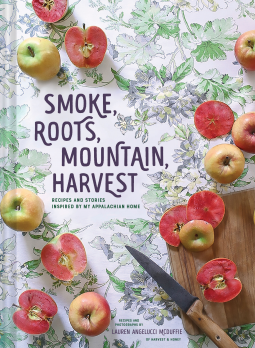
Case Study: Smoke, Roots, Mountain, Harvest by Lauren McDuffie

How Chronicle is using NetGalley to promote their most anticipated cookbooks

We love when publishers experiment with their titles on NetGalley, especially to try new categories, expand the tools they use to promote their titles on and off the site, and how they involve the authors in the process. That’s why when we saw how Chronicle promoted Smoke, Roots, Mountain, Harvest by Lauren McDuffie, we knew we wanted to share their strategies. 

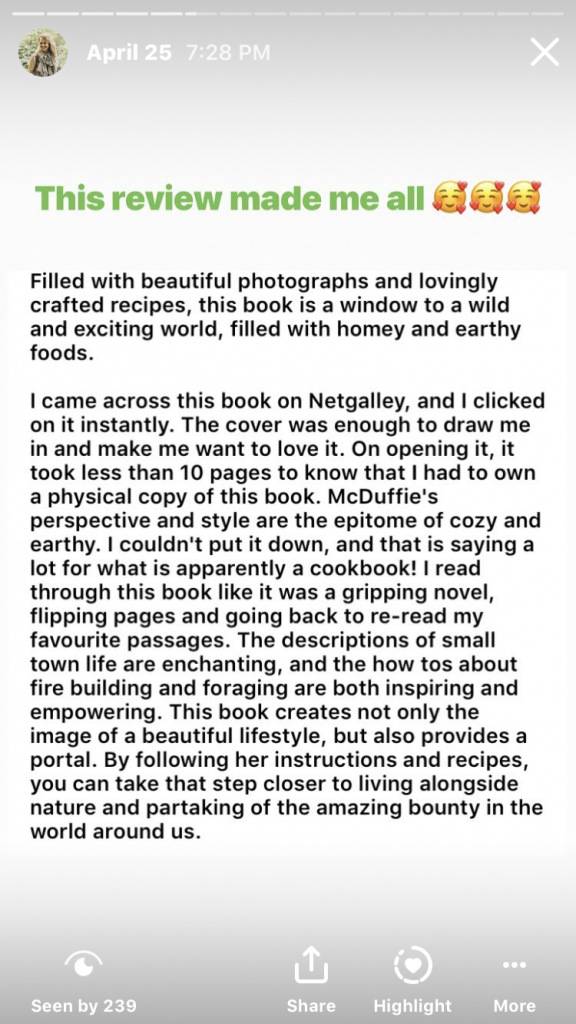
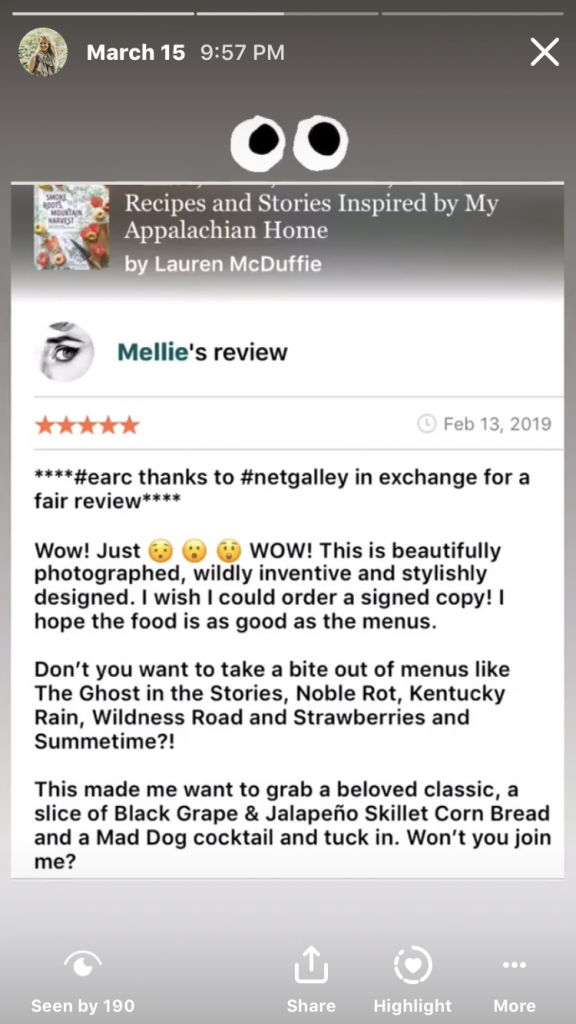
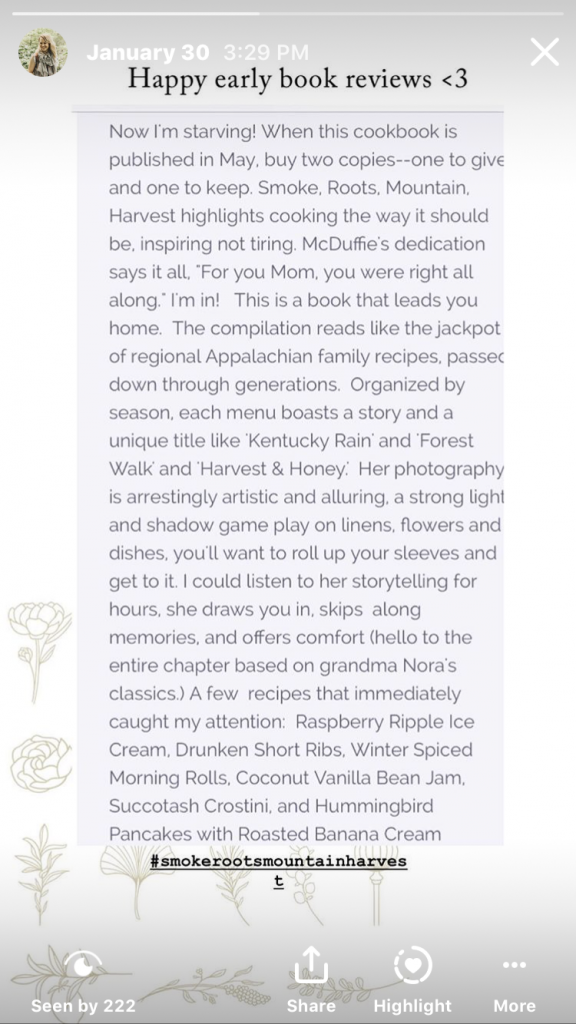
Chronicle recently started putting cookbooks up on NetGalley, using Read Now availability to save time and ensure the widest possible reach. They are using NetGalley data and reporting to guide internal strategy and to equip their sales teams with early analytics. And, in the case of Smoke, Roots, Mountain, Harvest, involving the author in creating special multimedia extras like a Spotify playlist, and encouraging her to share member reviews on her popular Instagram page.

Cynthia Shannon, Food and Lifestyle Marketing Manager at Chronicle shares the steps behind Smoke, Roots, Mountain, Harvest’s success: 

Smoke, Roots, Mountain, Harvest
by Lauren Angelucci McDuffie

What were your goals for Smoke, Roots, Mountain, Harvest on NetGalley? 

We wanted to drive early awareness of this debut cookbook by getting reviews in advance of publication. NetGalley is a great way to distribute the eARC of the book among readers who talk about books, whether on NetGalley, Goodreads, Twitter, or their personal blog. It was a key tent pole in our early marketing strategy, which also included the author producing a video trailer and creating a Spotify playlist.  

What did you learn about how cookbooks are received by the NetGalley community?

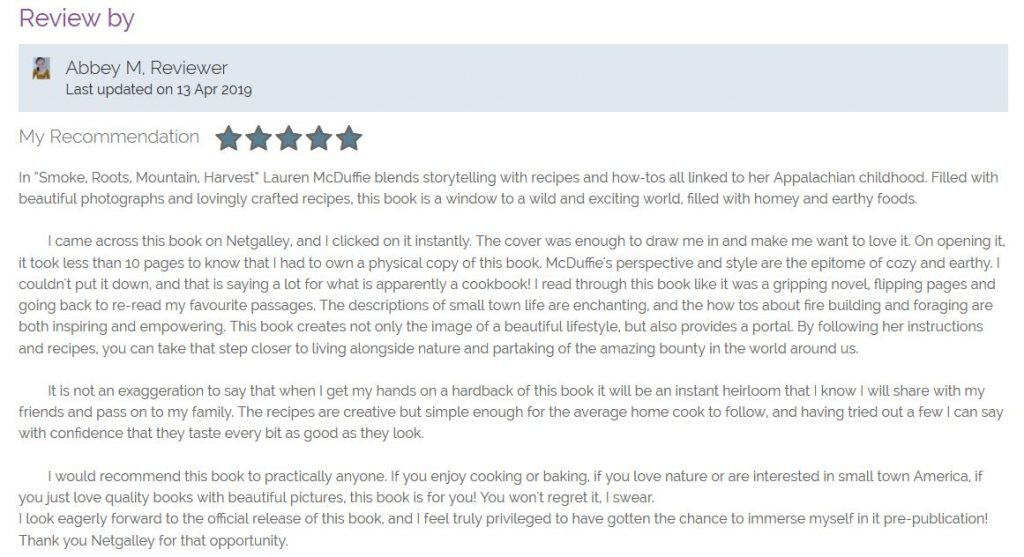
There is a lot of potential to sharing cookbooks on NetGalley and we are looking forward to exploring more ways to further optimize our NetGalley strategy. Adding cookbooks to NetGalley was a new strategy for us for Spring 2019, and I was pleased to see the overwhelmingly positive response. We saw many NetGalley reviewers commenting on the beautiful photographs and the level of complexity of the recipes or ingredient procurement, and how much they were inspired to try some of the recipes. More importantly, they’d comment about how they can’t wait to get a print edition of the cookbook so that they can add it to their collection. Chronicle Books prides itself on creating beautiful, physical objects that people will want to buy for themselves or as a gift, so having these endorsements helps customers make their book buying decisions.

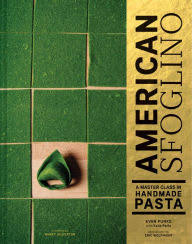
We’ve increased the number of cookbooks we share on NetGalley in advance of publication for our Fall 2019 list—for example, we have Tartine, Ama, and American Sfoglino, three of our most anticipated upcoming cookbooks, available for review on NetGalley now—and we’re exploring the many tools and services that NetGalley offers to further connect with reviewers.

How important is it for you to have reviews that address the recipes in addition to the other aspects of this book (or other cookbooks)? 

We were curious to see how readers would respond to the unique structure of the book, which is organized by seasons and weaves personal stories and anecdotes about growing up in the Appalachian South with modern recipes and cooking techniques. Reviewer response was overwhelmingly positive—the average rating for the book is 4.3 stars—with many also commenting on the beautiful photography that make this cookbook stand out from the rest. While it’s very regional, we were happy to see that it appealed to readers all over the country.

We loved that Lauren McDuffie created a special Spotify playlist to go along with her book! Tell us how and why you chose to include the playlist in your launch strategy. 

The book was inspired by a song (Emmylou Harris’s version of “Country Roads”) so it seemed like a natural way to evoke the feeling of Appalachia through another medium that could be used in tandem with the book. After all, it’s not unusual to listen to music while cooking, or creating a playlist for a dinner party! It also provides further connection with the author, who took the lead on compiling her favorite songs. We shared the link to the playlist wherever we could incorporate it online, and it provided the author with another way to talk about the book on her blog, Harvest and Honey, and on social media in an authentic and charming way


We ultimately received more than 1,500 impressions and nearly 50 reviews, much more than if we had limited the accessibility.

Smoke, Roots, Mountain, Harvest was available as a Read Now title. Tell us why that was the right availability setting for this book. 

We needed to get the book into the hands of as many readers as possible since the NetGalley audience was going to be critical in driving awareness in advance of publication. We were not concerned about it cannibalizing sales. By allowing readers to access the book as Read Now, it minimized the impact on our limited bandwidth to approve each and every interested reviewer. We ultimately received more than 1,500 impressions and nearly 50 reviews, much more than if we had limited the accessibility. 

How did you use the data and reports available for Smoke, Roots, Mountain, Harvest

We included the link to the NetGalley listing and highlights of reviews in reports to the sales team. This helped shed insights into how customers were responding to the book, so that they could share those insights with their buyers.

Did you share the NetGalley listing for Smoke, Roots, Mountain, Harvest outside of NetGalley? 

We were pleased to see more than half of NetGalley reviewers cross-posted their reviews to Goodreads, which the author in turn shared on Instagram stories. [Learn more about how publishers are using Instagram stories here]. This is a great example of how one marketing activity can be repurposed across multiple platforms to appeal to different audiences

We’re still exploring the many ways to utilize NetGalley in our marketing campaigns. We definitely recognize the value of getting those early reviews to inform our strategies; in fact, we’ve increased the number of books we’re sharing on NetGalley this Fall and will continue to look for new ways to engage with the audience. I have some ideas, and am looking forward to trying them out! 


Cynthia Shannon oversees the marketing for the Food & Lifestyle products at Chronicle Books. Prior to this she worked at Goodreads, Berrett-Koehler, John Wiley & Sons, and Other Press. She was named a 2016 PW Star Watch Honoree and is a graduate of the Stanford Professional Publishing Program as well as New York University. She lives in San Francisco. 

Read the rest of our case studies here, and subscribe to the NetGalley Insights newsletter so that you never miss a post.

Interviews have been edited for clarity and length.

Divider
Divider