Pre-Publication Tips for Authors: Build Discoverability

Search Engine Optimization (SEO) is the primary strategy that helps online content find its way to readers. SEO boosts discoverability. It means having thoughtfully and strategically optimized keywords. In practice, an author with great SEO skills stands a better chance of having their website or information show up earlier in Google results. 

The goal of SEO is to lead people to your content by paying attention to what they’re looking for If they’re looking for content similar to the content that you write, you want them to find you! When most of us type in a Google search, we know the general contours of what we’re looking for, but not the exact thing. That’s why we type broad keywords around the topic into a search engine. When you include those relevant keywords about the topics you cover in your own writing, you help your work rise to the top of the results page for people who are already interested in what you’re doing.

When you think about developing an SEO strategy, think about what someone might be looking for when you want them to find your work. What search terms are they likely to use? Those search terms will become the keywords that you can incorporate into your work.

There are a few ways to go about boosting SEO for your writing projects. 

One is through clear titles and subject lines for your writing. If you are posting a short story about undead hordes in an industrial English city, your title should include words like “zombie,” “brains,” and “Manchester.” That way, people looking for stories about the undead in the UK will be better able to find your work. 

You can also put keywords into your metadata and into the content itself. For example, WordPress lets you list keywords for your posts. But be sure to use your keywords in the writing itself, too. Adding in these keywords in metadata and content might seem redundant, but search algorithms work on repetition, so we recommend adding them in. 

Making your content easily shareable helps boost its discoverability as well. If you’re writing about how a specific author has inspired your current work, tag that author and add a link to your favorite book they’ve written. This makes it easy for that author to know that someone is writing about them, and makes it easy for them to share your work if they like. As an article or a website gets shared, it is more prioritized by search algorithms because it’s clear that readers are engaging with it already. 

Check out more author tips here, and subscribe to our weekly newsletter so that you don’t miss any of our best practices, case studies, or insider insights.

Divider

5 Tips for Newly Signed Authors from a Senior Literary Agent

Literary agents bridge the space between editors and authors, working with both to shepherd great books into the world. Because they work closely with both editors and authors, they have a unique vantage point within the industry. They know what editors expect, and how authors can best set themselves up for a successful working relationship. Here’s what the Nancy Yost Literary Agency’s Senior Agent Sarah Younger wishes every newly signed author knew:

1. You don’t have to be on every social media platform known to man

In fact, for fiction, you don’t have to be on social media at all. Sometimes publishers like to see authors supporting their book publishing efforts through social media, but you don’t need to have a robust following while you’re in the querying stage. You may not even need to have a big social media footprint when or even after your book is sold. Social media can become overwhelming, take away from writing time, and be a source of frustration to authors who aren’t innately inclined to visit the platforms. This is okay. However, social media can be a place where you find community and friendship. It can also be a way to communicate with your fans and readers, not to mention a fun way to support your books. Ultimately, when it comes to social media you have to find your own personal comfort level. If it doesn’t feel natural, don’t force it.

2. Get ready for edits

Yes, the author has the final say on their story, and their writing, and their book. But you should be prepared to work with your agent on possible revisions before manuscript submissions and know you’ll eventually get feedback and edits from an editor, copy editor, possible beta readers, and critique partners. They all want to help make your work stronger. And help you tell the story you want to tell. I know that the first response writers have when faced with revisions is not always LET’S GET TO WORK, but having a good attitude about those revisions will go a long way in establishing and preserving a great working relationship with the enthusiastic team behind you.

3. Create an author website

While you don’t need to be on social media, I do think it’s a good idea for authors to have an author website. It doesn’t have to be fancy or expensive, but having a place with your pen name, or your real name, and a bit about your books or your works in progress will be helpful when your readers want to find out more about you, your books, and your future projects. Before you shell out money for a website domain though, be sure that it is the name you really want to use. I advise using your name or pen name as your domain name. But, if that name is already taken, think about adding book-related words to the end. For example, if my name was taken, I would try adding “books” or “novels” or “author” or “writer” on the end to see if that domain is available instead, like this: sarahyoungerwriter[.]com  

4. Explore professional organizations.

Joining a professional organization could be a great way to find community and educational resources. However, membership fees are typically involved with these organizations, so know that this isn’t a requirement for your success. But, if the budget’s there, I advise authors to look into professional organizations in their genre of choice. (If they’re writing across genres, it can be helpful to be part of multiple organizations.) For example, I work with a lot of romance authors, so RWA (Romance Writers of America) is a helpful professional organization for romance writers, both published and unpublished.

5. Expect and prepare for rejection. This industry is not for the faint of heart. An author and agent will see and experience many more rejections than offers and success stories, particularly when they are starting out. However, receiving a rejection, or multiple rejections, doesn’t mean that this career isn’t for you. Just keep swimming! (Yes, I appropriated that quote from Dori.) But it’s true, just keep moving forward. Just keep writing. Just keep going. It only takes one YES!

Sarah Younger is a Senior Agent at the Nancy Yost Literary Agency. You can find out more about the projects she’s sold and the genres she represents here. Additionally, you can find her on Twitter.

Divider

Mark your calendars: July 2019

Upcoming conferences, panels, webinars, and networking opportunities

There is always a wide variety of programming available to help publishing professionals connect with one another, grow their skill-sets, and stay abreast of changing trends and emerging strategies. On NetGalley Insights, we share the events we’re most excited for on a monthly basis.

Even though summer hours are in effect for many in the publishing world,  there are still opportunities to connect with your peers and learn new skills in July!

If you know of an upcoming event for August or after, email insights@netgalley.com so we can feature it.

US


Thrillerfest

Conference – Networking

July 9, NYC

Annual conference for International Thriller Writers.

Romance Writers of America

Conference – Networking

July 24-27, NYC

“Join Romance Writers of America for RWA2019 at the New York Marriott Marquis in New York City, July 24–27, 2019. At the conference, career-focused romance writers can anticipate education and information, networking with fellow writers, interaction with editors, agents, publishers, vendors, retailers, and other romance publishing industry professionals.”

UK


Book Machine: Campaigns That Don’t Cost the Earth: Compelling marketing and publicity on a shoestring budget

Panel program – Marketing

July 3, London

“The majority of marketing and publicity departments work on very modest budgets. And while there are plenty of inspiring marketing and publicity campaigns that deliver great results, how many of them can you realistically expect to deliver? Even the ones that purport to be “low cost” are often not.

Our panel of experienced publicists and marketers will talk through three case studies of genuinely small or non-existent budgets. Each practical example will show how you can harness the latest techniques to boost the profile and sales of the books you publish, but without costing a fortune.”

Book Machine: Understanding Facebook: Ads Training for Publishers

Workshop – Marketing

July 9-10, London

“BookMachine Works is running two training sessions for publishing professionals who need a deeper Understanding of Facebook Ads, either for managing a team/agency; or for setting up your own campaigns. If you are familiar with Facebook, but lack confidence or understanding when it comes to running paid-for ads, then this is the course for you.”

Byte the Book: Breakfast Byte The Book Agent Tables – Speed Pitching to Agents

Speed pitching – Networking

July 10, London

“Eighteen authors, six agents plus a light breakfast at the Groucho Club, with each author submitting their work first and getting the opportunity to take two of the thirty-six slots on the day to meet privately with two agents each who have read their work.”

Divider

Make it Personal, Online

PubTech Connect – Book Lovers on the Internet: Connecting with Readers in Digital Ways

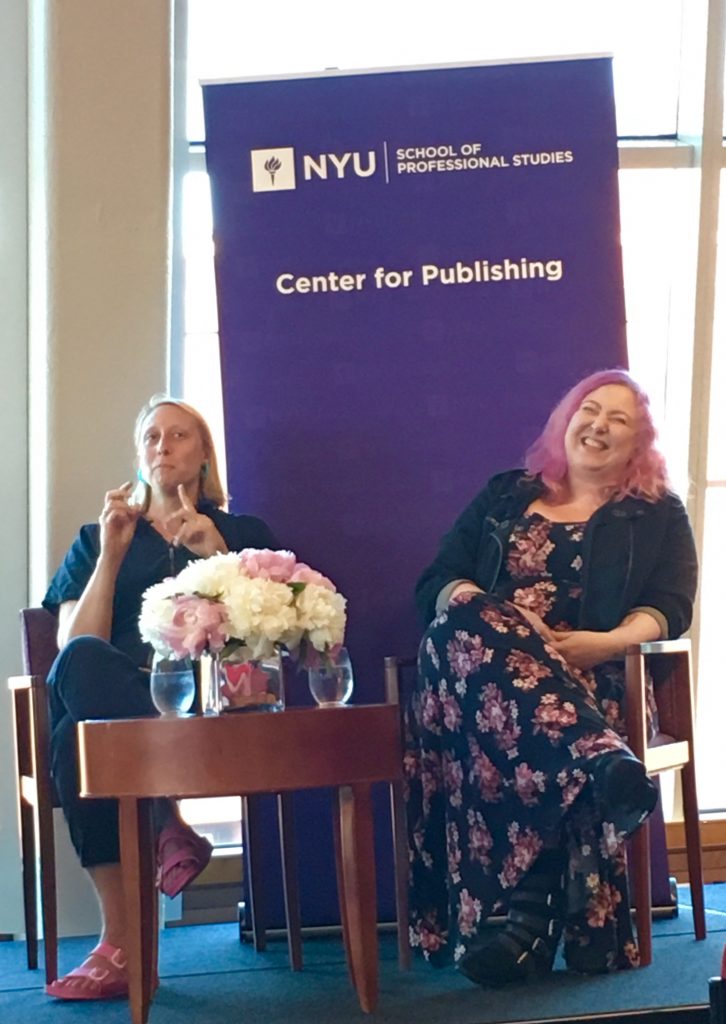
In partnership with Publishers Weekly, NYU’s Center for Publishing hosted a night of discussion about online book communities and communications as part of their PubTech Connect series. These diverse panelists all agreed on one thing: When talking about books, they are all far more interested in personal, affective responses to books rather than in sweeping generalizations about whether a book is Good or Bad.

Panelists

Even though the panelists all represent different ways of engaging with online book discussions and different reading communities. They – and their audiences – are each looking for stories about how books influence us, how books help us relate to their own lives or to current events, and how books can foster a sense of interpersonal connection. As Jess Zimmerman of Electric Lit put it, they are all moving from focusing on whether a book is good or bad to how a book is functioning and with whom it is resonating.

NYU PubTech Connect Publishing Emma Straub Jess Zimmerman
Emma Straub (left) and Jess Zimmerman

They shared some of their digital content strategies with this personal touch in mind. For authors and publishers, knowing what kind of content is resonating online can help you to make stronger pitches to media outlets, and to produce the content yourselves that will help you connect directly with your audience.

Personal essays

Cristina Arreola, Senior Books Editor at Bustle told the audience that personal essays are always top performers for Bustle. Essays like “I Re-Read Big Little Lies Amid the #MeToo Movement – And It Changed the Novel Entirely for Me” and “I Grew Up in a Fundamentalist Evangelical Community. How I ‘Rewired’ My Brain with Poetry” resonate with readers because they demonstrate the emotional pull that books have, the ways that they can shape us and stay with us, and can help us understand our current cultural moments.

Jess Zimmerman also publishes personal essays. She noted Electric Lit readers respond positively to personal pronouns in headlines. For example, titles like “The Book That Defined my Teen Anxiety Turned Out To Be a Lie” or “The Book That Made Me a Feminst Was Written by an Abuser” promote identification with the author of the essay. Even if the readers don’t share these particular, unique experiences, the framing around “I” gives them a reason to click. And the personal focus of the essays resonate with readers who have also been shaped by their reading experiences, even if those experiences aren’t the same as the ones being written about.

Quizzes

We all click on quizzes more than we’d like to admit. It’s not that we really need to know what our taste in donuts says about our innermost souls, it’s that we like to see ourselves reflected. That’s why Jane K. Lee of Epic Reads gives her YA-loving audience plenty of quizzes. Some of them are about specific books, and some are about creating personalized recommendations. Lee uses quizzes to help her audience connect with themes of a book by placing them in it – by seeing which character they are most similar to or seeing how well they would fare in a dystopian future.

Bookish Executive Editor, Kelly Gallucci agrees about the importance of quizzes. She told NetGalley Insights, “Bookish quizzes all put the reader in control. In a way, our quizzes are like a choose your own adventure for book recs! With the reader at the helm, the results feel more personal and curated because their choices (whether its their Hogwarts house or favorite dessert) led them to the book in the results. It results in a recommendation process that’s surprising, fun, and engaging for both us and our readers.”

Faces (or hands!)

Emma Straub, co-owner of Brooklyn’s Books are Magic noted that the bookstore’s Instagram followers want to see people. They love seeing authors, employees, and everyday readers in their feed. Through social media, audiences have increased access to authors, celebrities, and popular store owners. By showcasing the people behind the magic, and the ones who are enjoying it, Straub and her team create a feeling of intimacy online. That way, when people walk in to Books are Magic for the first time after following them online, they can already feel at home.

Moderator M. J. Franklin jumped in to agree that showing the person behind the online persona is crucial, but that he is often loathe to take a photo with his face in it. Instead he’ll show his hands in a photo so that readers know that there’s a flesh and blood person posting, but he doesn’t have to worry about catching his face at the perfect angle.

Through meaningful personal digital content marketing, you can help your audience connect with you at a deeper level. Audiences are hungry to know the people bringing them the books they love – whether those people are authors, publishers, booksellers, influencers, or reviewers.

Divider

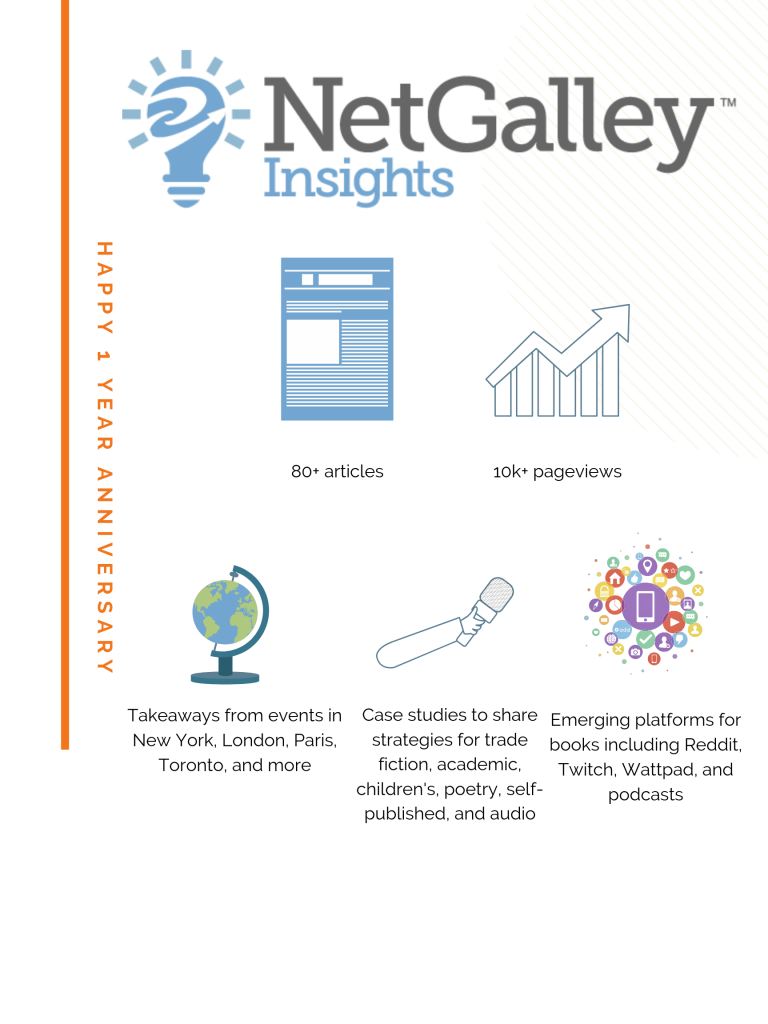
1 Year of NetGalley Insights!

Since our launch in June 2018, we’ve leveraged NetGalley’s unique position in the industry to share lessons from successful marketing campaigns, tips for connecting with influencers across platforms, interviews with industry changemakers, data-centric strategies, and plenty more. We’re looking forward to year 2!

Divider

Giving Publishers the Data They Need: Developing Eloquence on Alert

Firebrand Technologies’s newest service, Eloquence on Alert, gives publishers more access to data about their titles across retail sites than ever before. Through EoA, publishers can keep tabs on any changes to their title information, including changes to sale price, product pages, buy buttons, and third-party seller activity.

Catherine Toolan, Director of Eloquence Services at Firebrand, gave us an inside look at how Eloquence on Alert developed, and some of the surprising ways that publishers are already using it.

What were the origins of EoA?

Eloquence on Alert came out of a simple need for publishers to determine if and how their products were being displayed on retail and reviewer sites. Publishers send out metadata to trading partners and there is very little feedback from those trading partners once the metadata is received. This simple mission planted the seed and from there we have discovered that there is a lot more information we can provide to make it easier for publishers to help their products succeed.

A lot of the impetus for EoA came from Eloquence on Demand users. Many of our clients were sending out the very best metadata that they could on the industry recommended schedule but they were still having issues with the data or the timing of updates on some sites. They also encountered situations where their titles did not appear on some sites at all. As you can imagine, publishers with a large list cannot check retail sites daily for the presence or absence of their titles. Eloquence on Alert grew out of a need to help publishers tackle these and similar problems.

Eloquence on Alert was conceived in 2016, with the first data collection in July of that year.  We released an “alpha” Title Management-dependent version of EoA in 2017 and quickly realized that we needed to pivot and build a SaaS model (software as a service) that would allow for independent product growth.

How does EoA interact with other Firebrand products like Title Management and Eloquence on Demand?

Eloquence on Alert is a standalone product and does not require the use of any other Firebrand products. We will be working to integrate EoA with Eloquence on Demand and NetGalley in the future.

How does EoA fit in with Firebrand’s overall vision around publishing and data?

Firebrand’s flagship products, Title Management and Eloquence on Demand encourage publishers to develop workflows and data management practices that help them to provide some of the best metadata in the industry. Eloquence on Alert takes this a step further and helps publishers fine-tune their practices by drawing attention to trading partner behavior in relation to their metadata content and delivery schedule. The best metadata in the world does not do much for you if your partners are not using it.    

What need does EoA meet for publishers?

Eloquence on Alert monitors critical factors such as fluctuating list and sale prices, changes in sales rank, missing product pages, missing buy buttons, third-party seller activity, marketing assets, review count growth, and audience sentiment. EoA is committed to continued product development and enhancement to meet emerging industry needs.

We know that a select group of publishers have been using EoA in beta. How have you seen them use EoA?

Each of our beta customers is using EoA in a different way. This was somewhat of a surprise! Some are using it primarily to monitor third-party seller activity, some are using it to track missing product pages or price data fluctuation, and some are using the data in their own Business Intelligence systems to augment their internal data analysis.

Did any of them use it in ways that surprised you?

Yes, there are several uses that have surprised me. One that seems obvious to me now but did not initially is the use of EoA to track products that should not appear on certain sites. When certain products appear for sale on a specific site it is a violation and their product management team is alerted so that they can contact the site to have the product(s) removed.

How do you hope publishers will use EoA now that it’s more widely available?

I hope that EoA will become a “first thing in the morning” activity. The EoA results can be used to let you know if there will be any burning issues to deal with today, if any of your products are on the move, or if all is status quo for the day. A simple check-in with EoA can do a lot to inform your priorities.

Where can readers learn more about EoA or see if it’s a good fit for their goals?

The best way to learn more about Eloquence on Alert is to see it in action – words cannot really describe it! Readers can contact our Sales and Marketing department at info@firebrandtech.com to schedule a demo.

Divider