How Independent Authors Can Maximize the Benefits of NetGalley

Independent author M.J. Etkind recently shared her experience on Reddit about using NetGalley for her books — including landing a feature in the The New York Times and generating meaningful library sales. Her biggest takeaway? NetGalley is far more than a review tool. When used strategically, it’s a professional marketing platform designed to connect authors with booksellers, librarians, media, and industry professionals.

Here’s what indie authors can learn from her approach.

Remember Who NetGalley Is For

Many independent authors view NetGalley as a way to collect reviews on Goodreads or StoryGraph. And yes — reviews in these places absolutely matter, but M.J. believes they’re not the only thing that matters! 

NetGalley was built primarily to serve industry professionals, ranging from booksellers, librarians, media, reviewers and educators. But  M.J. has found that if your only goal is consumer reviews (meaning reviews shared on retail sites like Amazon or social sites like TikTok), you may be underutilizing the platform. Authors can, and should, think bigger! Trade visibility, library discovery, and retail relationships are all within reach when using NetGalley. M.J. discovered that one of her biggest long-term values came from focusing on professional audiences, particularly within libraries and bookstores.

Budget Conscious? You Have Options. 

For budget-conscious indie authors, M.J. recommends working with a NetGalley reseller to reduce the cost of the investment.

For independent authors, you have options:

  • Work with NetGalley directly: You have full control over your own account and title listing, with instant access to data. Plus, participating in NetGalley’s built-in promotions and Booktrovert are just a click away!
  • Work with a NetGalley reseller: Resellers may provide some discounts and/or shorter time commitments. Some even have marketing and PR options bundled into their offerings, which can benefit authors looking for a bit of extra help!

M.J. has used Victory Editing Co-Op, one of the longest-standing NetGalley co-ops/resellers available. Additional experienced resellers can be found here.

How to choose?

Authors who want full control, detailed data access, and the ability to actively manage and scale their campaigns may prefer working directly with NetGalley. Those looking for a lower upfront cost, shorter listing durations, or a more hands-off experience may find a reseller to be the better fit.

Anne Victory, owner of Victory Editing and facilitator of the Victory Editing Co-op, says, “My co-op gives authors maximum control while making NetGalley far more accessible. I focus on removing friction so authors can spend their energy where it matters—reaching readers.”

Know the Communication Rules

To maintain member privacy and trust, NetGalley has important guidelines regarding member contact. Based on her experience, M.J. recommends following these two lines of outreach to ensure broad engagement and relationship-building with readers: 

  • Send a gentle email to past ARC readers notifying them of a new book
  • Send reminders to approved members encouraging them to download and review

In fact, NetGalley offers template language to help you get started with outreach like this!

Plan your communication strategy carefully to ensure you’re following best practices that will help you stay on the right side of GDPR, CCPA, and other privacy-related regulations. 

Have Your Retail Infrastructure Ready

Timing matters. M.J. emphasizes making sure pre-order links are live everywhere, especially on Amazon, Goodreads, and through IngramSpark. This will ensure your retail links are available by the time your NetGalley listing gains traction! Metadata distribution through Ingram can take over a week from file approval to bookstore visibility, so plan ahead.

If industry professionals discover your book on NetGalley but can’t easily order it, you risk losing momentum.

Invest in Your Cover

M.J. saw a dramatic difference in performance between books with strong covers and books with weak ones.

On a platform like NetGalley where books are browsed quickly and feedback on the cover art is encouraged, cover quality directly impacts request rates. This is especially true of cover images that were generated by AI. While many indie authors are understandably conscious of budget, your cover image is not the area that you should scrimp on!

Include Industry-Focused Materials

In addition to the book file,  M.J. ensures that all of her developed marketing materials have been added to her NetGalley listing, so that industry professionals know how and where to reach her. She includes:

  • A sell sheet
  • Ordering information for bookstores and librarians
  • Contact details
  • Backlist catalog information
  • Direct links to social and retail sites for reviewers to cross-post reviews

This reinforces NetGalley’s professional purpose and makes it easier for industry members to act, as well as helping more casual consumer reviewers share their reviews widely! 

Integrate NetGalley into Your Bookstore Marketing Plan

For M.J., NetGalley isn’t a standalone tactic — it’s part of her broader bookstore outreach system. She includes her NetGalley link when pitching bookstores, giving them a frictionless way to preview the book in order to help them decide to carry it in their store, hand pitch to readers, and enhance sales. In this context, NetGalley serves not only as a review tool, but as a professional access point within a more comprehensive marketing strategy.

M.J. Etkind, author of the New York Times Featured book, The Witch of Wall Street.

M.J. Etkind lives a double life. By day, she is a corporate girly with a business degree. By night, she writes romance novels in a cozy book filled apartment in Boston. M.J. Etkind’s most favorite fun fact is that she once took an entire vacation to visit a bookstore. Etkind has previously published two romance novels. Dishwasher Safe (2024) and The Witch of Wall Street (2025) which was featured in The New York Times Book Review.

Divider

Interview: Michelle Halket, Publisher, Central Avenue Publishing

Michelle Halket, Publisher of Central Avenue, occupies a unique position in an unpredictable book market. Michelle is a Canadian publisher, but the vast majority of sales come from the U.S. owing in large part to their authors’ expansive reach on social media and with the help of her distributor, Simon & Schuster.

We’re excited to share Michelle’s expertise about what works best for Central Avenue titles on NetGalley.


Michelle, you strike us as a publisher who is small and nimble enough to be creative, but data-savvy enough to never be reckless. What brings you to NetGalley with your books, even after trying different marketing strategies?

As any company will tell you, marketing is one of those difficult places to spend money because it’s nearly impossible to determine the actual ROI. I’ve been around long enough to have tried everything: print and digital advertising in trade journals, paid social posts, author tours (both in person and online), trade show booths, festivals. But the reason I have kept my NetGalley account active every year after I’ve pulled the plug on so many other avenues is because I can see the actual results. There’s three main areas:

  • 📊 Metrics: NetGalley shares with me so much data on who accessed the book, ratings of content and covers, impressions, review incidence, etc. These are the hard data that give me an idea of how widely the book was seen, read, and shared. 
  • ✍🏼 Reviews: Not only do I get those data points mentioned above, I get actual readers telling me their thoughts that get posted online in so many places. They all start with “Thank you to NetGalley and the publisher…” so I am not guessing where they got the book. I know that the money I spend every month is reaching readers who then share their reviews on socials and on bookstores. And the algorithms that favor customer interaction now favor our books because of how robust those reviews make our book pages. (For NetGalley’s take on the power of reviews, read here!)
  • 📨 Direct Consumer Relationships: I get to be able to contact each and every reviewer in a very targeted way – I can identify the ones who loved a book and let them know an author has a new one coming. Or I can ask people to join our newsletter where they can get even more freebies. All this goes so far in building reader relationships.

At NetGalley, we like to say our website is pretty easy to navigate and use. Can you speak about efficiency and ease of use while also addressing what it is that keeps you coming back?

The UX is simple, intuitive and attractive – from the colors, typeface and generous use of white space to how every aspect you might need links to each other. I can be on a book’s page setting up metadata and with one click access reviews, and then from there, set a custom outgoing message, or determine who I want to have auto-approval. Kudos to your designers for taking a complex and integrated ecosystem and making it easy to use.

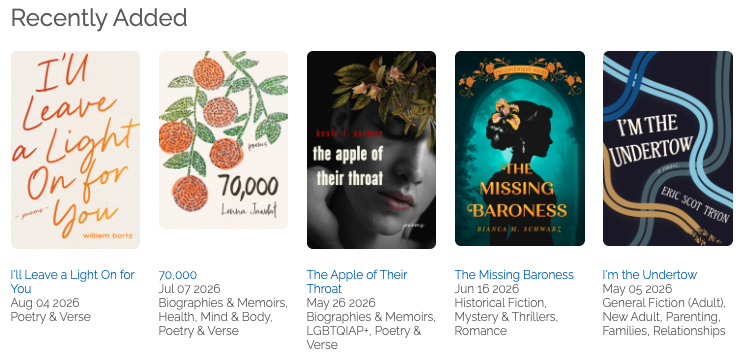
You champion fiction—often literary—and poetry. This is not necessarily the “consumer literature” that follows trends, but rather a conscious decision to, in your words, “move readers, challenge perspectives, and leave a meaningful impression.” What do you look for when considering requests from the NetGalley community?

With nearly every request, we click through and take a look at the person requesting. I like knowing if they actually leave reviews, and when they do, are they honest and fair, or are they just there for the free books? I very much appreciate current and fleshed out bios with specific details, such as knowing they like to champion queer books. I always check out their approval rating as this tells me how my peers see that reviewer. And it was a great addition to be able to make notations on users as we often see the same users request our books. By making those notes, it feels like we have gotten to know them and then other people at our press can read our thoughts when they are answering requests.

You’ve shared that NetGalley data and reporting is vital to you and the success of your books. What are the marketing KPIs you’re looking at, and what ROI are you aiming for? 

We are realistic and have different metrics for each book, for example, a romance novel will garner more requests than poetry titles. Generally, with a poetry book, I’m looking for dozens of requests. With romance or upmarket fiction, I’m expecting hundreds of requests. While the review rates vary quite a bit, it’s the ability to reach out to reviewers to remind them for a review or to post it on socials or bookstores. I also pay attention to the thumbs up/down of the cover. Given how trends change in cover styles, it gives me an idea if we hit the mark, or missed it?

We are realistic and have different metrics for each book… Given how trends change… it gives me an idea if we hit the mark or missed it.

In addition to the number of requests, I’m looking at the people requesting. I don’t often auto-approve because we approve on a regular basis, and I like seeing the names and organizations. Knowing that booksellers from Germany are requesting a particular book helps us with selling foreign rights as I can bring this information to my agent. A request from a popular creator, or journalist means a possible huge reach and now I have that person’s email address to reach out with a more personal message.

My ROI is solidly founded on the contacts I’ve made and the relationships that have come from them. When I compare the cost of our NetGalley account to any other advertising or marketing initiative, I quickly see how much value I’m getting. This isn’t just a list of emails – these are people that I know asked for and liked what we do here.

When I compare the cost of our NetGalley account to any other advertising or marketing initiative, I quickly see how much value I’m getting.

Can you share specific examples of how your books have performed on our site? And how those results might compare to other tools you’ve used in the market?

I took a look at a group of titles across genres – each of which were posted to different galley sites at the same time. In every case, the number of requests on NetGalley exceeded the others – varying by a factor of 1.5x to 10x. In addition, the average review/request ratio on others was around 6%. On NetGalley it was 18%. My marketing dollars seem to work harder and are more efficient on NetGalley.

The number of requests on NetGalley exceeded the others — varying by a factor of 1.5x to 10x. In addition, the average review/request ratio on others was around 6%. On NetGalley it was 18%.

What books do you decide to list on NetGalley? How do you approach backlist?

Every frontlist book gets a stint on NetGalley, usually starting about 4 months pre-pub. We only have an account that allows for 5 titles at a time, so we don’t get much opportunity to list our older books. That said, I might have to look at this strategy a little more closely! 

When you think about a B2B community, who do you include? We know publishers need booksellers and librarians who will purchase and champion your books. Is your definition of B2B larger than this? 

Oh for sure! As I mentioned before, we often get requests from journalists, creators, media, rights acquisition editors at other publishers, and film/tv professionals. These groups are important as well and I love that I get access to all types of businesses here.

And, finally, please tell us a bit more about your motivation to create The Poetry Shelf on your website. It’s been a wonderful service to the industry and to readers. We congratulate you on its success!

Wow, thank you for asking about it! It came about after Winter Institute in 2025 when so many booksellers said they just didn’t know what to do with their poetry sections. Before my career in publishing I spent an equal amount of time in market research – much of that advising grocery and drug retailers how to optimize their sections. I decided to use these same principles of good assortment and shelf planning that large booksellers and other retailers use and adapt it for independent booksellers who don’t have a poetry expert on staff. It’s based on how consumers buy poetry (the same buyer doesn’t usually purchase a TikTok star’s book and Chaucer). It’s then coupled with data from the Bookscan bestseller list, and then I add in a bit of research on a feature section for the month. For example, March was Women and Spring, featuring books by great women poets about renewal and feminine energy. It’s been a huge hit and I’m honored to share it for free every month with booksellers via our website and an ongoing feature in Shelf Awareness. 

About Central Avenue Publishing

Central Avenue Publishing is a home for fiction and poetry about us at our worst – and best.

We are proud to publish books that have resonated widely—appearing on bestseller lists, earning awards, drawing support from literary heroes and celebrities, and finding readers around the world.

At Central Avenue Publishing, our mission is to publish fiction and poetry that reflect the best and worst of the human condition—stories that move readers, challenge perspectives, and leave a meaningful impression.

Divider