
Each year, the NetGalley Community Survey offers insights into how reviewers, librarians, booksellers, media, educators, and industry professionals are engaging with books—and what they need from the publishing industry.
We’ve been conducting a community survey since 2018 and, while we’ve seen some changes over time, one thing remains consistent: readers are passionate. They are literacy advocates, professional book recommenders, and truly committed to spreading buzz about books they love!
Every survey also brings new confirmation, and sometimes surprises, about what our members want as book professionals. Last year, 2025 feedback centered mostly on personal challenges, like finding more time to read. This year’s 2026 survey results reflect a shift to a more external focus. Members are looking beyond their own reading habits, instead calling attention to broader industry issues. They’re advocating for ethics, access, and improvement to systems that shape how books are created and discovered.
Here are four important themes emerging from this year’s data, collected from nearly 12,000 respondents:

- AI Transparency
The most dramatic shift in our 2026 survey results is members’ escalation of concern related to AI transparency. We first saw a reaction to AI in 2025 when stories of stolen literature to train LLMs first hit the news cycle, leading to the landmark Bartz v. Anthropic settlement involving the use of pirated book content. Now, survey respondents are almost universally calling for 100% transparency of AI usage, including jacket covers, book text, and audiobook narration.
While most understand a complete ban is nearly impossible in any workplace, respondents are asking for absolute transparency and acknowledgement when AI is used in any part of the book-making process, including editing and marketing. At the forefront of those concerns is the protection of human talent.
- Algorithm Fatigue
NetGalley members also expressed burnout with algorithm-driven discovery. They reported frustration with what they perceive as limitations to organic discovery, particularly on mainstream platforms. While Instagram and Goodreads remain widely used by NetGalley members, many survey respondents told us they’re leaning toward smaller, book-focused spaces, where recommendations feel more intentional, human, and less driven by trends.
Readers are also pushing back against what they see as “TikTokification”: an environment where visibility is driven by popular buzzwords used for views rather than fit. A major point of friction is mismarketing, especially the overuse of popular tropes or genre labels that don’t accurately reflect a book’s content (e.g., labeling every fantasy “Romantasy”, even when romance has a minor subplot). This is an evolution of an historic frustration with mismatched “comp” titles.
- Readers Hold Tight to their Values
One thing that hasn’t changed year over year: Intellectual freedom and censorship is a primary professional challenge cited by Librarians and Educators. These groups continue to fight a rising tide of book bans, and readers looking to support these efforts can find resources and action steps though Unite Against Book Bans, created by the American Library Association.
Rising book prices was also a repeated concern. Librarians point to digital licensing models as unsustainable with high costs and long wait times for patrons. However, some publishers have begun to address price sensitivity. According to the 2026 Readers First Publisher Price Watch, “the annualized average library eBook price increase is flat over the last four years,” (if you ignore one Big 5 publisher). Readers and institutions want to keep up and support the industry they love, but hope that publishers continue to address price sensitivity.
Our survey respondents also expressed support for midlist, debut, and independent authors, who may not have access to major marketing backing or budgets.
- Readers Want Half Stars!
Even as readers raise bigger questions about the publishing industry, their day-to-day habits remain consistent: most are still reading daily, still tracking their progress, and still wishing—above all else—for DNF and half-star ratings across the various platforms they use.
At NetGalley, we’ve long supported this through our “Will Not Give Feedback” option, which is our version of a DNF that allows members to provide professional context for why they didn’t finish a book and are unable to provide constructive feedback.
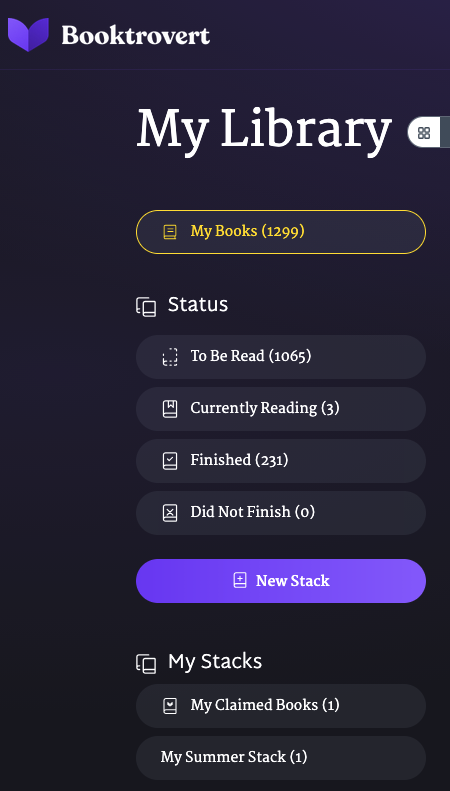
Plus, as we designed Booktrovert—our consumer marketing platform—we made sure to include built-in reading tracking tools. And because we know an evaluation of a book is often more detailed than a standard five-star scale, we recently introduced the option to rate books by half (and even quarter) stars on Booktrovert—which perfectly compliments the customizable “Stacks,” complete with sortable columns, filters, and DNF status options.
Read on for other ways we’re addressing our members’ feedback!
How We’re Responding
- AI Transparency: Members can indicate if they suspect a book is AI-generated as part of the “Will Not Give Feedback” option and, likewise, publishers can flag reviews where they suspect the same. As publishers continue to incorporate AI tools in parts of the book-making process, this year’s NetGalley survey results point to a community who will reward deliberate communication and prioritization of human creativity.
- Algorithm Fatigue: On NetGalley, members have the option to choose their favorite categories and publishers, and there are plenty of opportunities to see “new to you” books, including our “Recently Added” page—which is one of the most browsed of any page on NetGalley! Plus, on Booktrovert, readers discover new books while playing bookish games, completing reading bingo challenges, and via giveaways, sweepstakes, and special deals. Booktrovert does not use algorithms to interrupt readers’ feeds. The community is an opt-in experience where discovery is the reward, not a side-effect of scrolling.
- A Value-Based Industry: NetGalley is proud to help bridge the gap between marketing budgets, giving independent voices side-by-side visibility with Big 5 publishers in our catalog, and access to promotions designed for any budget, goal, and type of book. Plus, with the introduction of Booktrovert, any publisher or author can extend their reach with direct-to-consumer marketing as well.
We are so grateful to our robust, active community for their incredible feedback—not just about the books they’re reading, but about their hopes for the industry as well—and that we can pass along their message. These nearly 12,000 survey respondents are aligned with our vision: a world where the publishing community is empowered through technology to contribute to cultures of belonging and inclusion through content that connects and carries us forward. We believe that intelligent technology paired with human expertise is the key to increased accessibility, sales, and efficiency, igniting publisher success and bettering lives.
More 2026 Community Highlights:
