
How Book Reviews Power Discovery in the Age of AI Search

From SEO to generative engines, real reader reviews help books surface where modern audiences look for recommendations.

In a world of marketing acronyms, SEO has reigned supreme for many, many years. Search Engine Optimization remains important to help improve appearance in results from traditional search engines like Google and Bing. But now in the age of artificial intelligence, GEO (Generative Engine Optimization) and AEO (Answer Engine Optimization) are taking the reins. GEO helps with AI-generated responses like ChatGPT or Google’s AI Overviews, and AEO helps your content appear in direct-answer formats like featured snippets, AI summaries, and voice search.

Having trouble keeping all the acronyms straight? Us too, but here’s an easy overview.

The main thing to know is that the goals we’ve always had for increasing book discoverability have not changed. The work you do as a marketer continues to be in service of connecting the people who will most love your books with your books… no matter where or how they’re searching for them on the web. Now, however, we have to think beyond keywords because the discoverability infrastructure has changed. Your marketing copy and metadata needs to be easy for AI search assistants to understand, summarize, and recommend, ensuring that your content shows up in AI answer engines. While traditional SEO helps your book or website appear (ideally) at the top of a search index, GEO & AEO help ensure that there’s enough information about your book out in the world to be able to answer a more complexly-worded question.

Natural Language

AI feels scary to a lot of us. But a reassuring truth remains: Humans are still at the center of this conversation. We humans have been typing complex questions into search bars since the beginning of search bars. In marketing, we love to say “meet your readers where they are” and the reality is that people have already been using natural language to search for a long time. Now, AI is helping to return more nuanced results.

The training ground for AI is created by humans: the marketer who’s writing the book description, keywords, and other metadata; real readers describing that book on social platforms; and book reviews in media and on retail sites.  If hundreds of readers describe a book as a “slow-burn enemies-to-lovers romance with sharp banter” this language will become part of how search results are returned.

We know that book reviews have always been highly valued in search algorithms. The number of reviews, how recently the reviews were posted, the star ratings, and more have all gone into helping platforms surface books that they believe are relevant to a particular reader’s search. Book reviews containing natural language and sincere reactions from real readers continue to play a foundational role in strengthening a book’s discoverability. 

The Growing Importance of Reviews

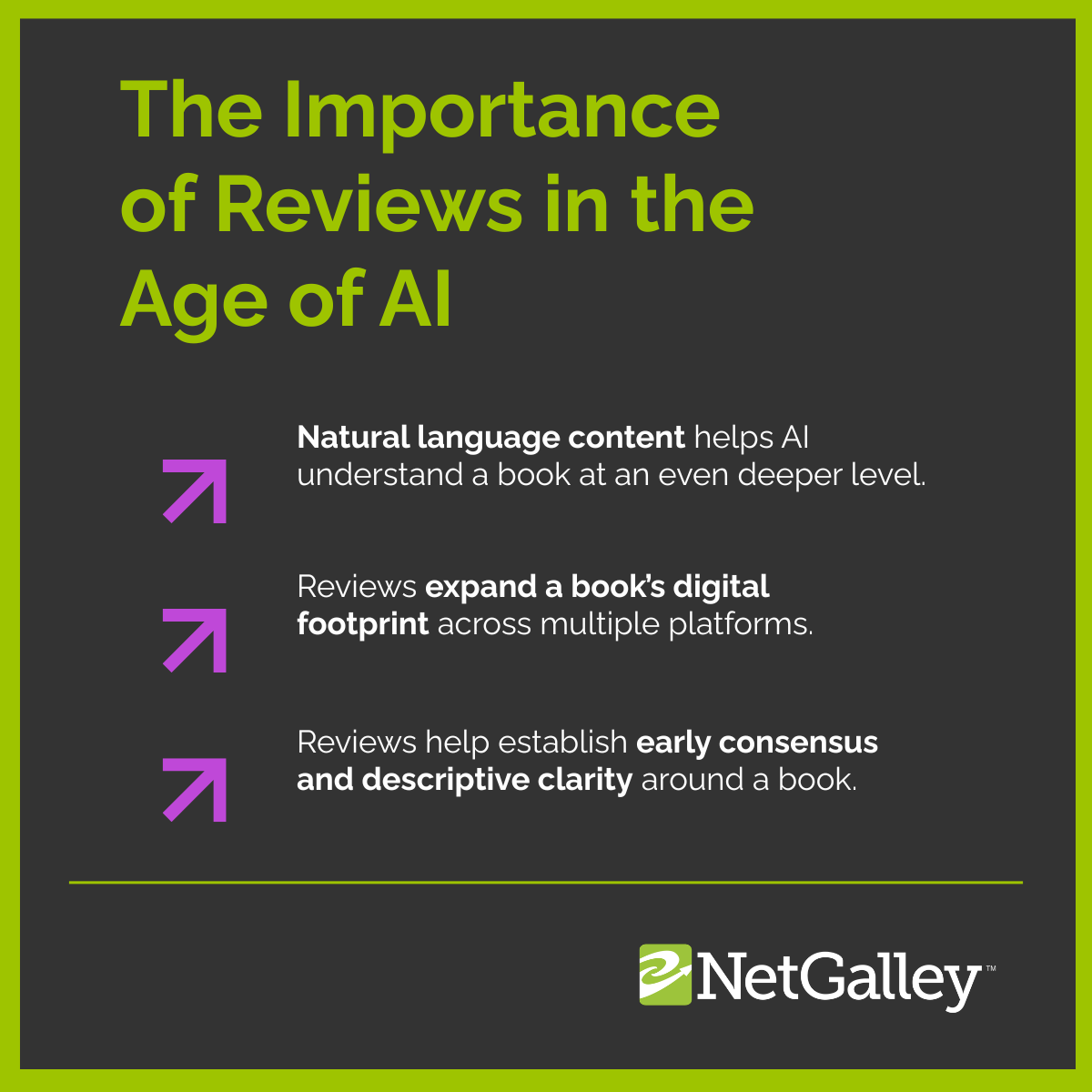
Now, the very quality of reviews’ natural-language content helps AI understand a book at an even deeper level. Every review adds descriptive keywords, genre signals, comparable titles, and thematic language around a book—often phrased the same way readers search or ask for recommendations. This creates a dense layer of searchable context across the web, helping titles appear more frequently in traditional search results and recommendation queries.

Reviews also expand a book’s digital footprint across multiple platforms. When reviews from sources like NetGalley are shared to retailer pages, reader communities, independent blogs, or even transcripts of podcasts, they create a network of references that search engines like Google interpret as signals of relevance and authority. This widely distributed presence increases the likelihood that readers encounter the book across different discovery pathways—from retail searches to recommendation lists and genre-based browsing.

Plus, reviews help establish early consensus and descriptive clarity around a book. When hundreds of readers consistently identify themes, tone, and audience (“slow-burn romance,” “twisty thriller,” “perfect for fans of…”), those repeated signals help both search algorithms and AI-driven recommendation systems categorize the book more accurately. The result is stronger placement in search results, recommendation engines, and AI-generated reading suggestions—making reviews one of the most effective ways to ensure a book can be found by the right readers, even (and especially) in this age of GEO and AEO.
The Good News for Book Marketers

If GEO and AEO sound intimidating, the good news is that authors, publishers and marketers are already doing much of the work required to support them. Writing clear book descriptions, developing thoughtful metadata, and encouraging reader reviews have long been core parts of book marketing. In many ways, AI-driven discovery simply rewards the same best practices the industry has always valued: rich descriptions, authentic reader responses, and widespread conversation about books online.

What’s changing isn’t the goal—it’s the ecosystem in which discovery happens. Search engines and AI tools are becoming better at understanding natural language and identifying patterns in how people talk about books. When marketers provide clear metadata and readers contribute thoughtful reviews, they collectively create the descriptive landscape that helps these systems understand what a book is about and who will love it. GEO and AEO aren’t entirely new challenges to solve. They’re the next evolution of discoverability—and one that builds directly on the power of reader voices. 

Additional Resources from the Firebrand Group

Learn more about marketing in the age of AI with
the Firebrand Group at London Book Fair 2026!

Divider

Celebrating Growth This Spring at NetGalley

At NetGalley, we’re honored to be your partner in connecting books with the readers you want to reach—and it fills us with pride to report on our platform activity that directly benefits your books. This month we’re celebrating all the amazing activity your books saw on NetGalley.com in Q1:

630,000+ Active Members

When we say “active” we mean it! NetGalley regularly removes inactive member accounts, ensuring that we’re reporting a true community size. We have a dedicated team who engage with the NetGalley community to ensure they have all the resources they need to succeed as book advocates. Resources like the Book Advocate Toolkit and Social Media Handbook are designed to help our members write valuable reviews, navigate key bookish social spaces like BookTok and Bookstagram, and become even more effective promoters of your marketing efforts. Plus, we’re always excited to help craft your Book Club Kits to include author interviews, recipes, activities, book recommendations, and discussion questions for library, school, bookstore, and reader-driven clubs. 

We love nurturing NetGalley’s knowledgeable and passionate community, who work to amplify your books’ reach across every corner of bookish conversation.

10.7 Million Avg Pageviews Each Month

With close to 11 million pageviews per month, Q1 2025 saw 9% growth when compared to the same period last year. This activity is driven by our community’s interest in the books that publishers and authors make available on NetGalley.com (nearly 7,500 books and audiobooks in Q1 alone), and desire to spread the word about the books they read!

More Than Just Views!

Your books benefit from more than just impressions on NetGalley—here are additional key KPIs that we tracked from January – March 2025:

Read more: Celebrating Growth This Spring at NetGalley Continue reading “Celebrating Growth This Spring at NetGalley”
Divider

The Benefit of Reader Reviews

Guest post by Corrin Foster, Sr. Director of Book Marketing & Promotions, Forbes Books

No book marketing initiative exists in a bubble. While each has a purpose, benchmarks, and expectations, how a book marketing strategy works together to build book visibility and sales momentum as a whole is what’s most important. At the center of this philosophy, reader reviews are the golden thread that ties together every element of a successful book marketing campaign. These candid reviews penned by avid readers hold the power to transform casual browsers into buyers and from buyers into fans, followers, and author devotees. They guide readers through the millions of reading choices, to the book that most meetss their needs, whether that’s solving a specific business problem, providing the best gluten-free recipes, or offering a fantastical escape from everyday life. 

Reader reviews are the golden thread that ties together every element of a successful book marketing campaign.

Need more reasons why reviews are vital to a successful book marketing campaign?

  • Reader reviews are the social proof that helps to convert browsers into buyers. They make readers feel confident in their buying decision and excited to read a new book. Generally speaking, the more reviews a book has, the more people read that book. And no matter where they are buying or borrowing the book, they’re likely checking the reviews on Amazon and/or Goodreads before doing so. 
  • Reader reviews help advertising convert to sales at a higher rate. If ad dollars are being spent to drive potential buyers to Amazon to buy your book, those potential buyers need proof that the book is worth buying. Ads generally begin to convert to sales at a higher rate once there are 15+ reviews on the book page, so make that your first reader review goal. 
  • Reader reviews have legs. They get shared online on retail sites, reading communities, blogs, and social media. They get shared offline between friends at brunch, at book club meetups, and in chit-chat with coworkers. 
  • Reader reviews keep books active in Amazon’s product recommendation algorithm. Reviews create page activity. The page activity tells Amazon that there is interest in a book and they should recommend that book to more potential readers. 
  • Reader reviews lead to more reader reviews. When readers see other readers sharing their opinions, they want to join in that conversation. That’s called buzz! 

You never know when or where someone will sing a book’s praises, but that cannot happen without actively engaging with reading communities like NetGalley. 

Here are some ways you can get started connecting with readers.

  • Make your book available on NetGalley. NetGalley is the first touchpoint between authors, publishers, and readers. They are enthusiastic readers, supporters of authors and independent bookstores. They are responsible for the success of many books. 
  • Proactively seed books with your author network. Identify 15-20 people who would be willing to review the book the week of publication. Give them a copy of the book 4-6 weeks prior to publication so that they can begin reading and be ready to review.
  • Take advantage of the giveaway functionality of reading communities like Goodreads, StoryGraph, and LibraryThing. Every book you giveaway is a potential review and every review is an opportunity to attract a new reader. 
  • Respectfully follow up with readers the week of publication.Thank them for their interest in the book, share any wins that may entice them to make it their next read (great trade review? Amazon bestseller? Readers love to know that!). Encourage them then to share their honest review on Amazon, Goodreads, or wherever they choose to engage. 
  • No hounding readers for reviews! Every avid reader has a stack of books to read and yours might not be at the top of that stack. Give them time to read, enjoy, and form their opinion. And remember that sometimes the best review is no review. 
  • Encourage honest reviews. As a publisher, we never like to see a critical review for one of our books, but readers should be free to share their opinions. Diversity in reviews not only helps books appeal to the right readers, it deters the wrong readers from buying a book and leaving a future critical review. Remember, it’s not about avoiding criticism, it’s about embracing the diversity of opinions that ultimately guide the right readers to your book while helping others avoid a mismatched reading choice.

Reviews act as a bridge between the author and the reader, offering valuable insights into the book’s quality, appeal, value, and relevance. They create a buzz; an ever-expanding conversation that draws more readers into the fold. To harness this potential, engaging with reading communities like NetGalley and proactively involving your network in reviewing your book are essential steps. 

In a world where readers have more choices than time, the importance of reader reviews cannot be overstated—they are the underlying heartbeat of long-term book sales and visibility.

In a world where readers have more choices than time, the importance of reader reviews cannot be overstated—they are the underlying heartbeat of long-term book sales and visibility.

Corrin Foster, Sr. Director of Book Marketing and Promotions, Forbes Books

As the Sr. Director of Book Promotions and Marketing at Forbes Books, Corrin Foster develops and executes strategic book launch marketing campaigns and works directly with authors to help them build their brand, establish authority, and connect with readers. With nearly 20 years of branding and digital marketing experience, Corrin holds an MBA from Indiana University, completed the Yale Publishing Course, and was a Publishers Weekly Start Watch Honoree.

Divider