Campaign Type: Private Booktrovert Sweepstakes Audience: Abby Jimenez’s Private Facebook Reader Group Title:The Night We Met Copies Available: 250 Campaign Duration: 7 days
Campaign Overview
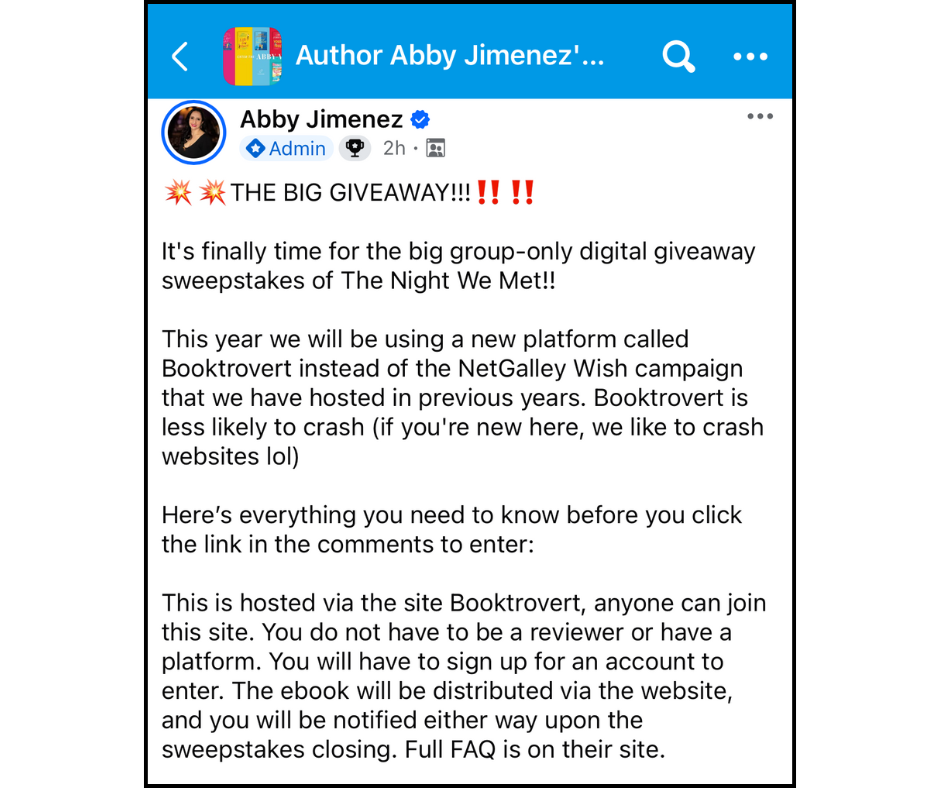
To generate early buzz and reward a highly engaged fan base, a private Booktrovert Sweepstakes campaign was launched exclusively for Abby Jimenez’s private Facebook reader group. This audience—comprised of deeply loyal, voracious readers—has a demonstrated history of enthusiasm for Jimenez’s work and a strong appetite for early access.
The campaign offered members the opportunity to enter for a chance to win one of 250 digital advance copies of The Night We Met. By limiting access to a private, author-owned community, the campaign capitalized on trust, exclusivity, and built-in excitement.
Strategy
The core objective was to activate an already passionate reader community while maintaining a frictionless, equitable entry experience. Key strategic elements included:
Private Access: The campaign was available only to members of Abby Jimenez’s private Facebook group, reinforcing a sense of exclusivity and insider access.
Sweepstakes Format: Rather than first-come, first-served, the sweepstakes model allowed all interested readers to participate over a seven-day entry window, reducing urgency fatigue while maximizing participation.
Automated Fulfillment: Winners were randomly selected at the conclusion of the campaign and notified via email, where they could seamlessly download a protected ebook file.
Execution – Ease & Challenge
Readers were invited to enter the sweepstakes through a private Booktrovert campaign page promoted within the Facebook group, ensuring that only members of the exclusive group had access to enter. Once the seven-day entry period closed, winners were automatically selected and notified, selected readers could immediately start reading their protected ebook file.
Ease: This approach minimizes the publisher’s administrative lift while ensuring a fair and transparent experience for participants.
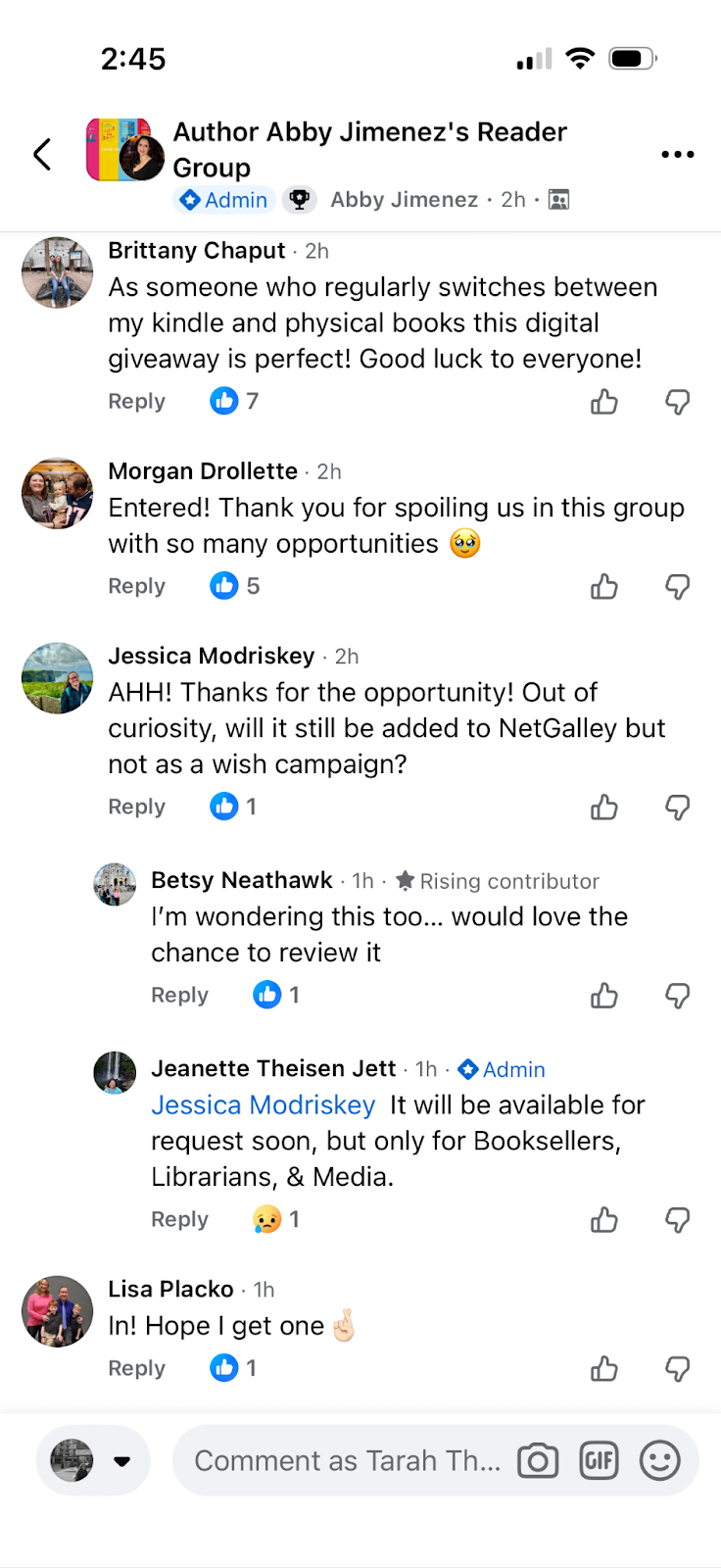
Challenge: Abby’s Facebook group includes readers from across the globe and, for now, Booktrovert only offers eBook access to U.S. readers. In part due to feedback from this campaign, the NetGalley-Booktrovert team is considering plans to expand service to readers in Canada as a first step toward wider distribution.
Audience Engagement
The private Facebook group proved to be an ideal environment for the campaign. Members are highly vocal, quick to share excitement, and eager to engage with anything related to Abby Jimenez’s work. The sweepstakes format amplified anticipation throughout the entry period, with readers actively encouraging one another to participate and expressing enthusiasm about the upcoming release.
Because the campaign lived within an established community space, the promotion felt organic rather than transactional—more like a reward than a marketing initiative.
Key Takeaways
Leverage Superfans: Highly engaged, author-owned communities are powerful launchpads for early-access campaigns.
Sweepstakes Reduce Friction: Allowing a multi-day entry window increases participation and goodwill, particularly in large or enthusiastic reader groups.
Exclusivity Drives Excitement: Private campaigns reinforce loyalty and make readers feel valued.
Automation Scales Trust: Random selection and automated delivery ensure fairness while streamlining execution.
Why It Worked
This private Booktrovert campaign succeeded by meeting readers where they already gather, offering meaningful access without complexity, and pairing exclusivity with ease of use. For authors with passionate fan bases, private sweepstakes campaigns are an effective way to generate early momentum while strengthening reader relationships ahead of publication.
Publishing professionals from across the industry descended on Nashville, TN at the end of September to attend the Publishing Innovation Forum, hosted by the Firebrand Group. This premier in-person event was designed to unite individuals from various segments of the book publishing industry to share insights, explore new trends, and discuss strategies to adapt to a rapidly evolving publishing landscape. With approximately 150 participants, the forum encouraged collaboration and innovation, ensuring attendees gain valuable knowledge and connections to drive future success in the industry. Expert keynote presentations, and three dedicated breakout tracks for Business, Technology, and Marketing, resulted in lively conversation and important takeaways. For our audience at NetGalley Insights, we have collected some key themes and tips from the highly experienced speakers.
Attendees at the inaugural Publishing Innovation Forum, 2024
Session: Innovations in Book Promotion: Publicity Trends That Move the Needle
Speakers: Kimberly Sneed (Digital Media Director, PR by the book) and Marika Flatt (Owner, PR by the Book)
Kimberly Sneed and Marika Flatt of PR by the Book kicked off this session by explaining that the goal for publicity efforts is to drive author and book recognition, visibility, and overall exposure. The wider the name recognition in the world, the greater chance that book and that author have to build and grow. Exposure is extremely important in early promotional efforts because you are planting seeds for a long trail that follows, even into the backlist. Some important avenues for modern publicists to focus on include:
Podcasts: There are hundreds of thousands of podcasts available. Find the right ones in both subject matter and audience for your individual authors.
NetGalley and other platforms: Maximize title pages on every platform to include assets like videos, advanced praise, author pages or social media, etc.
Social Media: Both presence and promotion matter. Identify and engage with niche, micro audiences, prioritize authenticity, align your messaging with their values.
Immersive Storytelling Techniques: Design “expert” pages for your authors, create additional materials like exclusive content, serialized content, short videos, and adjacent narratives to drive engagement and customize media outreach.
One size does not fit all in book marketing and publicity. Step outside the box and don’t be afraid to try something new! No matter what, always connect and build on what you have. Sneed’s and Flatt’s approach is centered on flexibility, experimentation, and working closely with authors to tailor strategies to individual needs and audiences.
Session: Influencers vs. Community: Strategic Activation for Your Book Campaigns
Speakers: Sarah Walsh (Brand Strategist, Branch & Bramble) and Hallie Fields (Social Media Assistant Manager, NetGalley)
Each speaker presented two distinct yet powerful marketing approaches: Sarah Walsh highlighted influencer campaigns, while Hallie Fields emphasized community-driven campaigns.
Walsh showcased how partnerships with influencers can boost brand awareness, leaning on examples like #marcreadsabook and HarperCollins’ #shelvesinthecity. These examples demonstrated the importance of personalized and trend-focused initiatives. It’s important to note that these campaigns were certainly in the high-budget realm; however, there are lessons to be learned from these exciting campaigns that even a publisher with a smaller budget should keep in mind:
Jump on trends and interact with followers as part of the community, not an administrator or organizer.
Consider the best type of influences to engage. Micro influencers can have big engagement numbers.
Give influencers time and opportunity to tell their stories. Bring them to beautiful spaces, or give them Instagrammable assets.
Form ongoing partnerships, not just one-off posts, which allows the influencer to create ongoing content that is more organic and authentic.
Fields focused on examples from Camp NetGalley, a community-based challenge campaign, and #MyNetGalleyYear, an annually recurring checkpoint campaign. These examples encourage user-generated content (UGC) by asking audiences to complete a task and share it with their followers. These campaigns allow you to engage with, and unite, the entire community, and allow you to secure your brand’s place in a recurring social landscape.
Know your community. At NetGalley, we know our members love fun, nostalgic, interactive experiences, so we built Camp NetGalley with that in mind.
Prizes can be simple and digital! In the case of Camp NetGalley, it was a digital badge members can share, and which appear in their NetGalley accounts. For #MyNetGalleyYear, a template we created for them makes it easy for them to brag about everything they’ve read.
UGC is excellent to share back to your community, help them feel involved, and take some load off your own content creation.
Consider creating campaigns that can be recurring, which gives the community something to look forward to.
Both strategies – influencer campaigns and community engagement – underscore the importance of creating meaningful, relatable experiences that resonate with audiences, while maintaining authenticity and connection.
Session: Book Marketing at Any Budget
Speakers:
Kim Lauber (Vice President of Marketing at Abrams)
Ashley Marie Mireles-Guerrero (Director of Sales and Marketing at Familius Publishing)
Allison Marie Pond (Director of Marketing at Mad Cave Studios)
Jin Yu (Director of Marketing at Berkley/PRH)
It was exciting to see these top leaders from across the publishing spectrum in one space, delving into practical approaches for maximizing impact in the marketing, publicity, and advertising spaces. The collective in-house wisdom from publishers large and small, who publish across many diverse categories, was too vast to fully cover in this short article, but here are a few key points:
Know your audience: Identify where the niche is, where and in what format they will buy, speak to them directly, customize your metadata to reach them.
Maximize metadata to boost discoverability, and feed the search engine with more content – announcements, bumpers, reviews – which will expand your reach.
Not all marketing involves advertising, and not all marketing has to be expensive.
When you do advertising, consider self-serve ads where you can control where the spend is placed. If you do have an ad budget, consider Amazon ads which one speaker said “are expensive, but are worth it.”
Events are a good way to connect with your community. Library and bookseller communities are especially relationship-based. Be sure to identify what you want to get out of it before deciding to attend since they can be expensive.
Virtual events have lower cost and can work if you’re creative on how you approach them.
Give out QR codes or offer to include items in grab-bags, like bookmarks or other items, which are a great way to stimulate interest.
PR is a lot of effort, make the most of it. Continue to utilize the results and keep it updated, making sure to leverage any media hits by letting additional outlets know it’s being talked about.
Session: Building Brand Trust: The Role of Empathetic Marketing in Publishing
In this popular and engaging session, Lyman emphasized that understanding audience values and emotions is key to creating impactful marketing campaigns. By analyzing consumer patterns in reviews and social interactions, publishers can tailor their messaging to resonate with their audience, and shift from transactional hooks to more meaningful communications.
Our values drive our emotions, which drive our decisions.
Make small shifts toward empathy, like altering email subject lines to be more engaging vs. a flat statement or sales hook.
Example from Alleyoop: Their customer feedback popup doesn’t ask what kind of makeup they like, or why, but rather asks the consumer about themselves and what issues they want to solve. For instance, one response is “I can only spend 5 minutes on my makeup.”
To maintain authenticity as you move into more empathetic language, start shifting your hooks to focus on the consumer. Stop making statements like, “Available now!” and shift to how readers will benefit from it. Questions are a great way to do this. A more empathetic subject line would be, “Need more time with your family?”
Bottom line: Empathy strengthens the connection between brands and consumers.
Session: Challenges in Audiobook Marketing and How to Overcome Them
Barto began this session by pointing out three main audiobook audiences: those who want, need, or happen to discover audiobooks. She emphasized that each of these audiences listens to audiobooks for their own reasons and that marketers should keep each of them in mind when considering their marketing language and campaigns–your approach can and should be slightly different when promoting to people who love the audio format, versus those who need to listen to audiobooks due to lifestyle or accessibility constraints. And never forget about those listeners who don’t yet know that they will love audiobooks! A few tips from Barto:
Think about audiobook marketing holistically. Integrate audiobooks into the broader marketing efforts through all aspects of the launch and ongoing campaign efforts. Start by educating authors that the audiobook will be available and is just as exciting and desirable as the hardcover. Make sure you update audio metadata at the same times as you update the other formats’ metadata.
Incorporate audio-specific keywords in metadata. Keywords like “dual-narrator” or “full cast recording” are important.
Market the production process. Listeners romanticize the publishing and in-studio processes. Lean into this!
Encourage narrators to be part of the promotion. Offer them announcement assets to share, ask them to record in-studio content, and leverage their audiences.
Create custom content (bonus chapters, interviews, music, bloopers, etc). If you’re going to pitch bloopers as a fun, custom bit of content to media outlets, be sure you’ve asked the studio not to discard or cut these bloopers during the recording process.
Barto pointed out that some publishers still seem to hold on to the notion that audiobook sales will somehow cannibalize print sales, but there has been no evidence of this! If anything, consumers will seek out the format they want. Make it easy for them to find. Audiobooks are more likely to be an “in addition” purchase than they are to replace a print sale.
Overall Themes
As you can see, themes of audience-centric and empathetic messaging ran throughout all of these marketing-focused sessions. Our expert speakers encouraged a shift from pushing books at people and, instead, connecting with readers.
Remember that not every influential reader is a celebrity, and they won’t all ask you for thousands of dollars to promote your books. Identify your core micro influencers, niche communities, and those who are passionate about the types of books you publish. These are the influencers that will drive word of mouth for your books most effectively and authentically.
Don’t be afraid to experiment! Get creative. Find fun ways to engage with your audience. Try new advertising techniques and assess whether they work for you. Adjust as needed.
We are thrilled that the inaugural Publishing Innovation Forum was received so positively by attendees, who told us they were inspired and leaving Nashville equipped to try out some of the strategies outlined above. We hope to see you at another Publishing Innovation Forum in the future!
– The NetGalley Team
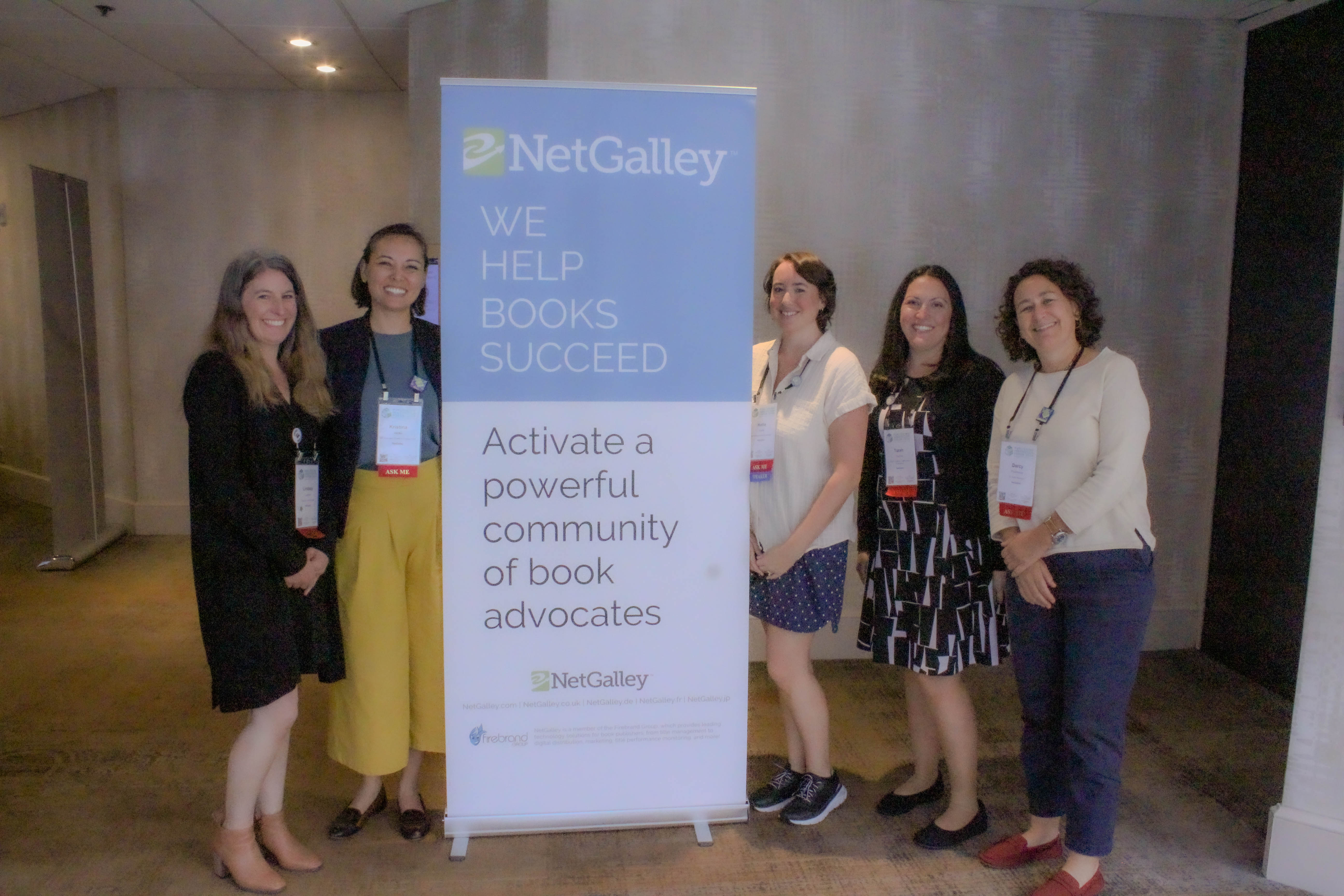
NetGalley team members at Publishing Innovation Forum, 2024: Lindsey Lochner, Kristina Radke, Hallie Fields, Tarah Theoret, Darcy Piedmonte
How an indie author and online writing coach kept engagement high for her debut novel across platforms, turning her audience into a launch team
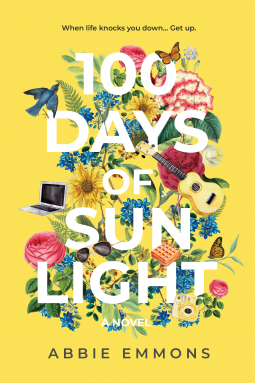
By the time Abbie Emmons was ready to publish her first book, she had built up an audience as a blogger, YouTuber, and Bookstagrammer. But having an audience doesn’t automatically mean success; eyeballs don’t equal engagement. So when Abbie Emmons was getting ready to publish her novel about two teens with disabilities who fall for each other, she knew she was going to have to work to turn her audience into her launch team.
Emmons strategically engaged with her audience across platforms during her pre-publication push for 100 Days of Sunlight. She kept her community in the loop through her writing process, with the cover reveal, and once she had review copies. As soon as 100 Days of Sunlight was available on NetGalley, Emmons brought her pre-existing community there, as well as finding a new audience of NetGalley members browsing for their next read.
As a writing coach, Abbie Emmons has thought a lot about strategies that independent authors can use to launch their books with limited time, budgets, and resources. And as an author, she was able to put those strategies into practice.
100 Days of Sunlight by Abbie Emmons
What was your path to becoming an author? What about a writing coach/educator/resource? Which came first and how did you make the pivot to the other?
I fell in love with stories at a very young age. My mom introduced me to the world of reading, and I was enraptured by the magic of storytelling. I started writing stories of my own as soon as I learned how to hold a pencil, and I haven’t stopped since.
Becoming a creative writing coach was a natural “next step” for me – it blossomed out of my passion for storytelling. In 2016 I started blogging about writing, which turned into creating videos, and it’s been about one year since I launched my YouTube channel. It’s been amazing to connect with other writers all over the world and share my insight and my authoring journey.
I mostly provide coaching through my video content, but I’m in the process of creating digital products to provide my community with the opportunity to go deeper and learn more. WritersLife Wednesday also has a Patreon community, which allows me to connect more personally with committed writers and offer them a one-on-one experience. Within the Patreon, there’s a private Facebook group where I connect personally with followers and also a monthly podcast where I answer specific story questions real-time.
Tell us a bit about your YouTube channel. How does it intersect with your work as an author?
My YouTube channel, WritersLife Wednesdays, is all about making your story matter. Through my videos, I teach writers how to harness the power and psychology of storytelling and transform their ideas into a masterpiece. I also share my experiences of the publishing process to help other authors take the next step with their book.
I love teaching about story because it intersects so beautifully with my writing. I’m constantly learning and improving my own writing processes, which helps me give better, clearer advice in my videos. It’s a journey of experience and growth, and I’m so thrilled that other writers are joining me in this pursuit of writing meaningful books.
In September, 100 Days of Sunlight was the #1 best seller in Teens & YA fiction about Disabilities and Special Needs on Amazon. What do you think resonates with readers about your representation of disability in the book? Did you focus on reaching audiences who might be interested in narratives about disability? If so, how?
I wrote 100 Days of Sunlight in hopes that it would resonate with every reader – whether they have a disability or not. That’s the reason why I focus so much on my characters’ emotional journeys in the book; because even if you’re not going through a physical challenge like Tessa and Weston, you might be very familiar with the feeling of fear, despair, or helplessness when life takes an unexpected turn.
My research process involved tons of reading and investigating. Not only did I reference experts for medical details, I consulted real-life accounts and experiences of people with the disabilities I wrote about. I read lots of blog posts, articles, watched videos, asked questions, read more, and constantly referenced true experiences throughout the writing and editing process. Researching this book was a fascinating and educational journey, and I’m humbled and honored to be able to include representation of these disabilities in 100 Days of Sunlight.
After the publication of 100 Days of Sunlight, I did actively target readers who are interested in the Special Needs genre and who love comparable titles and authors. I was so thrilled to see 100 Days reach #1 best seller in its category on Amazon!
How did NetGalley fit in with the rest of your launch plan for 100 Days of Sunlight?
I found NetGalley at just the right time – about 4 months before my release date. I was seeking a way to efficiently deliver my book to my ARC team, with as little back-and-forth communication as possible. As an indie author, I have to manage a lot on my own, and I knew my ARC team was going to be sizable.
I was able to send everyone from my YouTube channel over to NetGalley to request the book, and that first rush of requests helped me to rank high in my category [appearing in the Most Requested section], which in turn gave my book more exposure to new ARC readers. I couldn’t be happier with how it all turned out!
How did you determine the right timing for 100 Days of Sunlight‘s time on NetGalley with regards to its pub date and your other marketing and publicity efforts?
Every author has a different publishing timeline that best suits their schedule, but mine is roughly 6 months – starting the moment my book returns from my editor, and ending on the pub date. Of course, there’s post-release marketing, but that’s another animal.
Because of my shorter timeline, I decided that 3 months pre-publication would be a perfect amount of time. I wanted the book to still be fresh in my ARC readers’ minds when the release date rolled around, to create more buzz and conversation around the book launch.
100 Days of Sunlight has nearly 400 reviews! How did you get the word out about it once it went live on NetGalley?
I told all my people, multiple times. I made kind of a big deal out of the announcement – posting on my blog, YouTube channel, social media, and contacting all my email lists. I also continued to remind my followers on social media, urging them to go to NetGalley and request to read my book if they hadn’t already.
I had built up the hype for this novel long in advance, teasing it on my blog and YouTube channel – which made my audience all the more excited when it came out.
I received a lot of requests and happily accepted most of them. The result was a huge, fabulous ARC team who was excited to share their reviews of my book. I think it’s also worth noting that I had built up the hype for this novel long in advance, teasing it on my blog and YouTube channel – which made my audience all the more excited when it came out.
How have you kept momentum up for 100 Days on NetGalley throughout its time on the site?
Throughout the book’s listing on NetGalley, I continuously reminded my followers and fans to request to read the book. I also created an ad campaign on Facebook directly targeting librarians and teachers, sending them to NetGalley request my book. A book launch is really all about conversation – the more conversation you can create about your book, the more people will pay attention.
A book launch is really all about conversation – the more conversation you can create about your book, the more people will pay attention.
I worked hard every day to keep that conversation going, and it paid off. The number of requests I received for 100 Days helped move it up in the rankings in both the Women’s Fiction and YA Fiction categories. I couldn’t have been more thrilled!
How have you engaged with members who have requested or reviewed? Have you followed up with them or shared their reviews?
I personally reached out to readers who loved the book and asked them to share their reviews on Amazon and BookBub, as well as NetGalley. They were happy to crosspost their reviews, and it greatly helped the book’s early days on Amazon. I also continue to share excerpts from reviews in outreach and marketing campaigns for 100 Days of Sunlight.
We love that you have a dedicated website for your press kit and for supplemental material. Tell us why this digital presence is important to you and how you went about building it.
We live in an age of immediate access to all the information we need – and I knew that my book and author presence had to meet that standard. If someone comes to my website looking for specific information and materials, I want them to be able to find what they need as quickly as possible. It’s one of those small things that can make a huge difference.
Reviews are social proof, and nothing is more powerful when you’re trying to get people to pay attention to your book. I share reviews on my social media, my blog, my website, and in all the marketing campaigns I produce, such as Facebook ads and influencer outreach.
How have you been leveraging your reviews outside of NetGalley? Have you been sharing them on social media or elsewhere?
Reviews are social proof, and nothing is more powerful when you’re trying to get people to pay attention to your book. I share reviews on my social media, my blog, my website, and in all the marketing campaigns I produce, such as Facebook ads and influencer outreach.
Positive reviews are invaluable and I have NetGalley to thank for connecting me with so many amazing readers, as well as librarians, educators, and booksellers.
What is your top tip for authors listing their books on NetGalley?
Send as many of your people as you possibly can to request your book on NetGalley as soon as it’s available! That first rush of requests is vital to rank higher in your category, and thus gain more visibility on the site. New readers will discover your book and the word will continue to spread organically – and, I hope, exponentially. I recommend NetGalley to all my author friends and followers – it’s an absolute necessity if you want to make your book launch successful. Best of luck, fellow authors!
Abbie Emmons has been writing stories ever since she could hold a pencil. What started out as an intrinsic love for storytelling has turned into her lifelong passion. There’s nothing she likes better than writing (and reading) stories that are both heartrending and humorous, with a touch of cute romance and a poignant streak of truth running through them. Abbie is also a YouTuber, singer/songwriter, blogger, traveler, filmmaker, big dreamer, and professional waffle-eater. When she’s not writing or dreaming up new stories, you can find her road-tripping to national parks or binge-watching BBC Masterpiece dramas in her cozy Vermont home with a cup of tea and her fluffy white lap dog, Pearl.
*Interviews have been edited for clarity and length.
How The New Press used NetGalley to engage Dr. Tressie McMillan Cottom’s fanbase, while finding new audiences
The New Press publishes books that straddle the lines between academic and mainstream. Often, they publish works by academic authors geared towards a popular audience. This means that their marketing strategy needs to appeal to several kinds of readers – academic readers need to be assured of the intellectual rigor, while mainstream readers need to feel invited to engage in complicated discourse.
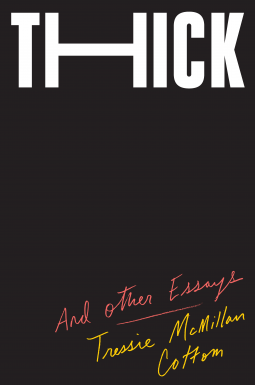
Thick: And Other Essays by Dr. Tressie McMillan Cottom, published in January 2019, exemplifies this dynamic between the academic and the mainstream. For Thick, The New Press was working with a professor of sociology who also happens to have a significant Twitter following and co-hosts a podcast with Roxane Gay.
Brian Ulicky, Director of Marketing and Publicity at The New Press, used early NetGalley reviews to demonstrate the effectiveness of pre-publication marketing efforts to Dr. McMillan Cottom. Seeing these early reviews encouraged her to share the NetGalley listing on her own social media platforms, engaging an audience that already loved her, whether or not they were on NetGalley. As NetGalley reviews rolled in, buzz for Thick really picked up, resulting in editorial attention from Goodreads and inclusion in a Kindle Gold Box deal (not to mention reviews from the New York Times Book Review and Los Angeles Review of Books).
Thick comes out in paperback on October 1.
Thick by Jessie McMillan
How does NetGalley fit into the workflow at a small indie publisher like The New Press?
For a good number of our authors, their first book with The New Press is their first book period (or at least their first non-academic book) and I think for any new author their book may not start to feel truly real until they see reviews of it in the world. Sharing NetGalley feedback with authors is a particularly gratifying part of the run-up to the publication date and has become really important to us in garnering early consumer reviews for our path-breaking works of nonfiction. We are particularly proud of our bestselling progressive education list (a very different subject area from my previous houses), and we wouldn’t be so successful at this publishing area without the support of teachers and librarians who adopt our books into their work and communities. I have loved connecting with educators and librarians on NetGalley for books such as on Monique Morris’s Sing a Rhythm, Dance a Blues or James Loewen’s Lies My Teacher Told Me: Young Readers Edition. The latter has been a particular hit for NetGalley users putting together home-school curricula.
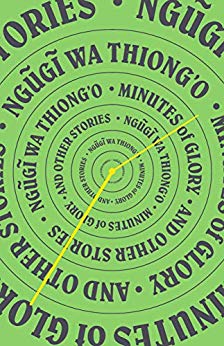
In the past, I worked on quite a bit more fiction than I do these days, and fiction is clearly a large part of the NetGalley community and a big part of my past experience with the platform. The New Press publishes select works of fiction, much of it in translation from the French, and we’ve had some great success with our fiction on NetGalley, like last year’s Slave Old Man by Patrick Chamoiseau or this year’s Minutes of Gloryby Ngũgĩ wa Thiong’o..
What were your goals for Thick on NetGalley?
Our goals were to build word-of-mouth buzz among booksellers, librarians, and book buyers on Goodreads, Amazon, and other consumer reading sites and social media. We felt from day one we had a very special book in Thick and I couldn’t wait to see that gut feeling confirmed with as-early-as-possible reads. And it paid off when, for example, Goodreads selected it for one of their spring editorial newsletters based on the strength of its reader reviews (which also led to a Kindle Gold Box deal over the summer).
You ran a homepage title promotion for Thick in the week after Thanksgiving. Tell us why that timing was the right choice for you.
The book went on sale the first week of January 2019 – this can be a sort of tricky spot as the big fall publishing season winds down and people tune out a little during the holidays. We had review copies landing in the world right after Thanksgiving and so I also wanted to make sure we had a stream of consumer reviews coming in shortly thereafter, just as we were doubling down lining up author media appearances first thing in the new year. Also that cover is pretty iconic and appealing – I just wanted to see it everywhere.
Thick was listed as a Read Now title. Tell us how you came to that reading option and what benefits it gave.
Thick definitely has an intriguing package and title if you already know the author’s work, but if you don’t know it, I didn’t want there to be any friction or hesitation if someone came across an essay collection by a new author and had the impulse to check it out. Listing it as Read Now meant that anyone who was even a little intrigued could check it out and fall in love with Dr. McMillan Cottom’s voice.
I didn’t want there to be any friction or hesitation if someone came across an essay collection by a new author and had the impulse to check it out.
How do you handle the challenges of promoting a book that might seem inaccessible or academic to a broad audience?
The core of The New Press’s mission and publishing program is to bridge the gap between a broad reading audience and new ideas and voices in the academic and social change worlds. We try to make sure our titles, subtitles, and jacket designs are appealing and put you in the picture without requiring too much prior knowledge from a reader; we work hard to get blurbs from recognizable names; and we aim for as much mainstream media coverage as we can get. We know there are readers out there who are hungry for books that challenge and inspire – it’s our job to find them – and sometimes on NetGalley, they reveal themselves!
The cover art for Thick received overwhelmingly positive feedback. How do you use Cover Ratings data internally?
Covers are one of the most important pieces of marketing any book gets and if the NetGalley community loves our designs, we must be doing something right. It’s helpful to have early feedback inform and confirm our very involved, iterative process of designing and choosing covers.
24% of members with access clicked to read Thick because they were familiar with Dr. McMillan Cottom’s work and 40% were drawn in by the book description. How did you think about connecting with these two different groups – the ones that were already fans of Dr. McMillan Cottom and those that were taking a chance on a new-to-them author?
The recipe for success varies from author to author. We knew that Thick gave us an opportunity to publish a book by an author with both a substantial following and the potential to reach many, many more readers with her sharp mind and her signature dexterity on the page. The marketing, title, cover, positioning are key to reaching new readers, and for a book as smart as Thick, getting early reads and reviews from NetGalley users plays an important role in spreading the word.
Dr. Tressie McMillan Cottom has over 90k Twitter followers and made a point tolet her Twitter followers know that Thick was available on NetGalley. How did you work with her to help bring new readers to NetGalley to access Thick?
We want our authors to see how much we’re doing to promote their books and we always point out NetGalley as one of our tools. I think Tressie saw the power in early reads pretty soon after the manuscript was done. We posted the final pass as soon as we could, shared with her a few of the first positive reviews we got, and the rest is history.
How did you use the positive reviews you received on NetGalley? Did you share them internally, use them in your pitches or press materials?
All of the above. We shared them with the author (fair to say Tressie loved seeing them roll in), with media, and with our sales reps and bookstore partners. It’s always great to have fresh material and feedback in your third or sixth or fifteenth conversation about an upcoming book.
NetGalley members shared their reviews of Thick to social media over 700 times! What did you do to encourage that social engagement or what do you think inspired members to share their feedback so broadly outside of NetGalley?
I think one of the things Tressie is uniquely brilliant at in Thick and on social is connecting the big picture with the personal in a way that clarifies both vantage points. When she’s talking about structures she’s talking about herself, and she inspires (and encourages) her readers to do the same. So it was rather organic. Her readers clamor to spread the word about her writing.
Brian Ulicky is the publicity and marketing director for The New Press,
an independent not-for-profit publisher of books to build social change,
where he oversees publicity, marketing, advertising and digital
strategy plus institutional development partnerships and strategic
communications initiatives. Before that he was in the publicity
department at Simon & Schuster and was publicity director at Blue
Rider Press, where he planned and executed campaigns for multiple New York Times bestsellers. He lives in New York City.
How Chronicle is using NetGalley to promote their most anticipated cookbooks
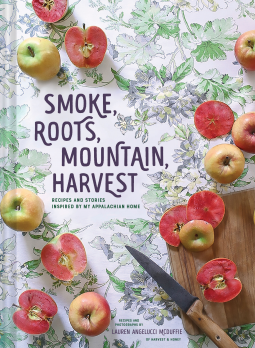
We love when publishers experiment with their titles on NetGalley, especially to try new categories, expand the tools they use to promote their titles on and off the site, and how they involve the authors in the process. That’s why when we saw how Chronicle promoted Smoke, Roots, Mountain, Harvest by Lauren McDuffie, we knew we wanted to share their strategies.
Chronicle recently started putting cookbooks up on NetGalley, using Read Now availability to save time and ensure the widest possible reach. They are using NetGalley data and reporting to guide internal strategy and to equip their sales teams with early analytics. And, in the case of Smoke, Roots, Mountain, Harvest, involving the author in creating special multimedia extras like a Spotify playlist, and encouraging her to share member reviews on her popular Instagram page.
Cynthia Shannon, Food and Lifestyle Marketing Manager at Chronicle shares the steps behind Smoke, Roots, Mountain, Harvest’s success:
Smoke, Roots, Mountain, Harvest by Lauren Angelucci McDuffie
What were your goals for Smoke, Roots, Mountain, Harvest on NetGalley?
We wanted to drive early awareness of this debut cookbook by getting reviews in advance of publication. NetGalley is a great way to distribute the eARC of the book among readers who talk about books, whether on NetGalley, Goodreads, Twitter, or their personal blog. It was a key tent pole in our early marketing strategy, which also included the author producing a video trailer and creating a Spotify playlist.
What did you learn about how cookbooks are received by the NetGalley community?
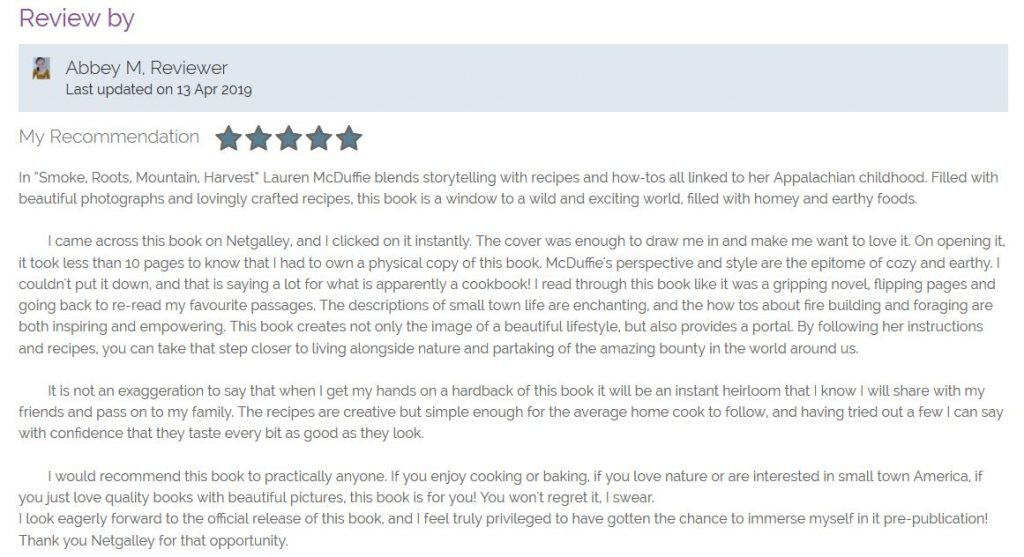
There is a lot of potential to sharing cookbooks on NetGalley and we are looking forward to exploring more ways to further optimize our NetGalley strategy. Adding cookbooks to NetGalley was a new strategy for us for Spring 2019, and I was pleased to see the overwhelmingly positive response. We saw many NetGalley reviewers commenting on the beautiful photographs and the level of complexity of the recipes or ingredient procurement, and how much they were inspired to try some of the recipes. More importantly, they’d comment about how they can’t wait to get a print edition of the cookbook so that they can add it to their collection. Chronicle Books prides itself on creating beautiful, physical objects that people will want to buy for themselves or as a gift, so having these endorsements helps customers make their book buying decisions.
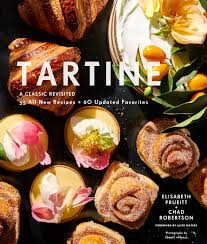
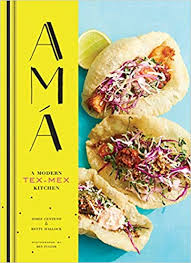
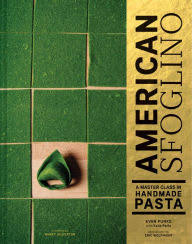
We’ve increased the number of cookbooks we share on NetGalley in advance of publication for our Fall 2019 list—for example, we have Tartine, Ama, and American Sfoglino, three of our most anticipated upcoming cookbooks, available for review on NetGalley now—and we’re exploring the many tools and services that NetGalley offers to further connect with reviewers.
How important is it for you to have reviews that address the recipes in addition to the other aspects of this book (or other cookbooks)?
We were curious to see how readers would respond to the unique structure of the book, which is organized by seasons and weaves personal stories and anecdotes about growing up in the Appalachian South with modern recipes and cooking techniques. Reviewer response was overwhelmingly positive—the average rating for the book is 4.3 stars—with many also commenting on the beautiful photography that make this cookbook stand out from the rest. While it’s very regional, we were happy to see that it appealed to readers all over the country.
We loved that Lauren McDuffie created a special Spotify playlist to go along with her book! Tell us how and why you chose to include the playlist in your launch strategy.
The book was inspired by a song (Emmylou Harris’s version of “Country Roads”) so it seemed like a natural way to evoke the feeling of Appalachia through another medium that could be used in tandem with the book. After all, it’s not unusual to listen to music while cooking, or creating a playlist for a dinner party! It also provides further connection with the author, who took the lead on compiling her favorite songs. We shared the link to the playlist wherever we could incorporate it online, and it provided the author with another way to talk about the book on her blog, Harvest and Honey, and on social media in an authentic and charming way
We ultimately received more than 1,500 impressions and nearly 50 reviews, much more than if we had limited the accessibility.
Smoke, Roots, Mountain, Harvest was available as a Read Now title. Tell us why that was the right availability setting for this book.
We needed to get the book into the hands of as many readers as possible since the NetGalley audience was going to be critical in driving awareness in advance of publication. We were not concerned about it cannibalizing sales. By allowing readers to access the book as Read Now, it minimized the impact on our limited bandwidth to approve each and every interested reviewer. We ultimately received more than 1,500 impressions and nearly 50 reviews, much more than if we had limited the accessibility.
How did you use the data and reports available for Smoke, Roots, Mountain, Harvest?
We included the link to the NetGalley listing and highlights of reviews in reports to the sales team. This helped shed insights into how customers were responding to the book, so that they could share those insights with their buyers.
Did you share the NetGalley listing for Smoke, Roots, Mountain, Harvest outside of NetGalley?
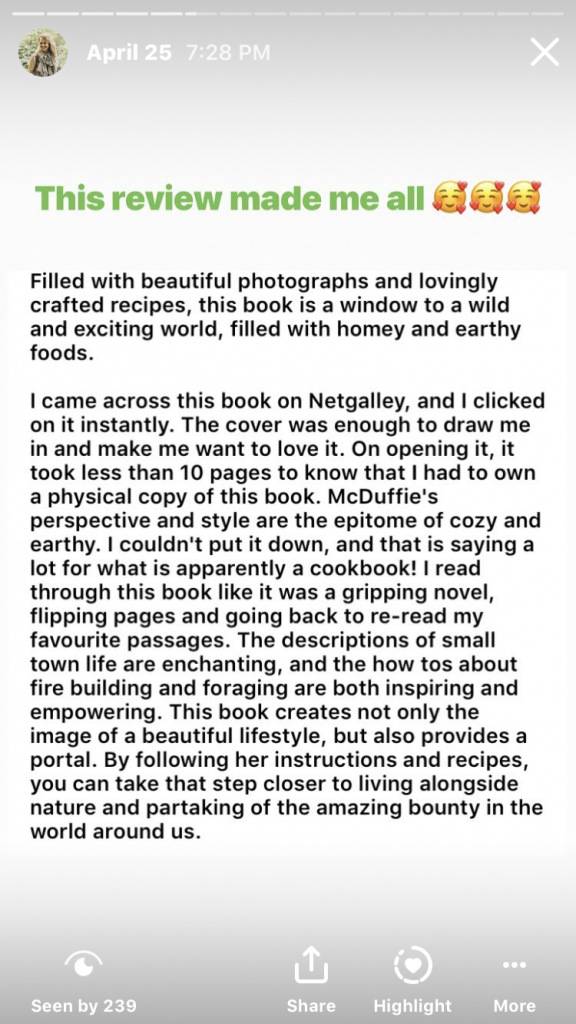
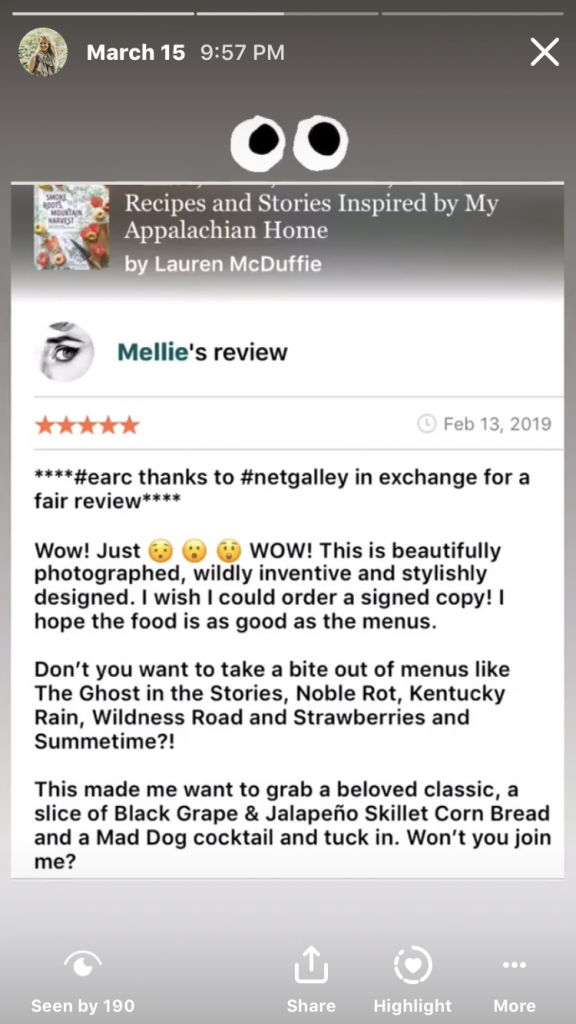
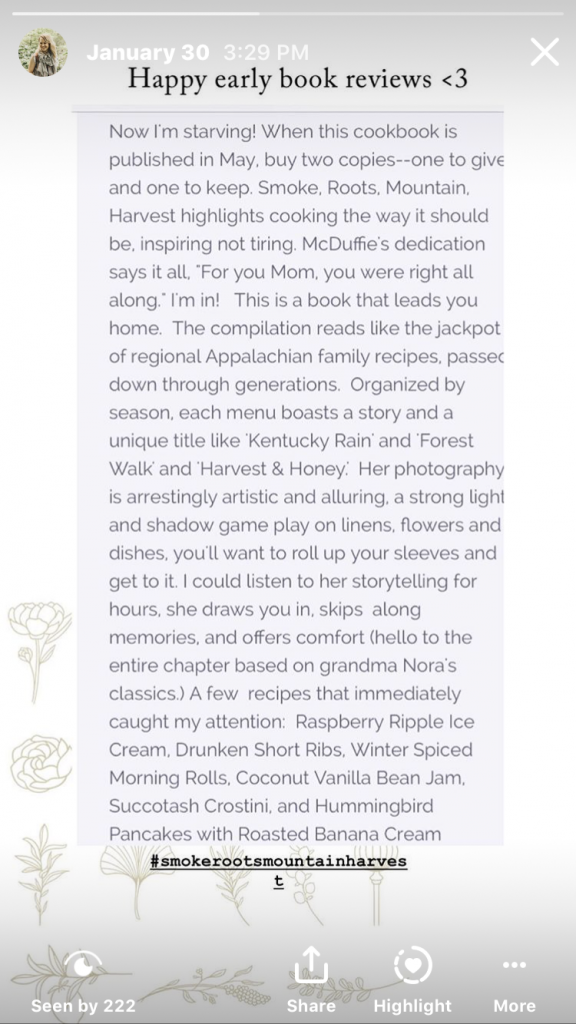
We were pleased to see more than half of NetGalley reviewers cross-posted their reviews to Goodreads, which the author in turn shared on Instagram stories. [Learn more about how publishers are using Instagram stories here]. This is a great example of how one marketing activity can be repurposed across multiple platforms to appeal to different audiences
We’re still exploring the many ways to utilize NetGalley in our marketing campaigns. We definitely recognize the value of getting those early reviews to inform our strategies; in fact, we’ve increased the number of books we’re sharing on NetGalley this Fall and will continue to look for new ways to engage with the audience. I have some ideas, and am looking forward to trying them out!
Cynthia Shannon oversees the marketing for the Food & Lifestyle products at Chronicle Books. Prior to this she worked at Goodreads, Berrett-Koehler, John Wiley & Sons, and Other Press. She was named a 2016 PW Star Watch Honoree and is a graduate of the Stanford Professional Publishing Program as well as New York University. She lives in San Francisco.
Reddit, the self-described front page of the internet is a powerful platform for connecting with enthusiastic and vocal readers. For a primer on Reddit and some ideas for engaging with its communities, check out our recent introductory article. Like any online community, Reddit has its own norms, its own lingo, and its own unique forms of communication. One of the most influential forms of Reddit-specific communication is the AMA.
AMA, which stands for Ask Me Anything, has its roots in early online forums like AOL chatrooms, Slashdot, Something Awful, and others. But it was on Reddit that the form was codified, popularized, and brought into the mainstream.
To conduct an AMA, a user will offer a brief description of themselves, and then open themselves up to a barrage of questions by writing “AMA.” Then, the floodgates open for any user to ask a question. One of the most commented-on AMAs from 2018 was from a Reddit user receiving Universal Basic Income. (UBI is a guaranteed stipend given to every citizen within a governed population.) They wrote “I am receiving Universal Basic Income payments as part of a pilot project being tested in Ontario, Canada. AMA!”
Unlike other forms of interviewing, AMAs tend to have an informal tone, giving Redditors a peek behind the curtain into the lives of either very famous people, or people with unusual lives. They can let authors and fans relax around one another, giving conversations a more casual tone, as opposed to a formal book talk Q&A. For example, in Bill Gates’s 2018 AMA, he answered Redditor questions from “What’s your favorite prime number?” to “What’s the most “treat yo self” rich guy thing that you do?” The answers were “2” and “having a nice house with a trampoline.” The thread contains over 10k comments.
Redditors discover these on dedicated AMA subreddits like r/IAmA or r/AMA, or as a feature on a subreddit dedicated to a different topic. For publishers and authors, relevant places to look for AMAs are r/books, r/writing, or genre-specific subreddits like r/fantasy or r/unresolvedmysteries.
AMAs let authors connect with readers to talk about a new book, answer questions about an older book, or talk about favorite characters. Plus, they are more convenient and less costly than a traditional book tour. For shy authors, an AMA can offer a way to speak authentically with fans while remaining in their own homes. They are not only more intimate than other kinds of interviews, but also more democratic. Readers don’t have to live in a major city or buy an advance ticket. All they have to do is be online at the right time to get a chance to talk to an author whose work they love.
There are a number of ways that publishers and authors can use AMAs to connect with Redditors.
Inspiration and Fan Appreciation
Beloved YA fantasy writer, Tamora Pierce went on Reddit to do an AMA under the r/books subreddit, answering questions about the inspiration behind favorite characters and listening to Redditors who have been reading her work for years. This AMA happened a few months after the US release of Pierce’s most recent book, Tempests and Slaughter.
Another way to use AMAs is to focus on yourself as an industry expert, to grow your own brand presence by offering advice. Eric Smith, literary agent and YA author took to Reddit to answer questions about everything from querying to MFA courses, to balancing his “agent brain” and his “writer brain.” While offering up some free advice, he was able to successfully position himself in front of Redditors as an expert in the industry, raising both his own profile and that of his agency, P.S. Literary.
Authors can also give writing tips during an AMA, both giving a behind-the-scenes look at their own process, and letting them give aspiring writers useful tips.
USA Today bestselling author Penelope Bloom answered questions about her writing process, in addition to book-specific questions during a 2018 AMA. She gave advice about balancing romance and plot, writing a sex scene, and how she manages her prolific career alongside parenthood.
Redditor, moderator of r/fantasy, and NetGalley member MikeOfThePalace describes the benefit of AMAs to authors. “We [are] offering them a chance to talk about their books to thousands of potential new readers, and they could do it at home in their pajamas instead of having to go traveling to a convention or a book tour. It made for an easy sell…As long as they’re ready to answer questions, it’s fine. If they come into it ready to have fun, it’s great.”
MikeOfThePalace also notes that AMAs are best used with authors who already have an established presence. If an author’s platform isn’t strong enough to have a fan base eager to ask them questions, an AMA risks getting very little traction.
Before hosting an AMA, make sure to promote it so that your audience will see it. Unless your author is so famous that they will immediately go viral if spotted on Reddit, make sure to tell the fans to be on Reddit at the appointed time so that they can join in on the limited-time conversation.
For authors and publishers interested in hosting an AMA, the first step is to contact AMA@reddit.com and send a short pitch about the author and the book. The Reddit team will be able to help you figure out which subreddit is the best fit for a potential AMA and help prep for it. You can learn what you need to set up an AMA and use this sign as a template for a proof photo to demonstrate that you’ll be doing an AMA. Then, once you’ve contacted Reddit to help schedule your AMA, they recommend getting in touch with the community moderators of the subreddit where the AMA will take place.
Cassidy Good, Reddit community manager told NetGalley Insights, “The most important factor in having a successful AMA is good prep work. This includes crafting a good title and thoughtful introductory text, which will encourage people to join in and ask questions. It also includes considering the best placement for the AMA. For example, an author who writes true crime would be very popular in r/UnresolvedMysteries as the community is already devoted to discussing crime. The more aligned the AMA topics is with the discussion themes of the community, the more successful it will be. This is why niche and specific communities often have very thoughtful AMAs.”
While Reddit AMAs might not be the right fit for every author, their success represent the ways that author reader interactions are being reshaped in the digital age. These interactions are increasingly happening on digital platforms, through social media, and with the expectation of deeper intimacy or honesty than a reader might expect to find in a traditional reading and Q&A. Whether or not AMAs are a good fit for your authors or your goals, it’s important to remember what makes AMAs resonate, and to take those lessons into your marketing strategy sessions.