How Featured Reviews Help Readers Discover Your Books

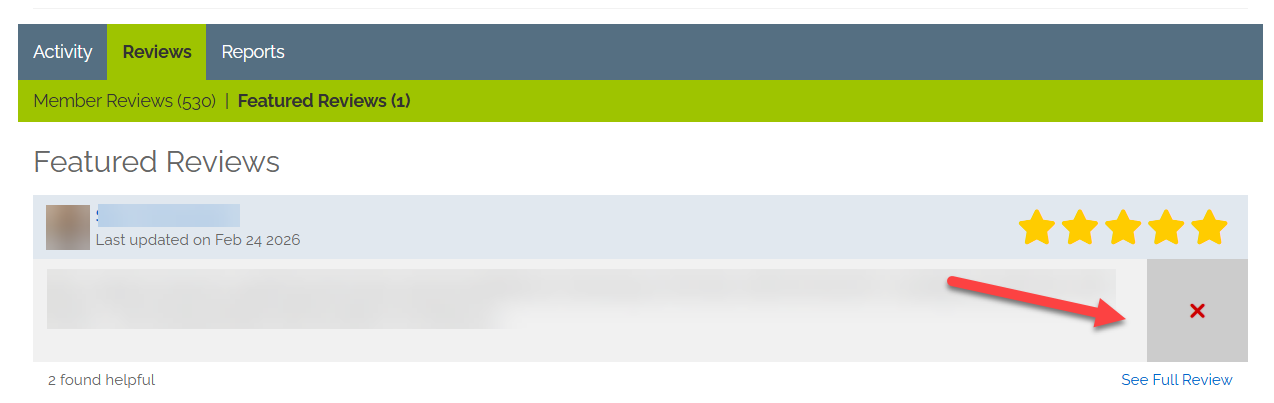
Every publisher has reviews they wish more readers could see: a glowing 5-star review that name-drops a perfect comp title or author, a reviewer who perfectly captures the emotional hook, or a librarian explaining exactly why a book will circulate well for a certain target audience. These are the reviews that help sell books and, on NetGalley, you can choose to spotlight them directly on your Title Details page.

Featuring reviews is quick and easy to do, and can have a meaningful, lasting impact on discoverability, requests, and reader engagement.

Help readers choose your book

Featured Reviews appear prominently on your book’s Title Details page, making them one of the first things NetGalley members see when browsing titles. 

That visibility matters, especially for pre-publication books. NetGalley members look for signals that a book will be a good fit for them when deciding to request a copy. Visible reviews from fellow book industry professionals can be incredibly persuasive!

Featuring reviews also gives publishers more control over the messaging surrounding a title. You can highlight reviews that emphasize the aspects of the book you most want readers to notice, whether that’s a standout trope, ideal audience, emotional tone, or strong comp title. Plus, now that Featured Reviews automatically appear on book pages on Booktrovert too, one small action can reach multiple bookish audiences!

In short: Featured Reviews help you curate the conversation around your book.

Increase discoverability beyond NetGalley

Featured Reviews are publicly visible, which means they can contribute to how books appear across search engines and AI-powered recommendation tools.

As search engines continue to incorporate AI, publicly available review language plays a growing role in how books are surfaced in search recommendations. Featuring strong reviews gives your books more high-quality, descriptive content tied directly to the title. See our article “How Book Reviews Power Discovery in the Age of AI Search” for more info.

Reviews emphasize human sentiment, emotional moments, and the cultural zeitgeist. When thoughtful, personal opinions in the form of reviews are associated with a book, context recommendation systems have the fodder to connect readers with titles they may enjoy.

This makes Featured Reviews especially valuable not only for frontlist promotion, but also for strengthening long-term discoverability of your backlist!

Reward and encourage engaged reviewers

Featuring reviews is also a meaningful way to recognize the readers who are actively championing your books.

When a NetGalley member has three or more reviews featured across the site, they earn a special Top Reviewer badge on their profile. For reviewers, earning that badge is a meaningful marker of credibility within the community, and for publishers, it helps strengthen relationships with engaged advocates who consistently provide thoughtful feedback.

It’s a small action that helps reinforce a healthy review ecosystem: reviewers feel valued, and publishers benefit from stronger community engagement.

A simple step with lasting value

Featuring reviews only takes a few clicks, but it can help increase requests, shape reader expectations, strengthen SEO and GEO discoverability, and reward your strongest advocates.

If you’re already receiving great feedback on your titles, let the world know!

Divider

Key Marketing & Publicity Takeaways from the Inaugural Publishing Innovation Forum

Publishing professionals from across the industry descended on Nashville, TN at the end of September to attend the Publishing Innovation Forum, hosted by the Firebrand Group. This premier in-person event was designed to unite individuals from various segments of the book publishing industry to share insights, explore new trends, and discuss strategies to adapt to a rapidly evolving publishing landscape. With approximately 150 participants, the forum encouraged collaboration and innovation, ensuring attendees gain valuable knowledge and connections to drive future success in the industry. Expert keynote presentations, and three dedicated breakout tracks for Business, Technology, and Marketing, resulted in lively conversation and important takeaways. For our audience at NetGalley Insights, we have collected some key themes and tips from the highly experienced speakers.

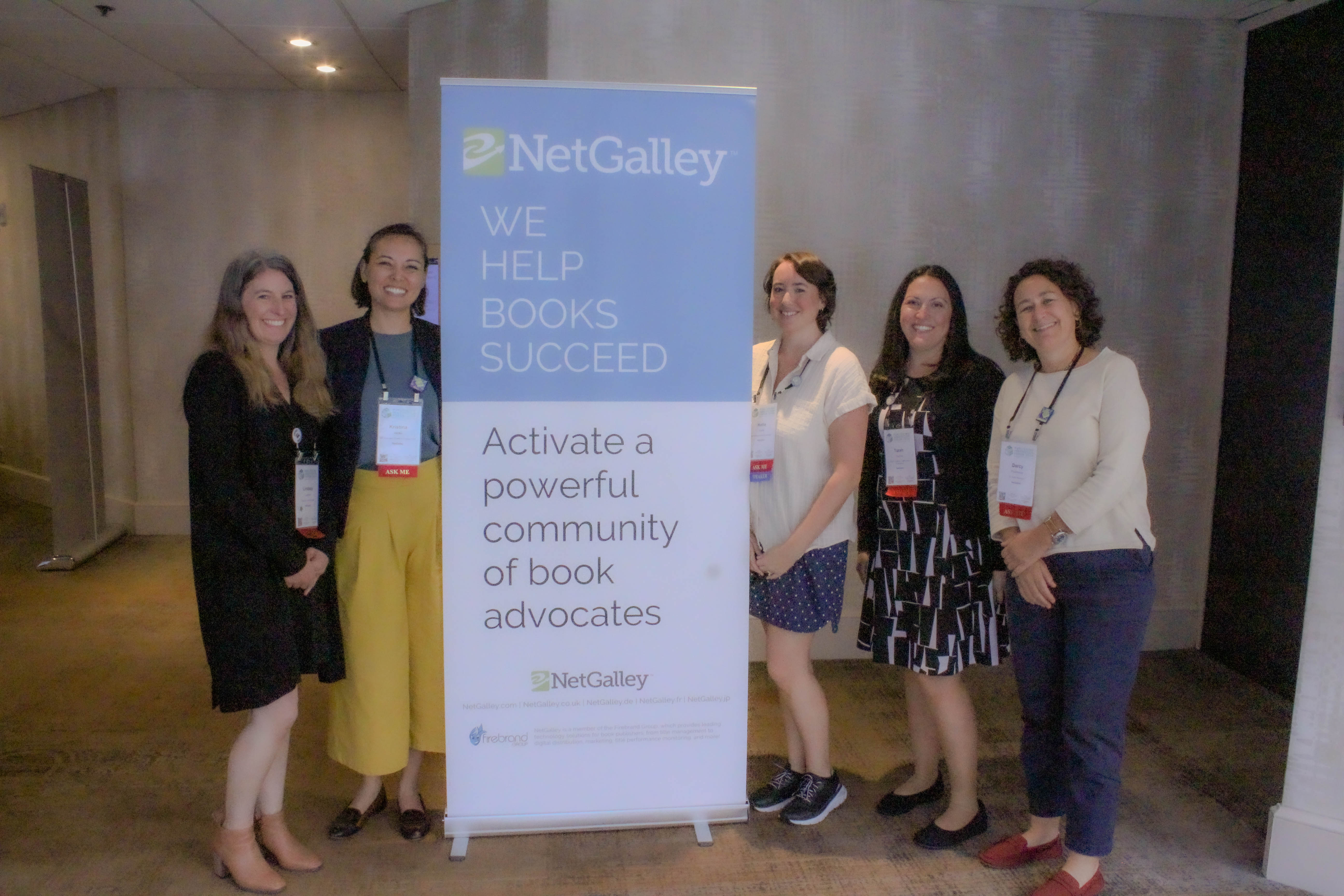
Attendees at the inaugural Publishing Innovation Forum, 2024

Session: Innovations in Book Promotion: Publicity Trends That Move the Needle

Speakers: Kimberly Sneed (Digital Media Director, PR by the book) and Marika Flatt (Owner, PR by the Book)

Kimberly Sneed and Marika Flatt of PR by the Book kicked off this session by explaining that the goal for publicity efforts is to drive author and book recognition, visibility, and overall exposure. The wider the name recognition in the world, the greater chance that book and that author have to build and grow. Exposure is extremely important in early promotional efforts because you are planting seeds for a long trail that follows, even into the backlist. Some important avenues for modern publicists to focus on include:

  • Podcasts: There are hundreds of thousands of podcasts available. Find the right ones in both subject matter and audience for your individual authors.
  • NetGalley and other platforms: Maximize title pages on every platform to include assets like videos, advanced praise, author pages or social media, etc.
  • Social Media: Both presence and promotion matter. Identify and engage with niche, micro audiences, prioritize authenticity, align your messaging with their values.
  • Immersive Storytelling Techniques: Design “expert” pages for your authors, create additional materials like exclusive content, serialized content, short videos, and adjacent narratives to drive engagement and customize media outreach.

One size does not fit all in book marketing and publicity. Step outside the box and don’t be afraid to try something new! No matter what, always connect and build on what you have. Sneed’s and Flatt’s approach is centered on flexibility, experimentation, and working closely with authors to tailor strategies to individual needs and audiences.

Session: Influencers vs. Community: Strategic Activation for Your Book Campaigns

Speakers: Sarah Walsh (Brand Strategist, Branch & Bramble) and Hallie Fields (Social Media Assistant Manager, NetGalley)

Each speaker presented two distinct yet powerful marketing approaches: Sarah Walsh highlighted influencer campaigns, while Hallie Fields emphasized community-driven campaigns.

Walsh showcased how partnerships with influencers can boost brand awareness, leaning on examples like #marcreadsabook and HarperCollins’ #shelvesinthecity. These examples demonstrated the importance of personalized and trend-focused initiatives. It’s important to note that these campaigns were certainly in the high-budget realm; however, there are lessons to be learned from these exciting campaigns that even a publisher with a smaller budget should keep in mind:

  • Jump on trends and interact with followers as part of the community, not an administrator or organizer.
  • Consider the best type of influences to engage. Micro influencers can have big engagement numbers.
  • Give influencers time and opportunity to tell their stories. Bring them to beautiful spaces, or give them Instagrammable assets.
  • Form ongoing partnerships, not just one-off posts, which allows the influencer to create ongoing content that is more organic and authentic.

Fields focused on examples from Camp NetGalley, a community-based challenge campaign, and #MyNetGalleyYear, an annually recurring checkpoint campaign. These examples encourage user-generated content (UGC) by asking audiences to complete a task and share it with their followers. These campaigns allow you to engage with, and unite, the entire community, and allow you to secure your brand’s place in a recurring social landscape.

  • Know your community. At NetGalley, we know our members love fun, nostalgic, interactive experiences, so we built Camp NetGalley with that in mind.
  • Prizes can be simple and digital! In the case of Camp NetGalley, it was a digital badge members can share, and which appear in their NetGalley accounts. For #MyNetGalleyYear, a template we created for them makes it easy for them to brag about everything they’ve read.
  • UGC is excellent to share back to your community, help them feel involved, and take some load off your own content creation.
  • Consider creating campaigns that can be recurring, which gives the community something to look forward to.

Both strategies – influencer campaigns and community engagement – underscore the importance of creating meaningful, relatable experiences that resonate with audiences, while maintaining authenticity and connection.

Session: Book Marketing at Any Budget


Speakers: 

  • Kim Lauber (Vice President of Marketing at Abrams)
  • Ashley Marie Mireles-Guerrero (Director of Sales and Marketing at Familius Publishing) 
  • Allison Marie Pond (Director of Marketing at Mad Cave Studios)
  • Jin Yu (Director of Marketing at Berkley/PRH)

It was exciting to see these top leaders from across the publishing spectrum in one space, delving into practical approaches for maximizing impact in the marketing, publicity, and advertising spaces. The collective in-house wisdom from publishers large and small, who publish across many diverse categories, was too vast to fully cover in this short article, but here are a few key points:

  • Know your audience: Identify where the niche is, where and in what format they will buy, speak to them directly, customize your metadata to reach them.
  • Maximize metadata to boost discoverability, and feed the search engine with more content – announcements, bumpers, reviews – which will expand your reach.
  • Not all marketing involves advertising, and not all marketing has to be expensive. 
  • When you do advertising, consider self-serve ads where you can control where the spend is placed. If you do have an ad budget, consider Amazon ads which one speaker said “are expensive, but are worth it.”
  • Events are a good way to connect with your community. Library and bookseller communities are especially relationship-based. Be sure to identify what you want to get out of it before deciding to attend since they can be expensive.
  • Virtual events have lower cost and can work if you’re creative on how you approach them.
  • Give out QR codes or offer to include items in grab-bags, like bookmarks or other items, which are a great way to stimulate interest.
  • PR is a lot of effort, make the most of it. Continue to utilize the results and keep it updated, making sure to leverage any media hits by letting additional outlets know it’s being talked about.

Session: Building Brand Trust: The Role of Empathetic Marketing in Publishing

Speaker: Emily Lyman (CEO & Founder, Branch & Bramble)

In this popular and engaging session, Lyman emphasized that understanding audience values and emotions is key to creating impactful marketing campaigns. By analyzing consumer patterns in reviews and social interactions, publishers can tailor their messaging to resonate with their audience, and shift from transactional hooks to more meaningful communications.

  • Our values drive our emotions, which drive our decisions.
  • Make small shifts toward empathy, like altering email subject lines to be more engaging vs. a flat statement or sales hook.
  • Example from Alleyoop: Their customer feedback popup doesn’t ask what kind of makeup they like, or why, but rather asks the consumer about themselves and what issues they want to solve. For instance, one response is “I can only spend 5 minutes on my makeup.”
  • To maintain authenticity as you move into more empathetic language, start shifting your hooks to focus on the consumer. Stop making statements like, “Available now!” and shift to how readers will benefit from it. Questions are a great way to do this. A more empathetic subject line would be, “Need more time with your family?”

Bottom line: Empathy strengthens the connection between brands and consumers.

Session: Challenges in Audiobook Marketing and How to Overcome Them

Speaker: Jolene Barto (Marketing Executive, Publishing Professional)

Barto began this session by pointing out three main audiobook audiences: those who want, need, or happen to discover audiobooks. She emphasized that each of these audiences listens to audiobooks for their own reasons and that marketers should keep each of them in mind when considering their marketing language and campaigns–your approach can and should be slightly different when promoting to people who love the audio format, versus those who need to listen to audiobooks due to lifestyle or accessibility constraints. And never forget about those listeners who don’t yet know that they will love audiobooks! A few tips from Barto:

  • Think about audiobook marketing holistically. Integrate audiobooks into the broader marketing efforts through all aspects of the launch and ongoing campaign efforts. Start by educating authors that the audiobook will be available and is just as exciting and desirable as the hardcover. Make sure you update audio metadata at the same times as you update the other formats’ metadata.
  • Incorporate audio-specific keywords in metadata. Keywords like “dual-narrator” or “full cast recording” are important.
  • Market the production process. Listeners romanticize the publishing and in-studio processes. Lean into this!
  • Encourage narrators to be part of the promotion. Offer them announcement assets to share, ask them to record in-studio content, and leverage their audiences.
  • Create custom content (bonus chapters, interviews, music, bloopers, etc). If you’re going to pitch bloopers as a fun, custom bit of content to media outlets, be sure you’ve asked the studio not to discard or cut these bloopers during the recording process.

Barto pointed out that some publishers still seem to hold on to the notion that audiobook sales will somehow cannibalize print sales, but there has been no evidence of this! If anything, consumers will seek out the format they want. Make it easy for them to find. Audiobooks are more likely to be an “in addition” purchase than they are to replace a print sale. 

Overall Themes

As you can see, themes of audience-centric and empathetic messaging ran throughout all of these marketing-focused sessions. Our expert speakers encouraged a shift from pushing books at people and, instead, connecting with readers.

Remember that not every influential reader is a celebrity, and they won’t all ask you for thousands of dollars to promote your books. Identify your core micro influencers, niche communities, and those who are passionate about the types of books you publish. These are the influencers that will drive word of mouth for your books most effectively and authentically.

Don’t be afraid to experiment! Get creative. Find fun ways to engage with your audience. Try new advertising techniques and assess whether they work for you. Adjust as needed.

We are thrilled that the inaugural Publishing Innovation Forum was received so positively by attendees, who told us they were inspired and leaving Nashville equipped to try out some of the strategies outlined above. We hope to see you at another Publishing Innovation Forum in the future!

– The NetGalley Team

NetGalley team members at Publishing Innovation Forum, 2024: Lindsey Lochner, Kristina Radke, Hallie Fields, Tarah Theoret, Darcy Piedmonte
Divider

Recommended Strategies for Audiobooks on NetGalley

It’s been a couple of years since we last answered some of publishers’ burning questions about promoting audiobooks on NetGalley. Now, with even more data to draw upon, we’re excited to share updated recommendations for audiobook publishers!

How early should I add my audiobook to NetGalley?

As early as possible! In most cases, we’ve seen that publishers are uploading their audiobooks to NetGalley within one month of pub date. This makes sense for most audiobooks, where the final file is not available until very close to the release date. However, if you have a highly-anticipated title, consider building extra buffer time into the production schedule to take advantage of a longer pre-pub marketing timeline. This can help you piggy-back the audio format alongside the earliest marketing and publicity efforts for a simultaneous hardcover release.

67.5% of audiobooks are added to NetGalley 30 days or less prior to the pub date.* However, if you have a highly-anticipated title, consider building extra buffer time into the production schedule.

In the chart below, you will see that a small selection of titles were added to NetGalley much earlier than one month pre-pub. 

67.5% of audiobooks are added to NetGalley 30 days or less prior to the pub date.

How long should my audiobook be available to NetGalley members?

3-4 months is our recommendation for audiobooks to remain active on NetGalley. Generally, the longer you keep an audiobook active on NetGalley, the more impressions it will receive, and we’ve seen that 90 – 120 days of activity is the sweet spot! Right now we’re seeing that most audiobooks are active on NetGalley for only 2 – 8 weeks but, based on our data, activity continues to grow all the way up to 4 months. Keep your audiobooks active for longer so you don’t miss out on members who discover and request a copy in those additional few weeks!

Audiobooks that are active on NetGalley for 90-120 days receive the most impressions, on average.

Audiobooks that are active on NetGalley for 90-120 days receive the most impressions, on average.

How can I drive more activity for my audiobook on NetGalley?

In addition to the organic interest that’s found on NetGalley, there are a number of ways to drive additional activity:

  • Widget: The NetGalley Widget is the quickest and easiest way to invite your key contacts to access your titles. Simply include the widget link in your pitch email and use our template language to ensure they have all the information they need to get started right away. This tool is included as part of your NetGalley subscription.
  • Detailed Activity & Feedback Reports – Use your Detailed Activity and Feedback reports for comp titles to identify key contacts who may be interested in your new title, and invite them to listen using the NetGalley widget. These reports, and more, are available on demand within your account.
  • NetGalley Promotions – Audiobooks can be included in any NetGalley promotion, from email promotions like newsletters and eBlasts, to on-site promotions like Category or Dashboard Spotlights, Featured Title placement, etc. There are also a number of audio-dedicated promotions available throughout the year. The link above suggests options based on specific goals like gaining overall exposure, introducing a new imprint, or driving activity during a particular time period. You can also view our Media Kit to see more information about open and click rates, editorial calendars, and pricing.


Audiobooks can be included in any NetGalley Promotion!

What should I expect from NetGalley members’ audiobook reviews?

In our article, How to Write an Audiobook Review, we recommend that NetGalley members discuss a number of audio-specific features in addition to commenting on the content of the book. For instance, we ask them to focus on the narration, discuss how the audiobook flows, mention unique elements like music or if it is a full-cast recording, and share a specific recommendation.

Members are highly likely to submit audiobook Feedback on NetGalley and share it widely with their audiences.

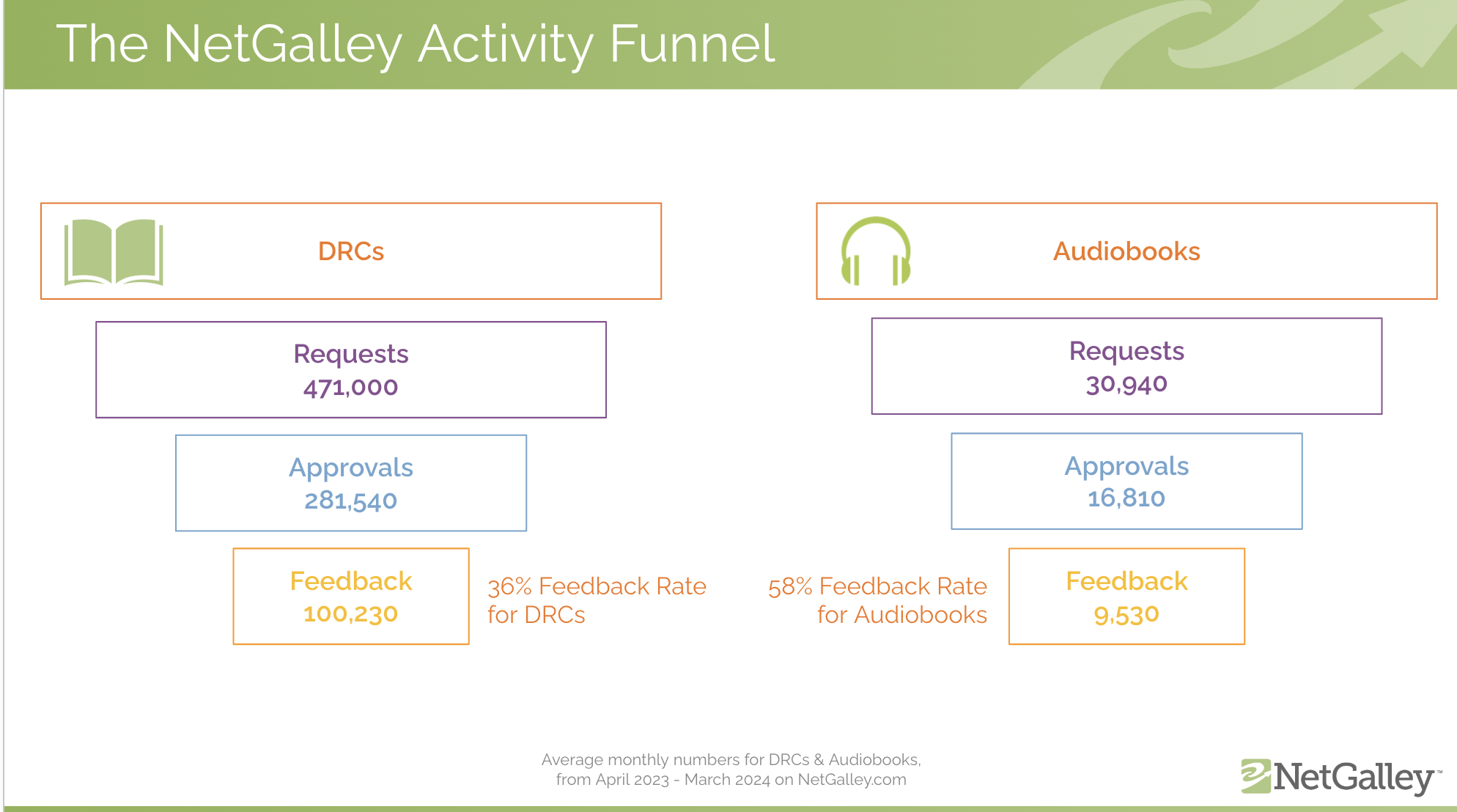
The Feedback Rate** for audiobooks is 58%, which continues to be higher, on average, than it is for digital review copies (36%). This means that approved members are highly likely to submit Feedback on NetGalley and share it widely with their audiences. We are thrilled that NetGalley members continue to embrace the audio format. 

Remember, you can always follow up with approved members to encourage them to share their Feedback! Take a look at our template language here, and best practices for reaching out to NetGalley members.

**Feedback Rate is calculated based on the amount of overall Feedback submitted divided by the number of approvals (of any kind).

For more information about audiobooks on NetGalley:

*Data is based on audiobooks created on NetGalley.com between July 1 2023 – June 30 2024 unless otherwise noted.

Divider

10 Common Questions

NetGalley is a vital promotional service hundreds of publishers and authors use to enhance their marketing and publicity campaigns, but with so many ways to use NetGalley we know you may be wondering where to start! From widgets to wishes, promotions and reports, NetGalley offers tons of features to ensure your books get the enthusiastic launch they deserve. Whether you’ve just started with us or you’re a longtime user in need of a refresher: Hello, welcome, and read on for some NetGalley publisher must-have information!

1.  How do I invite contacts to view my title?

Seamlessly send pre-approved digital copies of your books to your own trusted contacts using the NetGalley widget. The widget can be used anywhere a link is used—just copy and paste it into an email with your custom pitch. YOU retain your personal connection with the recipient, while ensuring they can easily access the book on their preferred device.

Secure widgets use an email address or a list of emails to secure your title. Only recipients who log in to a NetGalley account with this pre-approved email address are authorized to use that widget.

You can also choose to create an Open widget, which is not assigned to any email addresses, and can be used by anyone who receives the link. We recommend sending open widgets to trusted contacts, like an editor who will assign the title to a reviewer. No matter what, you can always see who has accessed your titles in your NetGalley publisher account. 

Here’s some suggested language to use, which includes a link to our Device Guide and support team. We encourage publishers to customize the template language, but this should give you a strong foundation!

NetGalley Widget FAQs

2. How can I tell who has accessed my book?

Find this information by navigating to the Title Details page of your book and clicking on Approval History in the left-hand sidebar. This will take you to the Members with Access page, which breaks down these members into various categories—Approved, Auto-Approved, Read Now, Widget Invites, and Wishes Granted. You can see if a member has clicked to read or listen to your book. You can also find this information on your Detailed Activity report.

Request History FAQ

3. What is the difference between Private, Read Now, Available for Request? 

Publishers have complete control over who can access their books on NetGalley. You have a few different options: Private, Read Now, and Available for Request. 

Private: NetGalley members won’t know your title is available on the site unless you invite them to view that book using the widget, or if you use the book’s link to collect wishes.

Read Now: Members will have instant approval, so it’s best to use this option when you want to approve all requests automatically. Publishers often use the Read Now option for special promotions—like making a title available to Read Now for a limited time or number of downloads—or for special content like samplers, excerpts, catalogs, or backlist titles.

Available for Request: You will make the decision to approve or decline each member’s request to access that specific title. You can also allow requests from only certain member types for specific time periods—for more information, click here.

Title Availability FAQ

4. What does auto-approving a member do?

Many publishers have a VIP list of readers, like ALA-member librarians, trusted reviewers at media outlets, and bloggers who reliably provide great reviews for your titles. You can make their day by auto-approving them! Once a member is on your Auto Approved List, any requests they make for your titles will be automatically approved, so they don’t have to wait for you to see and approve them manually.

Auto-Approved Members FAQs

5. What file types are best to upload to NetGalley? 

 NetGalley publishers can upload 3 different file types for digital review copies: ePub, mobi, and PDFs. Audio publishers can upload zipped MP3 files.

An ePub file is preferable for most books on NetGalley and, if an ePub is uploaded, there’s no need to upload a PDF– the ePub will always take precedence over a PDF file, because it provides a better reading experience for our readers. Our file recommendations can be found here.

Content File Troubleshooting and Optimization FAQs

6. How can I test my own files?

Testing files on your computer is simple; you can do so directly from your publisher account! 

To test the NetGalley Shelf app and Kindle app, you can begin by using the widget to grant yourself access to the book. Be sure you have a member account to test with! First, create the widget in your publisher account, then paste the link into a new window or tab. Please note that before navigating to the widget URL, you must sign out from your publisher account—or you may want to use a private/incognito window. Once you click the link, simply sign in to your member account and follow the next steps:

Recommended: To test on the NetGalley Shelf App, first download the app to your iOS or Android device, sign into your NetGalley reader account, and you’re done! If you’ve already accepted the widget you sent yourself, the book will automatically appear in your NetGalley Shelf App!

On a Kindle device: First, ensure that your Kindle email address is on your NetGalley member account in Settings, under Reading Preferences. Also be sure that kindle at NetGalley dot com is approved to send to your Kindle. You’ll only need to do this once.

After you’ve accepted the widget you sent yourself,  simply click “Send to Kindle” from the title details page for the book in question.

If you prefer to download to your computer or another Adobe-supported device, you will need to download Adobe Digital Editions on your computer and sign in using your Adobe ID. Afterward, go to the Title Details page of your book, where you’ll want to click the orange arrow next to Upload/Preview Files in the left sidebar. Click the file type you’d like to test (PDF or ePub), and your file will download.

Previewing Your Files FAQ

7. How can I use the NetGalley reports?

NetGalley reports are an incredibly useful tool for a publisher using the site. You can find them by navigating to a title’s Feedback page or by clicking the purple gear icon on the right-hand side of the Manage Titles page. We have five reports available on NetGalley: Detailed Activity Reports, Feedback Reports, Snapshot PDF Reports, Opinions Reports, and Active Title Reports. Whether you’re looking for consolidated information about reviews submitted for a title (try the Feedback Report!); want to see a summary of the activity for all your titles that are not archived (we’d recommend the Active Title Report!); or if you need to know about every interaction between a title and the NetGalley community (the Detailed Activity Report is perfect for this!), we’ve got you covered. Our reports can help you understand trends, identify media contacts interested in connecting with an author, and even show what your readers are most excited about regarding your titles.

Reporting FAQs and NetGalley Advanced Reports

8. How can I book additional marketing promotions?

NetGalley’s marketing promotions are extremely effective tools to highlight your titles on the site and to access our member community. There are many creative promotions you can book through NetGalley US, with options for any budget and type of book. View the 2021 Media Kit here.  (Our UK promotions are available here!) We encourage publishers to book promotions early, since dates are often booked months in advance. Please note: In order to participate in our promotions, your title must first be listed on NetGalley.

NetGalley Marketing FAQs

9. How do I receive/change email notifications?
To change the email address that receives all alerts, simply navigate to your account Settings, by clicking your publisher name at the top right of your dashboard. In the Email Alerts section, you can change the frequency of these email alerts, as well as who receives them.

If you’d like a colleague to receive the email notifications for a specific title, just go to the Title Details page of the book, scroll down to Settings in the sidebar, and look for “Email Alerts.” The email address you add here will receive request and feedback notifications for that title only.

Email Notifications for publishers FAQ

10. Can I override an approval/decline?

We—or our cats—all click something we didn’t mean to every once in a while! Though there is no way to undo an approval once it’s been made, you can override a decline. If you decline a request by accident, or if you change your mind, you can send the member a widget inviting them to view the title.

More in-depth answers to these, and more, questions can be found on our Publisher Knowledge Base. Pro tip: use the search bar to find the relevant articles to answer your specific questions!

Divider

A Publicist’s Tips for Being a Stellar Book Advocate

Estelle Hallick at Forever shares her strategies for finding the right NetGalley members for her books

Originally published on We Are Bookish

NetGalley members are always curious about how they can get publishers to approve more of their requests. That’s why We Are Bookish’s Kelly Gallucci interviewed Estelle Hallick, Publicity and Marketing Manager at Forever, about her process for managing requests, and her advice to members looking to improve their profiles. In addition to giving members an inside look at how a publicist is looking at their profiles and their NetGalley activity, Hallick also provides other publicists and marketers with a template for managing requests systemically. 

In this interview, Hallick shares the metrics she considers when approving Reviewer requests, how she treats new NetGalley members, and why a critical review doesn’t mean that she won’t approve another request from that same member.

Read the interview below! Plus, if you have a book or an author that you think would be a great fit for We Are Bookish, pitch them here

Take us behind the curtain: What does the NetGalley request approval process look like for Forever?

I always start by looking at the Feedback Ratio; I sort the reviewer requests and start the approval process with the highest numbers. Since we get so many requests every day, 80% Feedback Ratio is a benchmark number for me. 

When I start to get below 80%, I begin reading through bios. I tend to give more attention to the people under 80% because I’m genuinely interested to know why they are requesting the title or what brings them to NetGalley. I hope to see that bios are updated recently, or within a year (to me, it’s an indication that they are active reviewers) and to see if they have a list of authors they enjoy. This helps me decide if they are a good fit for our titles. While Feedback Ratio is important to me, I remember what it’s like to be a new reviewer and try to consider newer members whenever I can–but it starts with a detailed Profile.

What are three common missteps that can lead to a declined request?

I look for Feedback Ratio, correct member type, and updated bio with working links. I see so many Profiles with inspirational quotes or information that feels a little like a dating profile. I love personal details, but, in order to catch my eye, the combination of personal and professional information is important.

I look for Feedback Ratio, correct member type, and updated bio with working links. I see so many Profiles with inspirational quotes or information that feels a little like a dating profile. I love personal details, but, in order to catch my eye, the combination of personal and professional information is important.

Do you look for different information in NetGalley Profiles based on member type? 

Every member type should be as detailed as possible.

Bookseller: Where do you work? Are there book clubs at your store?

Librarian: What department do you work in? Are there any programs you run that would be of interest to publishers?

Traditional reviewer: What outlets have you written for?

Blogger: What street teams are you on? Do you organize any annual events on your platform? Do you cross-post? What are your stats?

Traditional reviewers and bloggers should absolutely include links to recent reviews or author interviews that they’ve done.

How often should members be updating their Profiles?

My hope is that reviewers are seeing continual growth on their platforms and want to communicate those updated stats with us. A good rule of thumb is to update whenever there’s something new to add–think of it a bit like a resume in that you want to provide your best and most up-to-date information. Put your best and most accurate foot forward.

We know publishers rely on member stats included in NetGalley Profiles when making approval decisions. Are there any specific stats you personally look for? (Psst, members: To find a publisher’s approval preferences, visit their Publisher page!)

For bloggers, I do look at social media platform growth. While I look at follower count, someone with a following of less than 500 (just as an example) won’t deter me from approving them. To me, it’s about engagement on the platform and how well posts perform.

Let’s talk about review etiquette. In your opinion, what are three important things members should think about when writing reviews? What do you recommend members do when faced with reviewing a book they didn’t enjoy?

First, I want our reviewers to be honest. Giving a book a critical review won’t mean you aren’t qualified to receive other books for review; if anything it makes it easier for us to understand what kind of books you do enjoy. (Reading is an extremely personal experience.)

Second, the most helpful reviews give a sense of the story but do not give away the entire plot. As a bonus, I love when you share if you personally identified with something in the story.

Third, timing. As a NetGalley member, you’re often able to read books well before they’re in stores or libraries. If you love something, don’t wait to share it! Early buzz is so important to authors and publishers. It also alerts other reviewers about the book. The one thing we ask you to keep in mind is remembering to share again on release day.

As an added note, please do not tag authors in critical reviews. Reviews are for other readers, and authors do not need to be alerted of them by a tag.

What can newer members, who may not have a high Feedback Ratio or strong blog/social stats yet, do to stand out to publishers?

New members should take advantage of “Read Now” books to grow their Feedback Ratio, and also give us a better idea of the books you like. Listing authors you enjoy (so we can think about comparable authors we have) and not overdoing the category/genre options would be a great help. I’d also love to see new reviewers share where they read reviews and their hopes for their review life–all great places to start.

Is there anything we didn’t cover here that you’d like to add?

As a NetGalley member, please be sure to read over the decline email you receive before contacting the publisher. A good letter will tell you why you didn’t meet the qualifications for this particular book. If you are still unsure, definitely reach out for specifics.

Divider

8 Tools for a Remote Team

How the NetGalley team gets it done

At NetGalley, we think a lot about how to work more efficiently — how we can help publicity, marketing, and production teams minimize manual effort and maximize output, and how we can do the same for ourselves. Like our publishing partners, we are working on multiple projects, involving different teams coordinating with one another. We just launched We Are Bookish, are building backend support for full audiobooks, and working on some big changes to making accessing books on NetGalley even easier.

As a fully remote team, we can’t just peek our heads into someone’s office to ask a quick question. Instead, we rely heavily on cloud-based shared tools to help us stay on the same page, on track with our roadmap, and in line with what our publishers need. 

Here are some of the tools and programs that let us stay connected and on track with our goals. We hope that by sharing these tools, you might see something that can help you and your team work together even more efficiently in the new year. 

Smartsheet

The NetGalley team uses Smartsheet’s customizable spreadsheets and forms in a number of different ways. We use its spreadsheets to create our editorial, communications, and promotional calendars, to keep track of our own internal metrics, and to plan for conferences and events. We  generate forms through Smartsheet to let publishers schedule marketing opportunities, as well as to log our own hours and expenses, and submit new ideas for feature developments. Because it is cloud-based, we never have to worry that we didn’t get emailed the most recent copy of a spreadsheet. We always know that we’re all using the most up-to-date information.

Zoom 

As a remote team, scheduled weekly and monthly calls help us stay connected to one another. We use Zoom meetings for our weekly all-team conversations, our communications and sales calls, our data calls, development calls, one-on-one meetings, and more. We also use Zoom to hold training and strategy calls with publishers and conduct webinars. Zoom lets you record any call or webinar, so we can save development and planning calls for posterity or in case anyone is out of office so that we can share webinars for anyone who wants a recording. One interesting fact about how NetGalley uses Zoom, though, is that we never use the video functionality! Plenty of teams, especially remote teams, rely on video conferencing to see each other’s faces, but we find that we’re able to get that same collegial energy with audio alone. 

Jira and Confluence

Like 150k other companies in over 190 countries, NetGalley uses tools from software developers, Atlassian. We use Jira and Confluence for project management and for sharing internal documentation, respectively. Amanda Delatorre, QA Manager, works with the development team as well as the member- and publisher-facing teams to prioritize our development schedule, test new features, and document any issues along the way. Jira and Confluence are crucial to her work. “We use Jira to keep track of technical requirements, to schedule and assign the work to developers, and to show what phase the feature is in (up next, in development, ready for testing, completed). The scheduling is useful for keeping new feature development on track, but it is also an excellent way to keep the entire development process transparent for everyone else at the company who may find technical requirements intimidating. We use Confluence in conjunction with Jira in many ways, but, for me, it is most useful as a documentation repository. When a new feature is being developed and tested, we keep detailed notes around the rules and suggestions on how to use the feature, which we publish to Confluence for the rest of the team so there is never any question about how something is intended to work or what the rules are around the feature, and there is always a place to refer back to.” 

Passpack

Because we share access to websites, platforms, and tools across teams, we need to have a secure place to store shared passwords. Passpack allows us to share passwords with each other securely, and to generate new strong passwords whenever we make new accounts or profiles. Plus, having a shared password manager lets us cut down on emails or Slacks asking one another for login information. If you don’t already use a password manager for your professional or personal life, this article from Wirecutter might change your mind. 

Slack

We are big fans of this instant messaging service. Having an instantaneous way to chat with one another cuts down on our inbox clutter and speeds up communication. With Slack, we can direct-message one another, create topic channels with multiple team members, and group chat to brainstorm with one another. Also, as a remote team we do sometimes miss the water cooler conversations that happen in physical offices. That’s why we have channels dedicated to non-work talk within Slack!

SugarCRM

SugarCRM is how we keep track of our relationships with current and prospective clients. We can see which of our contacts work for which publisher, what their roles are, who our point people are, and what our communication histories are with them. We can archive email conversations to SugarCRM, which lets the team understand any relevant historical background to our relationships with publishers. For Katie Versluis, Sales Associate, SugarCRM is essential. “It is an absolute lifeline for me, as someone whose job is focused primarily on customer management. I look at it as a relationship building tool, since it allows us to easily and effectively stay in touch with our clients in meaningful ways. The email archiving system and the ability to collect notes about each account is crucial for us a team– we can sort through years of history with a client at the click of a button, which helps us do our jobs much more effectively. It also allows us to set reminders for ourselves to check in with a publisher we haven’t heard from in a while, or to send a friendly email to a prospective client who expressed interest in our service. It’s important to us to deliver a high level of customer service, and SugarCRM helps us do that.”

Online To-Do lists

The NetGalley team loves a list. And while a few of our team members use physical calendars and paper to-do lists, most of us are deeply devoted to one online to-do list or another. Several of us are fans of TeuxDeux, which lets you set recurring tasks and create ongoing project lists in addition to daily task lists. Others swear by Todoist. Dana Cuadrado, Social Media & Administrative Assistant, is a Todoist devotee. “The productivity nerd in me loves Todolist for all of the options it gives users. I can nest different items on my list, especially helpful when I have a specific idea for upcoming social content. I love that it tracks how many items you check off via specific date so you can see what days you’re most busy on. There are even more options that I don’t specifically use like setting high priority items or sending to-do agenda items to other team members.” 

Zendesk

We use Zendesk to communicate with our communities. On Zendesk, we host Knowledge Bases for both our members and our publishers. These Knowledge Bases have our FAQs about everything from which devices members can use to read books from their NetGalley accounts to how publishers can get the most out of the reports available to them. We also use Zendesk to conduct member support. One major benefit for publishers and authors listing their books on NetGalley is that we handle all troubleshooting and support inquiries from members accessing their books. 

Alicia Schaefer, Customer Service and Community Assistant, uses Zendesk to conduct that support. ”Our goal is to make sure any question or concern is solved in a manner that is quick and efficient but is also satisfactory for the person writing in and for the support member. Zendesk helps us accomplish these goals by providing a versatile platform that allows customizable, time-saving automation options as well as advanced reporting features and member and publisher-facing knowledge bases. My favorite feature is the ability to create ‘Problems’ and ‘Incidents’ where all tickets relating to one type of issue can be grouped together easily. This can be a huge time-saver when it comes to locating and following-up with members in a timely manner!” 

Honorable mentions

Camtasia: Create instructional and strategy-based videos

Canva: Generate images and infographics for social media, email, blog posts

Dropbox: Share documents internally

Google Suite: Email, calendars, collaborative document editing


Let us know what tools you use in the comments or by emailing us at insights@netgalley.com. We’re always looking for new ideas!

Divider