As we begin a new year, it’s always fun to look back on all the great things that happened in the last year. The needs of our clients have always led the evolution of the NetGalley service, and I’m proud that our conversations with various types of publishers continue to drive our development.
Through these conversations, it has become apparent that publishers of all sizes are relying on data to assess how their strategies are working, and if they’re reaching their goals for engagement. More and more of you are employing data scientists, or are analyzing data yourself. Numbers from all across the industry come together to reveal the story about a book’s success. You’re tracking and analyzing results that range from engagement with your social media platforms and click-throughs for your digital advertising, to sales numbers and rankings.
One of the purposes of NetGalley has always been to give you more insight into the success of your pre-publications efforts. Many reports in NetGalley (including Feedback, Opinions, Snapshot, and Detailed Activity) already offer a deep dive into the specific activity your titles are seeing on the site.
During the Firebrand Community Conference this year our CEO and Chief Igniter, Fran Toolan, mentioned the DIKW hierarchy–a model that emphasizes the relationships between data, information, knowledge, and wisdom. The idea is that each level of the pyramid is reached through analysis that adds context to the level below. So data will lead to information, which will lead to knowledge, which will lead to wisdom. Once you reach wisdom, all of that learned experience can guide your actions.
In 2019 we’re excited to bring you even more tools to drive targeted activity on NetGalley, and to display valuable data and information to help you reach those levels of wisdom that can inform your strategies. When you analyze the activity happening in your NetGalley account, it can help you identify early trends so you can anticipate them as your books go on sale, or give you evidence that support a change in strategy.
We are committed to continuing to build tools that will reduce manual effort and time for your staff, and give you more space to gain knowledge about your strategies and the activity they’re generating. It’s our New Year’s Resolution to continue to help you attain wisdom about your strategies, and strive for it ourselves, too.
To learn more, join our webinar on Wednesday, Jan. 30 all about NetGalley Advanced–our new, premier level of service.
Since NetGalley Insights launched in July 2018, we have published nearly 40 articles about the publishing industry – interviews, industry trends, best practices for using social media, case studies from successful book marketing campaigns, and more.
We are looking forward to continuing to leverage NetGalley’s unique place within the industry to provide creative marketing ideas, to highlight the great work that’s being done across the publishing world, and to help our readers keep up with new tech and trends.
We are grateful to our community of publishing industry professionals for sharing their expertise and experience with our audience. And, of course, to you, our readers.
Here’s what we’ve been up to in 2018!
NetGalley has unique access to different members of the publishing industry – we work with authors, publishers, and publicity and marketing services. By sharing their successes and strategies with you, we hope you’ll find new, creative ideas that you can implement, too. In 2018, we interviewed members of the publishing industry at all levels; from interns to senior account executives. We even tapped our own team for their experiences finding and keeping mentors.
We know how valuable it is for authors, marketers, and publishers to learn from each other’s successes. That’s why we feature case studies from our NetGalley clients. We’ve shared the strategies that made Glimmerglass Girl, a debut poetry book, one of the Most Requested poetry titles on NetGalley, how NYU Press successfully engaged with NetGalley members, and North South books used availability settings and timely subject matter to create pre-publication interest for a children’s book.
Readers looking for their next pick tend to trust recommendations from content curators in their communities and online . With that in mind, we talked to librarians, podcasters, and a BookTuber to help publishers better understand these influencers’ communities, what kinds of books they are looking for, and how they find them.
Social media platforms and tools are always changing. That’s why we do our best to help you keep tabs on new trends and to offer strategies for making the most out of different social media platforms. We recommended Instagram accounts to follow, gave examples of how publishers are using Instagram stories, gave you a peek into the Librarian Twitterverse, provided a primer on BookTube, and suggested ways for both authors and acquisitions agents to get the most out of Wattpad.
We know that you can’t be everywhere at once, so we’re doing our best to be there for you. NetGalley Insights attended conferences for the ECPA, Firebrand, and for BISG. We listened to book club gatekeepers, including the books editor at O: The Oprah Magazine and the founder of Well-Read Black Girl, talk about what’s important to them as they make their influential book club picks.
With a dedicated NetGalley UK site and partner sites in Germany, France, and Japan, NetGalley is a part of the global book industry. With our global perspective, we featured stories about the German book market and recapped the first year of NetGalley.co.uk.
Subscribe to our weekly digest so that you can stay tuned for everything that NetGalley Insights has in store for 2019. You can expect articles on blockchain and metadata, interviews with content creators and curators, case studies from successful marketing campaigns, tips for authors, and more coming to you in the new year.
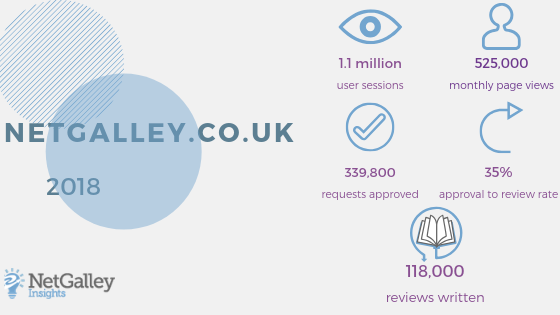
It’s been a year since we launched NetGalley.co.uk – our dedicated UK platform, showcasing all the best in British books – and so it feels like the right time to give an overview of all that’s been happening on the site. We’ve been delighted by the response from readers and publishers alike, and are proud of the new ways we’ve been able to highlight titles to prospective new reviewers.
A bigger audience, visiting more than ever!
New promotions, new views
With Netgalley.co.uk, one of the main aims was to find new ways for members to find titles – and to show a distinctly British slant on the site. Now members can see only the books for which they are likely to be approved, and British titles are always front and centre on the site. The introduction of featured titles and category spotlights has been hugely successful, boosting impressions, discoverability and requests for all titles included.
Results have been amazing, with an increase in requests for featured titles on the previous two week period varying anywhere from 150% up to 8800%!
Eblasts – more popular than ever
Our dedicated eblasts are sent to all UK members opted into marketing communications, and have become the most popular way of marketing to members. It’s the digital equivalent of a Super-Proof, showing members just how excited you are about a particular title.
We still only ever send one eblast a day to our members, which means that we’ve been fully booked for almost every day – week and weekend – for the whole of 2018. As many of you know, spots are now at a huge premium, so in order to get the date you want, don’t forget to book well in advance. Booking forms for 2019 are here.
2018 has been a brilliant year for NetGalley UK, and we’re very much looking forward to the New Year, and helping publishers really boost the performance of their titles!
For ten years, the ALA initiative I Love My Librarian has been recognizing the best librarians in the country. Communities nominate the librarians who are best supporting their patrons, providing creative programming, increasing intellectual curiosity, and bringing resources to those who need them. Because we also love librarians, NetGalley attended the award ceremony for the ten winners of the 2018 I Love My Librarian Award at the Carnegie Corporation of New York on Dec. 4.
Winners thanked their colleagues for their support and their patron communities for letting them do what they love for a living. They affirmed libraries as places for patrons to explore their own identities and for marginalized groups to find acceptance and support.
One of the patrons who nominated Lindsey Tomsu, a teen and YA librarian from the Algonquin Area Public Library District, described the work she does to create an inclusive atmosphere. “She creates a haven for…teens questioning their identities and orientations, diverse teens, rich and poor alike…” Stephanie H. Hartwell-Mandella, head of Youth Services at the Katonah Village Library thanked the librarians who didn’t bat an eye when she was a curious adolescent who started checking out romance novels. Paula Kelly, library director at Whitehall Public Library, is committed to keeping her diverse community’s needs at the forefront of her programming. She sends a bus every month to pick up patrons (mostly elderly members of immigrant families) to transport them to and from the library. Her library also partners with its Bhutanese community to preserve their shared history and stories, and to share those stories with other Pittsburgh residents. Learn more about all of the 2018 winners here.
Librarians are an important part of the NetGalley community, so we are always curious to learn more about what makes their communities and their libraries unique. And we know that this information is valuable to publishers, as well! Check out our Ask a Librarian series to read more.
Congratulations to the 2018 I Love My Librarian Award winners from all of us at NetGalley!
NetGalley operates all over the world, serving the needs of global publishers. With dedicated NetGalley sites for Germany,France, and Japan, as well as the U.K., we are proud to support many different publishing ecosystems, all with their own unique characteristics. Today, we’re hearing from Karina Elm, who heads up customer relations and community management for NetGalley Germany. Below, she gives an overview of the German publishing landscape and book market.
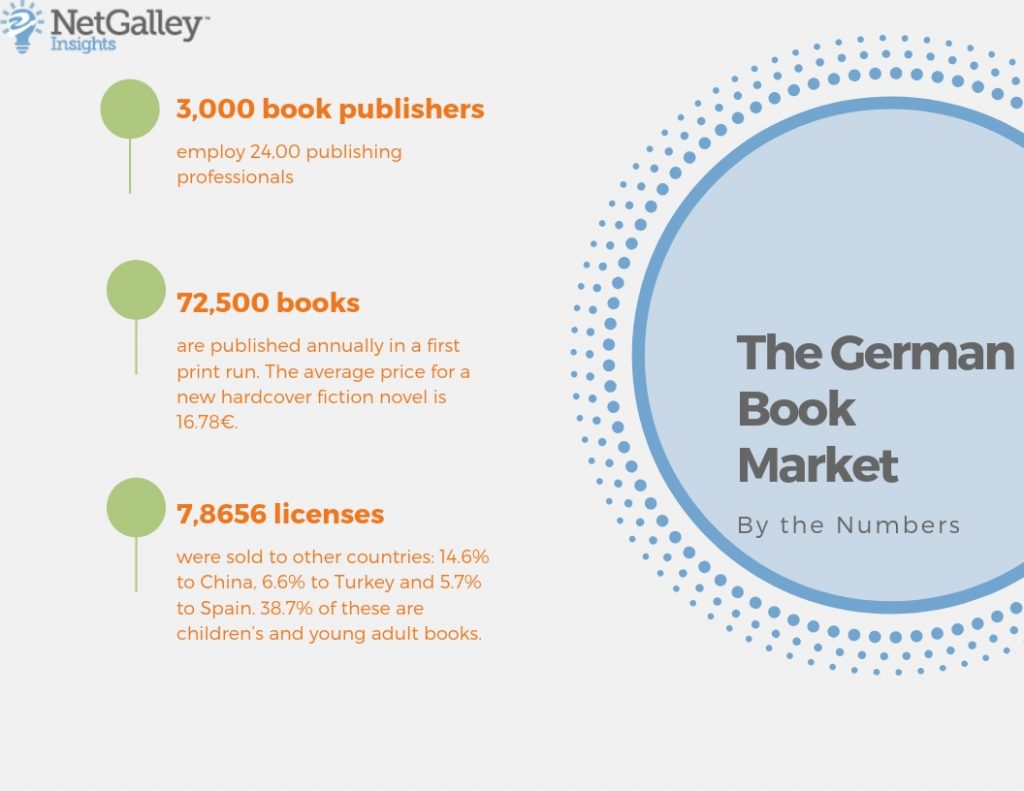
Germany, well known to some for its great poets and thinkers (to others for its sausages, beer, football and the Autobahn), owns the largest book market in Europe. Struggling – just like in many other countries – with the rise of strong competitors called Netflix, Facebook, Instagram and others, the book is not yet forgotten. On the contrary: Even though the number of people buying books has decreased, individual people actually read more and the amount of titles published per year is still rising. Let’s have a closer look at some facts and figures from the year 2017 as well as some specialties of the German book market!
Source: Source: MVB-online.com, “Buch und Buchhandel in Zahlen.” 2017.
Bookselling: Bookstores and Fixed Prices
6,000 bookstores are selling books to readers, employing a total of 27,800 booksellers. 3,500 are small independent bookshops and 1,200 are part of bookstore chains. Berlin has the most bookstores in German – 236 stores for its 3.5 million inhabitants.
Many bookstores meet the challenge to compete with online sales platforms by selling coffee, hosting events (like public readings) and turning their shops into cultural meeting points. Since 2015, the German Ministry of Culture honors the most innovative bookshops with the German Bookshop Award.
Germany has fixed book prices. This means that publishers set a price for each book which is then mandatory for retailers. Only a limited number of discounts are allowed. Publishers can change the price, and the price for a different edition may vary. The tradition of fixed book prices goes back to the 19th century, the current law was introduced in 2002. Fixed prices are widely seen as a strong advantage of the German book market since they have benefits for both the industry as well as from a cultural perspective.
Booksellers of all sizes profit from a calculable margin on bestsellers, retailers compete not just with their prices but also with their service. It is beneficial for brick & mortar booksellers in the often destructive competition with online retailers and vendors outside the book industry. For publishers it means that they can cross-subsidise bestselling books with other works, allowing publishing decisions to be made on other aspects than just the selling potential sometimes. This helps support the work of lesser-known authors, as well as titles with complicated or expensive layouts. For readers, the fixed price system results in a large variety of books as well as publishing houses with different profiles. It also allows for a very efficient distribution system: If you order any book at your favorite bookstore you’d most likely be able to pick it up the next day. Last but not least, a strong network of bookshops offering a diverse and colorful range of books is an important part of a diverse and colorful society!
German Readers: Who they are and how they read
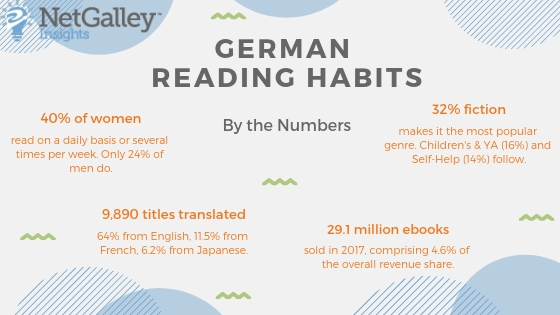
Source: MVB-online.com, “Buch und Buchhandel in Zahlen.” 2017.
Just like in many countries, book bloggers are on the rise in Germany. By 2018, thousands of blogs about books, reviews and other bookish topics can be found online – the actual number is difficult to establish. The blogosphere is very active, well connected and spanning all genres and formats. Booktubers and Bookstagrammers are on a strong rise, too. By now, many publishers are working closely with individual bloggers, some even launched unique platforms for bloggers to read and review their titles. In 2017, the first German Book Blog Award was initiated by NetGalley Germany in cooperation with the German Publishers & Booksellers Association and rewarded the best German-language literary blogger as well as one booktuber. In 2018, the prize was given out in 9 categories, among them Romance, Literary Fiction, Suspense, Children’s Literature, Newcomers and Other Formats.
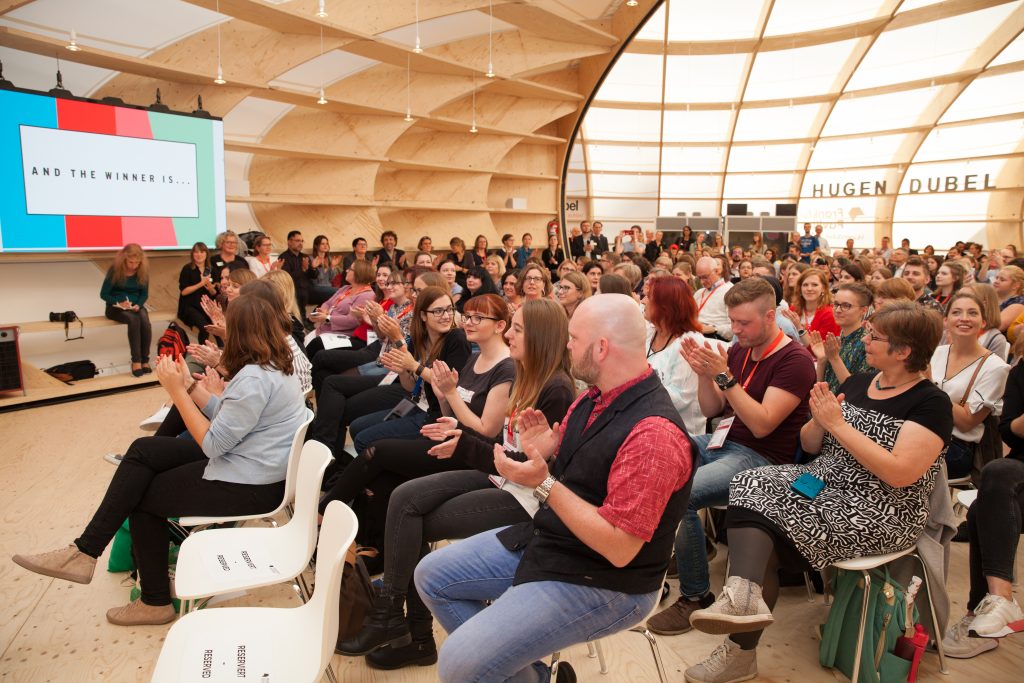
German Book Blog Award Ceremony 2018
The Tolino is Germany’s own reading device for ebooks, competing with Amazon’s Kindle – and rising above it with a market share of 40% in 2017. Tolino is a strategic alliance between biggest German retailers to offer and produce e-readers and tablets. In January 2017, the Japanese Rakuten Kobo took over the shares of their former technical partner Deutsche Telekom. 2,000 bookstores sell books through the Tolino system and many independent booksellers are connected to it as well. Contrary to the Kindle, Tolino is an open system which means ebooks can be bought at any participating shop and read on any other device as well.
Book Industry Events, Awards, and Associations
Two book fairs are the German publishing industry’s yearly highlights and every book lover counts the days between them. The big one, Frankfurt Book Fair, is actually the world’s largest trade fair for books and has a long tradition, rooting back to 1454. Every year in mid-October, publishers, agents, tech companies, and content providers meet for business, trading, and international rights deals. Over the weekend, the fair opens for the public. More than 7,300 exhibitors from over 100 countries and more than 286,000 visitors took part in 2017.
In comparison to this, Leipzig Bookfair and it’s 208,000 visitors in 2017 is like a younger sister. It’s history goes back to the 17th century and it is a fair for the public: Visitors can attend all 4 days in order to discover new books and meet their favorite authors. There are hundreds of public readings at the fair but also throughout the whole city of Leipzig which transforms into a huge festival of reading during this time in March.
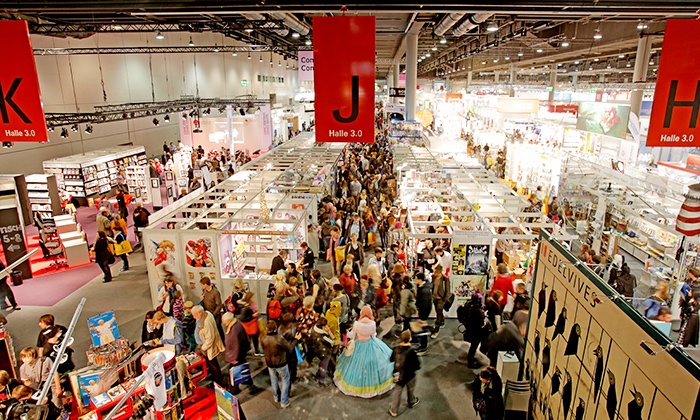
Frankfurt Book Fair 2018
Germany has numerous literary awards for books and authors. The most famous of them is probably the German Book Prize which can be compared to the Man Booker Prize. Launched in 2005, it honors the best novel written in German in each publishing year and is awarded at the Frankfurt Book Fair in October. Most of its winners have already been translated into English, you can find a list here.
The most prestigious literary award in Germany is the Georg Büchner Prize which honors an author’s lifetime of work and was, for example, given to later Nobel Prize winners Günter Grass, Heinrich Böll, Elias Canetti and Elfriede Jelinek. A very atypical literary award is the Ingeborg Bachmann Prize. It honors an author for an unpublished literary excerpt only and is very publicly awarded during the Festival of German-Language Literature where the texts are read out loud and the jury comments directly, often very critical, while the audience watches in the room as well as in front of the TV across the whole county.
The German Publishers and Booksellers Association (Börsenverein des Deutschen Buchhandels), founded in Leipzig in 1825, represents all sectors of the book industry: Publishers, Retail Booksellers, Antiquarians and Wholesalers. They also organize – among other things – the Frankfurt Book Fair and the German Book Prize, and they are custodian of the fixed price system.
NetGalley Germany
NetGalley.de was launched in March 2016 (just in time for the Leipzig Book Fair!) and by now has more than 11,500 members, The first ones to adopt the platform were of course book bloggers who had already used NetGalley.com and were very excited to finally also find German publishers and titles available for them.
German publishers by then were working with their own bloggers already and saw NetGalley as a platform to use it in their communication with those bloggers, and to widen th
NetGalley Germany
eir network. However, a few adventurous German publishers started sending the NetGalley widget to their network of booksellers, as well. It was a big transformation of workflows that have existed for many, many years (and we all know
how painful this can be) but it was worth it: We now receive excited and very happy feedback from both publishers who followed this example, as well as from booksellers, telling us how much easier their daily work has become.
The growing implementation of NetGalley in publishers’ work with booksellers has resulted in the following division of member types, very special for the German market: As of October 2018, 47% of the German speaking members are reviewers, 43% booksellers, 5% media and 5% librarians and educators. Their favorite genres are Fiction (45%), Teens and YA (40%), Thrillers & Crime (37%), Fantasy & Sci-Fi (35%) and Romance (25%). During an average month in 2018, more than 26,000 galleys were sent out through NetGalley.de, and members provided over 5,000 pieces of Feedback.
Do you publish in German? Use NetGalley.de to reach out to our avid community of professional readers, promoting your tiles to German readers! I would be very happy to hear from you via karina.elm@netgalley.com.
Karina Elm is Customer Relations and Community Manager at NetGalley Germany – and a huge bookaholic. After studying Comparative Literature, she worked for Ullstein Publishers as part of the team around digital imprints Midnight and Forever, and as the online marketing manager at Clear Canvas, an online marketing agency in Berlin. Karina Elm is initiator and driving force behind the German Book Blog Award which launched in 2017 and has been teaching a class at the Free University of Berlin about online reading communities in 2018.
The Book Industry Study Group (BISG) works to create a more informed, empowered and efficient book industry. Their membership includes trade, education, professional and scholarly publishers, as well as distributors, wholesalers, retailers, manufacturers, service providers and libraries.
Throughout the day, seven different presenters described their jobs – their workflow, the challenges they face, and where their work fits into a book’s lifecycle.
Most of us only see books during a relatively small part of their lives. The details and strategy that consume our workdays are only a fraction of the work that goes in to bringing a book to the public. Acquisition editors see books when they are just manuscripts and ideas. Printers shepard books into the physical world and then pass them along. Library marketers are thinking about how books will live in communities years after their pub date, when the pages are soft and earmarked. This overview of what our colleagues are doing across the industry was a welcome reminder that we all depend on each other’s work to bring the best books to the readers who will love them.
For those who weren’t able to attend, here is a bit of what was covered:
Publishing is beyond personal taste
Contrary to popular conception, Todd Stocke described his role as SVP and Editorial Director at Sourcebooks as less about his own inimitable tastes and more about analyzing data and looking for spaces in the market to tell new stories. For him to be successful at his job, he needs to be able to think outside of his personal preferences and the demographic details that have given rise to his interests and tastes. He has to have an idea of what people of different backgrounds are interested in, and to have access to the writers telling those stories. He described the necessity of having a pipeline that is both broad and deep. A broad pipeline means getting manuscripts from a variety of sources and a deep pipeline means developing relationships with the people providing those manuscripts so that, for example, an agent will know immediately if the manuscript in their hand is the perfect book for the Sourcebooks nonfiction editor.
All stages of book publishing are about the audience
This was the overarching theme of the day. It was not a shock to hear audience as the focus for acquisitions, bookstores, or libraries. These are the parts of the industry that we know need to be responsive to what readers are looking for. But we were surprised to hear how much audience fits into how other players in the industry do their jobs. As Judine O’Shea described the design process for a book, she made the point that a big driver for her is audience-appropriateness. If she’s designing the title and page layout for a children’s book, how many colors will be too busy for young eyes? Will the font be easily legible for early readers? Michael Shea from LSC Communications pointed out that audience use determines the physical form of a book, too. Different binding styles are better for the different ways books live in our lives. For example, an art book that is meant to lay flat on a coffee table will be bound differently than a trade paperback meant to be read on the subway. The glue used on a technical textbook that will be out of date in a few years will be different from the glue used on a book that might be passed down from generation to generation.
Mr. Tiger Goes Wild by Peter Brown illustrates Judine O’Shea’s audience-centric design principles – Plenty of visual interest for many rereads with simple font for early readers.
Know your local, professional community
Suzy Takacs chalked up some of her success at the Book Cellar to her close relationships with local players of the book industry. She described her warm relationships with other booksellers, and how she has called upon stores like Women & Children First to help her stock titles in advance of events. She even described visiting IPG’s warehouse for a last-minute pickup. She is able to quickly respond to inventory needs and meet consumer demand because she has positive relationships with other booksellers and with distributors. Stephen Sposato of the Chicago Public Library expressed a desire to work more closely with booksellers. He suggested sharing data about which titles have long hold lists, so that bookstores will know what readers are asking for and can make sure to adjust their inventory to align with demand.