NetGalley provides every publisher with a wealth of early data and analytics about each of your titles to bolster your marketing efforts and inform your overall strategy, including easy ways to follow up with approved members using the Detailed Activity Report and Feedback Report.
Today we’re focusing in on the Snapshot PDF Report, which is available for every title listed on NetGalley. It contains data points that can assist publicists, library marketers, social media teams, and others, as well as high-level decision-makers looking at overall trends.
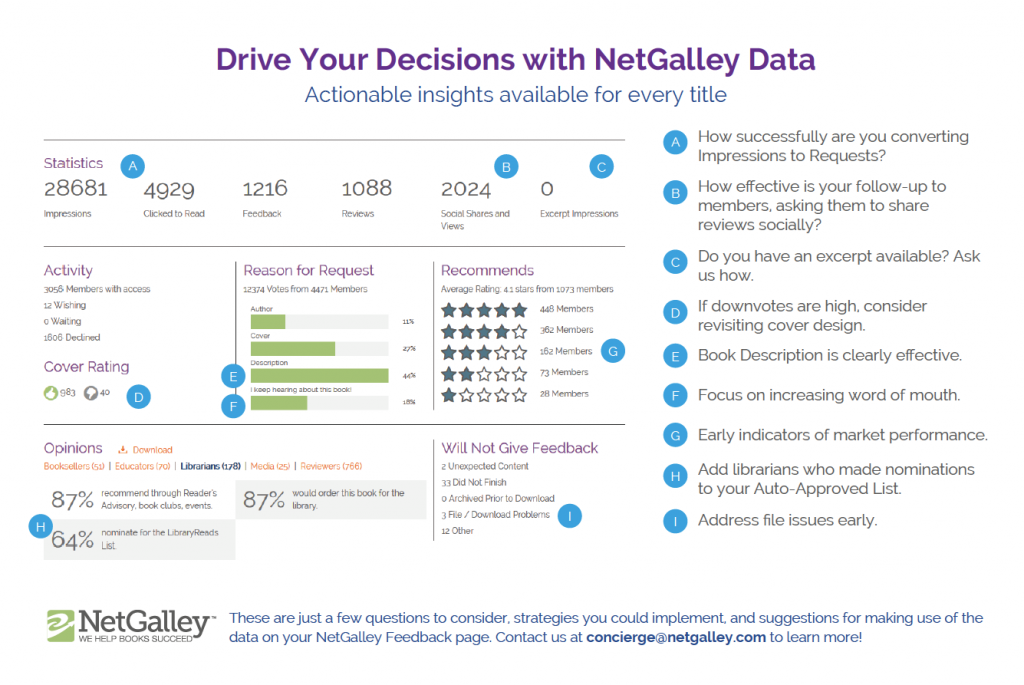
The Statistics section of the Snapshot PDF shows a title’s general performance (Impressions, Reviews) as well how members are following through. You can look at the relationship between Impressions, Clicked to Read, and Feedback to see how your pipeline is working. And if you aren’t converting as much Feedback as you’d like, consider how you are communicating with those members who Clicked to Read. Are you following up with them and enticing them to read and review? Or, if your conversion rates are high, analyze what you are doing right and apply that method to other titles.
Reasons for Request provides early indicators about what aspects of your books are resonating with readers. You can use this information in two ways – both to see what is working, and to see where there is room to try a new strategy. If, for example, most NetGalley members are requesting access to a book based on the description, you know that copy is effective and catchy. If most members are requesting based on the author, you can capitalize on that personal connection in your ongoing marketing and outreach. On the flip side, if only a few NetGalley members are telling you that they’re requesting a book because they keep hearing about it, you can tell that you might need to be showing that book in more places and more proactively building word-of-mouth buzz.
NetGalley members can express an opinion about a book’s cover design, whether or not they request it. If you see plenty of thumbs up in the Cover Rating in your Snapshot PDF, you know that you have an especially compelling cover. Consider using it – rather than, say, author photos – in marketing campaigns and social media posts. If a NetGalley member is only lukewarm on a cover design, they won’t usually downvote it, so consider downvotes to be strongly held opinions. If you find yourself receiving more downvotes for a cover than you’d prefer, consider repackaging the book if there’s time. If you don’t have time to redesign your book’s cover, you can still take that intel into your design meetings for future books.
The Opinions section of the Snapshot PDF, downloadable as the Opinions Report, can guide your targeted followup and help you curate a list of the NetGalley members who are most engaged in your books. When members submit feedback for books on NetGalley, they are asked questions specific to their member type. For example, booksellers are asked if they are likely to handsell the title, if they would suggest that their store purchase the title, if they are interested in the author visiting their store, plus given the opportunity to nominate the book for the Indie Next list. You can read all about our member-specific questions here. After looking at this information, you might consider reaching out to interested booksellers to arrange author visits, or offer to connect media to the author for an interview. You might Auto-Approve every librarian or bookseller who nominates your book for LibraryReads or the Indie Next List.
For more ideas about how to use NetGalley data and reports, reach out to us at concierge@netgalley.com. We’d be happy to chat!
Michelle Vu, Director of Business Intelligence & Data Management at Houghton Mifflin Harcourt, is implementing automation at HMH while keeping humans front-of-mind
Automation in publishing, as in any other industry, can seem risky. Workers wonder what will happen when their job can be done – in part or in full – by a computer program. For example, how will interns break into the industry if there are no galley envelopes to stuff and send?
But where some see cause for concern, Michelle Vu sees opportunities. In her role as Director of Business Intelligence & Data Management at Houghton Mifflin Harcourt, Vu is working across divisions at HMH see how automation could make workflows smoother and more effective. She is fostering honest dialogue about pain points throughout the book publishing process. Vu is using automation to give her colleagues more space to do the creative and thoughtful work that humans are uniquely good at, and that is required to shepherd great books into being.
She recently gave NetGalley Insights an inside look at how she thinks about automation and how she is implementing it at HMH.
How do you define automation?
Automation takes a process typically performed by a human being and uses technology to either remove the human element completely or create a hybrid of the two. We’ve seen many forms of automation throughout history, mass production and the assembly line, chat bots, Alexa and Siri, and the thermostat in our homes. It is easy to forget modern conveniences are the result of some form of automation.
I see automation as an opportunity to improve employee satisfaction by reducing the amount of boring but necessary tasks we each do every day.
Photo via Yotel
One of my favorite hotels to stay at in Boston is the Yotel in the Seaport District. Walking into the lobby, you check in at a kiosk with the credit card used to book the room, the machine creates a security card for entry to your room and prints a receipt with your room number. Automating tasks like check-in and setting up room access frees up the concierge to do the very human work of making a visit special through personalized recommendations. If I need recommendations for things to do, there is a human being at the concierge desk whose time was not spent processing my stay but rather guiding me to the exciting things Boston has to offer. I realize this type of interaction (or non-interaction) may not work for everyone, but I find the experience very liberating.
You use the framework of Human+ to think about incorporating automation. Tell us what that means to you.
Human+ is building a digital workforce of software bots, machine learning, and artificial/augmented intelligence to work alongside and complement our human workforce. Identifying and segregating tasks that robots excel at with speed and accuracy (processing invoices, sifting through reams of financial data) from tasks that humans do best, especially those requiring subjective reasoning and creativity. To me, this means recognizing there really is a way to do more with less. By offsetting our talent with the aid of technology, we could invest more of our time with innovation.
By offsetting our talent with the aid of technology, we could invest more of our time with innovation.
How are you integrating automation into workflows at HMH? How and why did you take on this role?
We have been using software bots in the HMH trade division for the past six years on a much smaller scale and only within the data group. Our bots function to automate the retrieval, manipulation, and ingestion of data from external sources (think point of sales, daily ebook sales, etc.). It was not until recently that HMH implemented an enterprise level RPA (robotics process automation) program. Recognition of and support of RPA organization-wide has not only helped us ramp up automation projects; it has given us the visibility needed to expand beyond data ingestion into business processes.
Last year, our corporate automation team reached out to me to become a member of the advisory board for the RPA initiative. As the head of data and analytics for the trade division, RPA has been an area I have been wanting to explore for several years. To be perfectly honest, I knew very little about automation, but since I already work closely with our Publishing Operations team on workflow and processes, this was the perfect opportunity to dive right in!
What are the psychological, cultural, or social implications of integrating automation into publishing?
Evangelizing automation from an empathetic perspective is the most important thing for a successful RPA implementation. Ask a person at any level from various industries and they are sure to be overwhelmed, doing the job of two people or simply cannot find enough time in a day to finish their work. It’s important to remember that automation is not just a series of meetings to go over process improvements nor is it the new shiny IT project. A grassroots approach would be most effective, so people are less inclined to view automation as a mandate or a cost-cutting initiative. Having people create their own areas of efficiencies allows for greater ownership and accountability over their processes.
Evangelizing automation from an empathetic perspective is the most important thing for a successful RPA implementation.
I think of automation as a shift in our culture and rethinking the way we work and what we call “work” from a holistic point of view. It is not biased toward return on investment or reduction in staff, but rather a long-term approach for employee engagement and innovation. Traditional publishing is often hierarchical in structure with divisions and imprints focusing on each of their own processes. Honest conversations between departments about automation can help break down the silo mindset and engage employees to think bigger picture where they can add the most value to the book production life cycle.
What responses have you been getting from colleagues when you are automating parts of their workflow?
I am fortunate to be working with such a wonderful group of people at HMH, who have reacted to my questioning and probing into their work with curiosity and excitement. My role is to foster discovery sessions where we uncover and unravel processes, asking why we are doing something and what kind of results are expected. I’ve received positive feedback even during the discovery phase where we are stepping back and breaking down tasks. Not all projects are good candidates for automation, but the conversation itself has had a positive impact in people’s work in an empowering way. Having the support of upper management is key. I am grateful to have a management team that understands and realizes this is an opportunity to create powerful changes in our definition of work.
Which kinds of jobs have already been affected by automation? Which roles do you anticipate will be impacted next? How will it change entry-level positions?
The types of automation we’ve looked at have been administrative type tasks that are being done by non-admin people. For example, an editor submitting author advance payments or accounts payable invoices or a production manager tracking the status of shipments from freight carriers. We are looking at tasks and not necessarily entire jobs. For entry-level positions, I expect automation could potentially mean fewer admin duties and more meaningful work.
In the case where entire jobs are being eliminated, some companies transition and train the people affected by automation to manage and even build the actual bots. It makes sense since they know the process best and can troubleshoot and fix issues.
What hopes or plans do you have for the future of automation in publishing, either at HMH or across the industry?
I would like to see vendors of publishing software integrate automation features into their applications by improving the management of production schedules and having a more targeted approach to workflow based on user profile. From a contracts, permissions, and sub rights perspective, using NLP (natural language processing) for semi-structured data in managing contracts and royalties would improve accuracy of data management and tracking of licenses. It would be interesting to integrate bots into the manuscript editing process that could potentially reduce the number of passes and streamline the workflow. One of our next big projects at HMH is to automate certain parts of metadata management to resolve data discrepancies, missing data and potentially even have bots create new data.
Michelle Vu is the Director of Business Intelligence & Data Management at Houghton Mifflin Harcourt, where she heads the data and analytics team for the HMH Books and Media division. In her thirteen years of experience in trade publishing, she has led many metadata initiatives to improve workflow efficiency and generate product discovery. Michelle is passionate about delivering insights in meaningful ways, facilitating increased productivity and driving effective decision-making. Most of her free time is spent baking, cooking, eating, talking about food, and all things cats.
Interviews have been edited for clarity and length.
Tips and success stories from NetGalley’s marketing experts
The NetGalley marketing team loves collaborating closely with our clients. We’re working with publishers and authors every day to help put their books directly in front of the NetGalley members who are most likely to read, review, and advocate for them. Since our clients are so diverse (from the “Big 5” houses to self-published authors, and publishers of all kinds of books—bestselling fiction to nonfiction and academic, religious, graphic novels, children’s and YA, cookbooks, and beyond) our marketing team has seen first-hand which strategies have worked to engage many different kinds of readers.
Our first Proven Strategies post covered how to grab a reader’s attention with a strategic subject line. Now, our marketing team is sharing tips for the next step: optimizing the design and content of a dedicated eBlast, one of NetGalley’s most popular promotions.
Design
Not every publisher or author has the budget or bandwidth to create unique eBlast designs in-house. That’s ok! You don’t have to design an eBlast in order for an eBlast to succeed. NetGalley’s marketing team has a standard eBlast template that can easily incorporate any art or assets. For example, images you’ve used as Facebook or Twitter covers (like The Bromance Book Club), or graphics from your website or from the jacket art itself, to match the book’s overall branding and achieve a more cohesive look.
The call to action (CTA) should clearly tell the recipient what to do next—and should fit your goal for that campaign. Before creating your eBlast, think about what you want from the recipient: requests, limited-time downloads, wishes, reviews, pre-orders, purchases? Highlight the CTA with color, placement and text treatment. We use standard “button” images that mirror the recognizable action buttons of the NetGalley site, so that recipients can easily spot where to click in the email.
Plus, make sure to preview your email design across multiple devices and email clients, so you know how it will render for recipients who are reading your email on mobile devices, on their computers, or elsewhere. Our team will help test, too!
Content
Remember that, like all of us, the recipients of your eBlast are busy and have short attention spans. It is highly likely that they won’t spend very long on your email, so it’s key to design that email with efficiency and readability in mind. Keep the CTA “above the fold” so the recipient can see it without having to scroll too much. Can the recipient answer what, why, and how after just a few seconds of looking at the email?
And, be sure to include the book’s pub date prominently so they know the best time to submit and post their review. We Are Bookish Executive Editor Kelly Gallucci told NetGalley Insights: “My pet peeve is definitely when emails don’t contain enough information. It’s most helpful for me when the author, book title, genre, and pub date are as up-front and clear as possible.”
When writing the content of your eBlast, keep in mind that less is more. Including an entire book description will likely overwhelm a reader, or increase the chance they will lose interest before taking action. Readers scan emails quickly for info that is relevant to them, so divide text into short paragraphs. And remember that a prominent headline (at the top or center of your eBlast) is your second chance at a strong first impression (after the email subject line). Is your headline clear, impactful, intriguing?
Don’t forget to leverage high-profile relationships. Highlight if your author is already a bestseller, or if there are any exciting crossovers into television or film. And if you have quotes from industry professionals or big-name authors, include those but keep blurbs brief.
We also recommend considering your secondary goals for the campaign, in addition to the main CTA. For instance, in addition to driving requests on NetGalley, do you also want the book to get more nominations for LibraryReads and the Indie Next List? Include a nomination reminder with deadlines (but only if the eBlast is being targeted to librarians and booksellers). Or, in addition to driving Pre-Orders, do you also want to build an author’s brand and social following? Consider including a short author bio, plus a photo and social media links. Do you want to increase brand awareness for your company or imprint? Make sure to highlight your logo and link to your publisher page on NetGalley so members can “favorite” you.
Have questions or need advice? Ask NetGalley’s marketing team – marketing@netgalley.com! We’re here to help, and want to help your book succeed. And, be sure to subscribe to NetGalley Insights so that you don’t miss our next Proven Strategies post.
You already know that NetGalley is a data-driven service. But did you know that in addition to giving publishers access to book-specific information about performance and member interest, we are also working with our own data scientist to dig into site-wide activity? We’re looking at data across publishers, categories, and years to examine trends and help publishers capture NetGalley members’ attention.
In this article, you’ll learn about opportunities you may be overlooking to reach readers interested in some underserved categories on NetGalley.
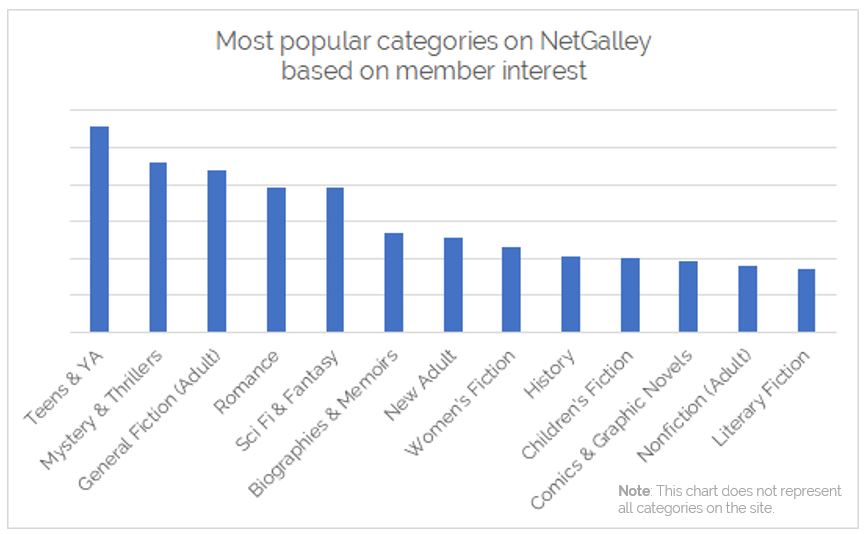
As a general rule, NetGalley functions as a microcosm of the book retail market. The titles and categories that perform strongly on NetGalley tend to also sell the most once they go on sale. This means that publishers can use NetGalley as an early indicator of success. The top 5 most popular categories on NetGalley are Teens & YA, Mystery & Thrillers, General Fiction, Romance, and Sci Fi & Fantasy. But there are plenty of other categories where you’ll find an enthusiastic readership on NetGalley!
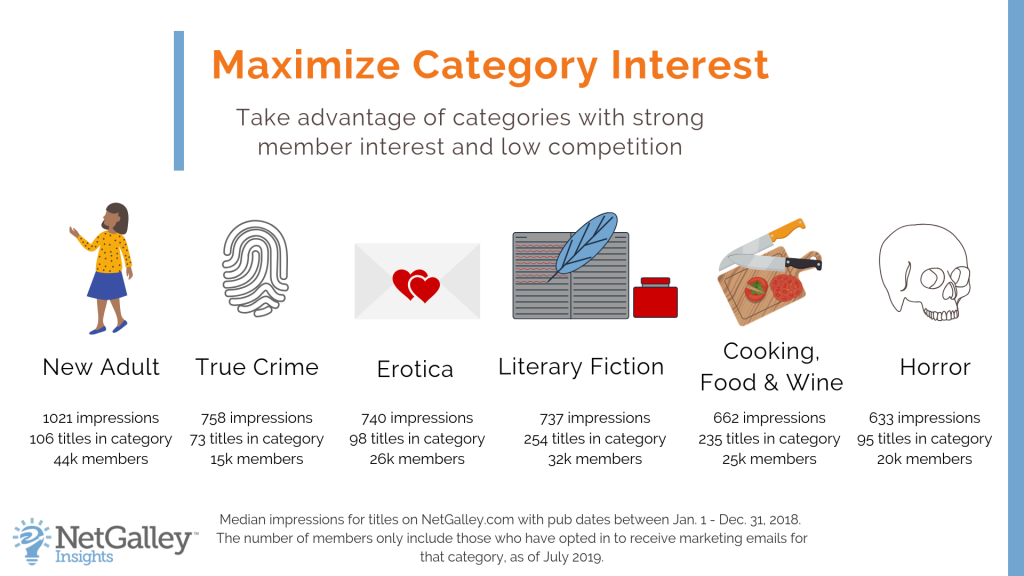
While looking at this data, we discovered several categories with high median impressions (lots of views), but a relatively low number of books in the category. This means that there is less competition for more views!
Our data scientist helped us compare median impressions versus number of titles in each category on NetGalley, and we were able to discover which categories have a hungry audience and opportunity to expand the number of available books.
The data set includes all books on NetGalley.com that were published between January 1 – December 31, 2018. We looked at the median impressions (views of the title details page) to ensure that extreme outliers of activity would not skew the data too much in one direction or another. The median number refers to the midpoint of the observed values, meaning that there is an equal probability of falling above or below it.
While looking at this data, we discovered several categories with high median impressions (lots of views), but a relatively low number of books in the category. This means that there is less competition for more views! Here are a few examples:
By comparison, some of the very popular categories like Romance and Mystery & Thrillers included many more titles, making the competitive field more challenging. (Romance: 706 median impressions and 2,224 titles. Mystery & Thrillers: 748 median impressions and 1,523 titles).
Keep in mind that some of the highest performing titles within these underserved categories are cross-listed in a second category. While this does mean that some of the impressions for these titles likely came from members browsing other categories, the success of cross-listed titles indicates the effectiveness of the strategy. Publishers can assign two different categories for each book on NetGalley, which we always recommend for increasing discoverability.
For example, Bad Man (which was one of the top-performing Horror titles of 2018) is listed in both Horror and General Fiction. This means that members who were browsing in either Horror or General Fiction were able to discover Bad Man, and request it if it piqued their interest. If they browsed in both categories, they saw it twice! In total, only 13 books were cross-listed in these two particular categories in 2018. Similarly,Honeybee was one of the top-performing New Adult titles in 2018, and was cross-listed with Poetry. Some of the most common category combinations include General Fiction + Mystery & Thrillers, Romance + LGBTQIA, and Teens & YA + Sci Fi & Fantasy.
Publishers also took advantage of on-site marketing to give their titles a boost in these categories. For example, The Kill Jar benefited from Category Spotlights in both Nonfiction and True Crime while it was active for requests, as well as a Dedicated eBlast targeted to members interested in True Crime and a list of comp titles—all of which helped it to become one of the most successful True Crime books on NetGalley in 2018.
If you ever have questions about how to best position your titles on NetGalley in order to connect with readers who are most likely to advocate for your books, email concierge@netgalley.com.
We are continually working with our data scientist to delve deeper into publisher and member activity, and will be sharing more of our findings here on NetGalley Insights. Subscribe to our weekly newsletter so that you don’t miss any upcoming data-driven strategies.
Repackaging books with new covers, new back cover copy, or even a new titles is one of the tools in a publisher’s arsenal to give a book more life. Whether making decisions about the trade paperback design after the hardcover has been on sale, or discussing changes to a backlist title that’s been acquired from another publisher, Sourcebooks uses a lot of data to support their repackaging efforts.
Sarah Cardillo, Director of Publishing Operations at Sourcebooks shares how she and her team use sales numbers, comp titles, and audience responses to guide their redesign strategy.
1. Consider a book’s total positioning, in addition to sales
When we are looking at the trade paper edition of a hardcover release, we start by looking at sales – how many [books] did we actually sell, what percentage of the inventory sold through within the first 6-8 weeks, and did it sell at the level we had expected it to sell? We look at retail sales [as well as] library sales. Sometimes a book might not sell at our expectations at retail, but may have landed very strongly with the library markets.
If we are looking at the cover for a book that was previously published by another publisher, or perhaps self-published, we look at how the book was positioned as a whole. So, we start even further back than the cover. We think about the title, the story hook, or positioning, and the category the book will be shelved in. Even if the book had relatively strong sales, some of these other factors may give us insight into how to launch the book at a new level for Sourcebooks.
Hardcover
Repackaged as a trade paperback
2. Involve everyone in the process
Since we start by looking at sales, the decision begins with the sales department and the marketing team. The marketing team weighs in with what they were seeing at the point of launch. Did they get the reviews they’d hoped for, the media placement they’d planned? Do they think the media had an impact on the sales (or lack thereof)? We may also discuss what the consumer reviews look like. Sometimes we see that consumers are most excited about a particular aspect of the book that we did not position against – that we didn’t address on the cover or with the back cover copy.
If this was a previously published book by another publisher or self-published, then the conversation may start with editorial – again though the editorial team starts with how they want to publish the book for their list – once they determine that positioning, the art director will review and make a recommendation on the cover direction.
In most instances, the design team is brought into the conversation when there’s already a recommendation on the table to repackage.
3. Pay attention to comp title performance
We rely heavily on data – and comp titles provide data. We may see that a design trend has faded or taken off and so we rethink our packaging to fit into that trend. We research the categories and subcategories in depth to provide expertise on what works (and what doesn’t) when positioning a book into a certain category. We want to make sure that the consumer who reads a particular type of book knows at immediate glance that this book is for him or her. We want to make sure that our cover fits within the design space of similar books, but also stands out or stands above the other books. That the consumer sees it and knows it’s what they like to read, and that they care enough to pick it up.
4. Listen to your audience
I would say most repackages are driven by external market considerations. If we believe the current cover didn’t help sell the book, a new cover has the chance to reach a different audience – where your hardcover may have been packaged more like a romance, but your reviewers really like the mystery in the story – a repackage could lean toward the mystery aspect. So it’s still based on content, but now external factors are telling us to reposition against other aspects of the content.
A good example within the romance space was a repackage we did for a book that we published as a trade paperback title – The Curl Up & Dye by Sharon Sala. Sharon Sala is a New York Times bestselling author in the romance space, but this trade paperback did not land the way we had hoped. But when we released her second Blessings, Georgia book, I’ll Stand By You as a mass market romance, we saw that her numbers were very strong in the mass market space and that people really loved her Blessings, Georgia setting. So we then repackaged The Curl Up & Dye as a mass market romance with a new title, You & Only You. It was already set in Blessings, Georgia, but we did not market it that way for the original trade paperback release. When we put it in mass market we made sure to communicate to the consumer via the packaging that this was set in Blessings. The one thing about mass market books and authors is that they often write within a “world” and the consumer is trained to look for copy on the cover (or in online metadata) that indicates a particular book is part of a particular series, or world. The success of I’ll Stand By You showed opportunity and a market – but more specifically that her customers were in that space already – she had success with other publishers in the mass market space, and keeping her where her customers were but then also packaging her new titles in a cheaper format allowed her to grow her reach both with existing customers but also with customers who read similar mass market titles by other authors. Plus, the lower price presented less of a barrier for entry for new customers.
Trade paperback
Mass market romance
5. Remember your deep backlist
Sometimes we look at titles that were published 5-10 years ago (or more) and think about bringing them back out with new covers as a way to boost sales. Especially in the young adult and the romance space. Since those audiences (especially Young Adult) turn over to new people so regularly and trends change so quickly, a successful book with a fresh cover can easily find new readers, and the accounts are happy to take the book because it was successful in the past with the previous audience. We are seeing a lot of illustrated covers in the young adult space right now. 10 years ago covers were all photographic. So we are looking at our backlist right now and seeing what books sold well but could get new life with an illustrated cover direction.
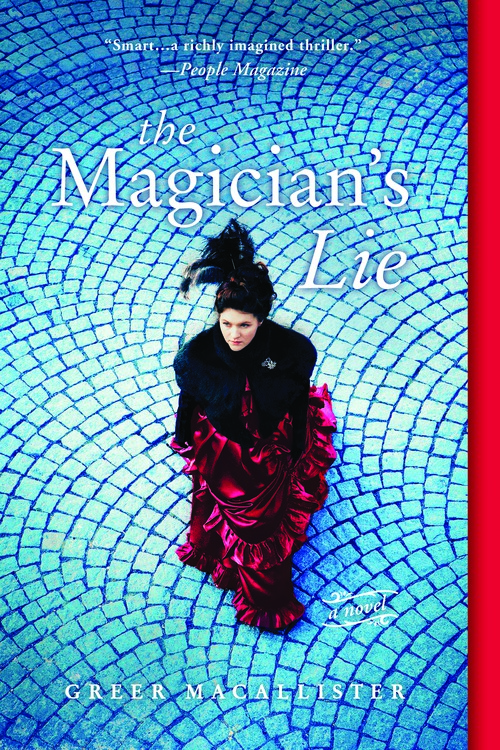
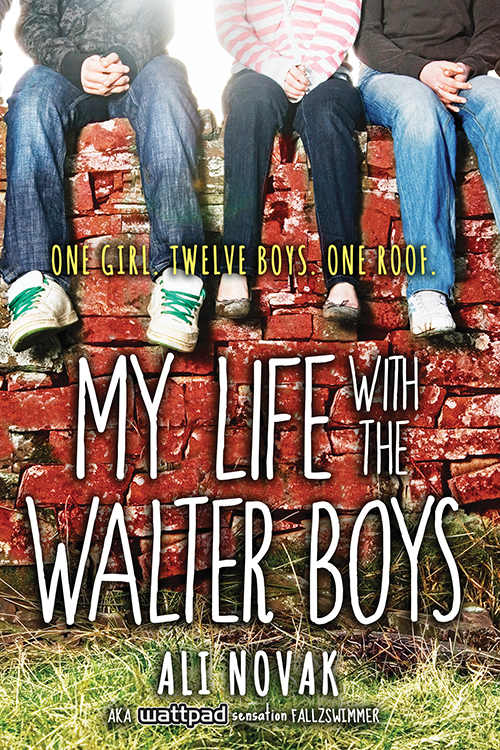
Photographic cover
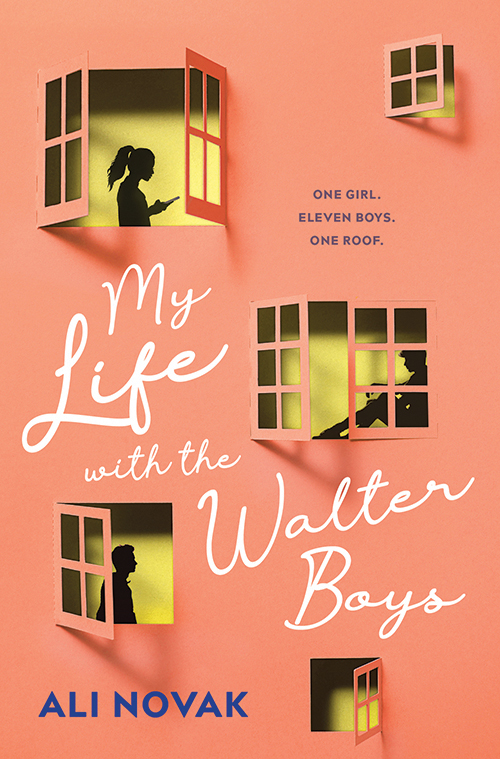
Illustrated cover
6. Capitalize on the success of a repackaging campaign
If the sales increase, we can attribute part of that to the cover, of course, but we know other factors may play a part, too. The change to a more affordable format and the repositioning of the back cover copy are also important. When we see a repackage working really well, we’ll consider what we did and if there were elements that we can use from that repackage to guide the cover for the author’s next book or similar books in the same genre.
7. Think about repackaging at all stages of the publishing lifecycle, including acquisitions
Our goal in repackaging the Poisoned Pen Press backlist titles [which Sourcebooks acquired in 2018] was to give them a more cohesive look across authors and series and to have more immediate recognition for consumers. We wanted to make sure that the consumers who devour mystery titles but have never heard of Poisoned Pen would recognize the books as mysteries that they’d want to read. We felt that, while there were many strong covers on the books, there was room to help drive consumer awareness even more. To use our experience designing for this market to increase sales.
Sarah Cardillo is the Director of Publishing Operations at Sourcebooks, one of the 10th largest publishers and the largest woman-owned trade book publisher in North America. She began her career as a production editor with Publications International (now Phoenix International Publications) but since joining Sourcebooks twelve years ago, she has grown her professional reach exponentially. As director of publishing operations, Sarah oversees numerous key departments, including the award-winning art and design department, and the production, manufacturing, and editorial production departments. She utilizes her project management and change management knowledge to build workflows and increase efficiencies across publishing operations. At the onset of the digital transformation, she rebuilt the standard bookmaking process to seamlessly integrate ebook production into the workflow. Her passion for organization and process has transformed the way departments communicate within Sourcebooks. Sarah has both a bachelor’s degree in written communication and a master’s degree in corporate communication and change management.
For independent authors who are publishing your own work, it can be hard to know how much to spend, and where to spend. Can you publish a book using only free tools and services? Do you need to make a serious dent in your savings account to get your book into the world?
NetGalley and the IBPA worked together to gather information from an engaged and thoughtful group of authors about how much they budget for their books, where that budget gets allocated, and where they find the most value. We hope that this information can help other authors strategize for their own books, getting the most value out of their budgets.
These authors understand that they need to invest in their book, and that the biggest and most valuable expenses will be editing, design, and advertising & marketing in order to give their books the most professional launch possible.
Thank you to the thoughtful authors who shared their budgets, strategies, and lessons learned about the finances of independent book publishing.
Only 11% of respondents reported spending less than $1,000 on their books, indicating that the most active authors understand that they need to invest at least a bit in their books. The majority of authors spent between $1,000 – $6,000 on their books, with the $1,000 – $3,000 bracket accounting for 28% of the overall responses.
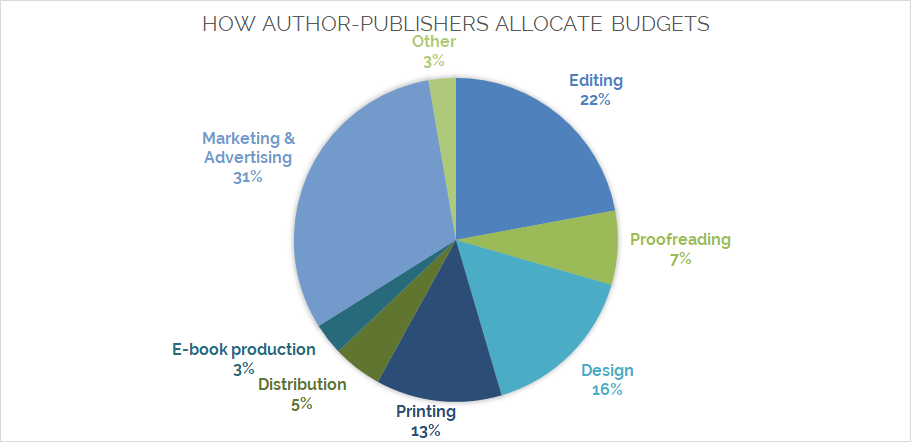
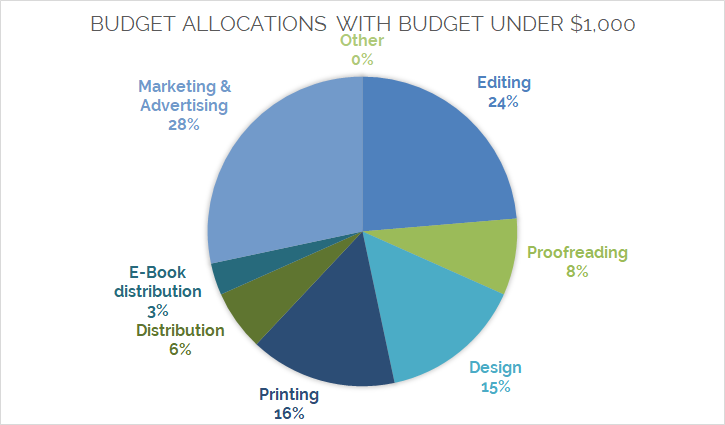
Across budgets, most authors spend the bulk of their budgets on a combination of marketing & advertising, editing, and design.
You can see how authors allocated budgets within different budgeting ranges here:
As authors’ budgets went up, they increased the amount that they spent on marketing and advertising. Other line items – print distribution, proofreading, and ebook distribution – stayed relatively stable across budget brackets.
Editing was the most valuable line item to 41% of respondents, followed by marketing and advertising (26%), then design (21%). We’ve broken down how they valued these three categories by budget spend below.
Editing was the most valuable line item to 41% of respondents, followed by marketing and advertising (26%), then design (21%). We’ve broken down how they valued these three categories by budget spend below.
As an author’s budget goes up, marketing & advertising became more valuable to them. And for the respondents with more limited budgets, they found the most value in first editing, then design.
We also asked how authors determined what made a line item valuable to them. Surprisingly, it wasn’t always sales. Only 17% of respondents used sales as their primary marker of value. Instead, 31% of respondents found value when they could see that an expense had made their book a higher quality product. We can see this correlated to the value found in design and editing. Authors were most interested in making their book look – both inside and out – professional and polished, and then putting eyes on it.
When asked what they would spend less money on in the future, 17% or respondents said marketing & advertising and 15% said printing. But, even in a question about spending less, 12% responded to a question about lowering their budget by saying it would stay the same, 7% said they would spend more. We see again that authors understand that they will need to invest in their books in order to make them the best product that they can be, and to then help their books find readers.
NetGalley and the IBPA are both dedicated to helping author-publishers. Through NetGalley’s partnership with the IBPA, as well as through direct work with independent authors, we help author-publishers reach our engaged NetGalley community. Plus, authors find many tips and author-focused case studies here on NetGalley Insights. The IBPA has programs, events, webinars, and resources for author-publishers, as well as other segments of the industry. Learn more about the IBPA here, including special NetGalley packages available to IBPA members.
Survey collection: NetGalley and the IBPA collected survey responses from 137 author-publishers between May-June 2019.