Case Study: The 7 ½ Deaths of Evelyn Hardcastle by Stuart Turton

How Sourcebooks used data from NetGalley & BookishFirst campaigns to land this debut novel on “Best of 2018” lists
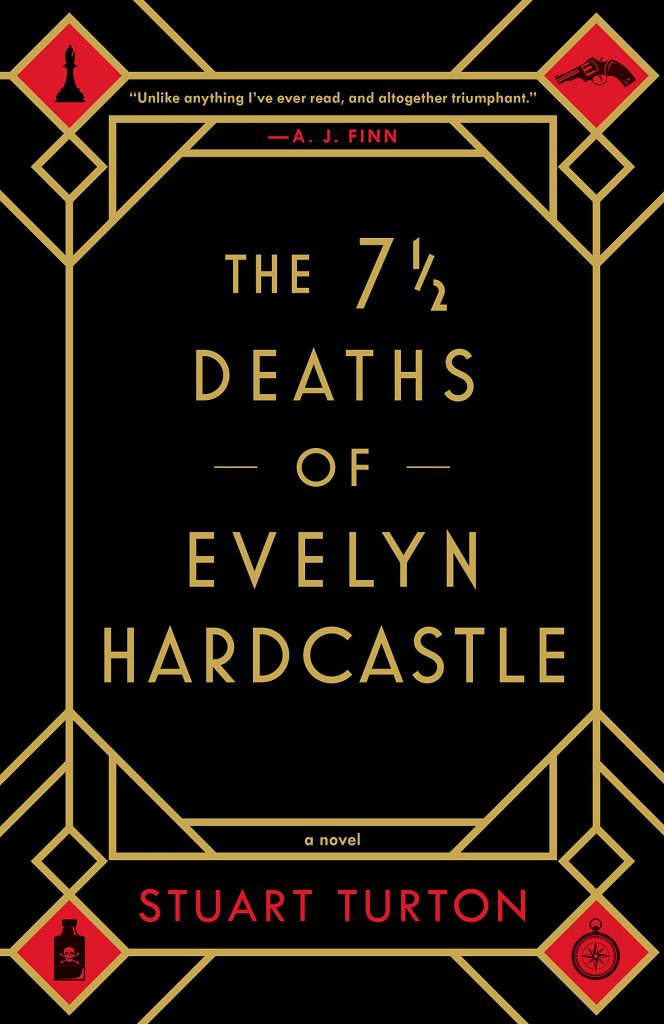
When Sourcebooks brought Stuart Turton’s The 7 ½ Deaths of Evelyn Hardcastle to the U.S., they knew they would have to make a splash with early readers to get this debut novel the attention it deserved.

On NetGalley Insights, we highlight the successes of our publishers and share some of their strategies with you in case studies. Today, we’re bringing you an inside peek at how one of the most data-centric publishers uses early metrics to turn their books into successes, first on NetGalley and then in the market. By using data to activate an advanced-reading audience, Sourcebooks turned  7 ½ Deaths into one of the most successful titles on NetGalley in all of 2018 in addition to landingit on multiple year-end lists. It’s due out in paperback on May 7.

Valerie Pierce, Marketing Director at Sourcebooks, shares her strategies below:


The 7 ½ Deaths of Evelyn Hardcastle is a debut novel. How did that factor into your overall marketing strategy?

Because The 7 1/2 Deaths of Evelyn Hardcastle was a debut, we knew that we needed to launch this title in a very visible way, and we needed to do it very early on. The book came out in September [2018], and as many of us know, that is a very busy month with lots of book releases! Our plan hinged around breaking through the noise by building excitement amongst the industry (media, booksellers, librarians, and bloggers) as well as creating direct-to-consumer engagement. We were able to use strategic trade and consumer advertising campaigns that drove people to sign up for the galley (digital and/or print), and this really helped us create a database of people who were interested in the book. We were able to then go back and retarget those people.

We were very fortunate with this debut because we had an intriguing title, an incredibly unique premise, and an amazing cover. We were conscious of using all of those elements in every piece of marketing. When you ask any reader if they’re interested in an Agatha Christie mystery, with a Groundhog Day loop and a dash of Quantum Leap, you get the reader’s attention 99.9% of the time!

How did your data-driven framework guide this campaign and put The 7 ½ Deaths of Evelyn Hardcastle on best-of lists from the Guardian and Harper’s Bazaar?

The most important element of a marketing campaign is ensuring that your messaging is on pointe. We did start with great messaging, but we also tested a variety of other options, and then constantly looked back to see what performed at the highest level. Honing in on what worked and dropping what didn’t work was key to helping us create success for The 7 ½ Deaths of Evelyn Hardcastle.

Honing in on what worked and dropping what didn’t work was key to helping us create success for The 7 ½ Deaths of Evelyn Hardcastle.

Which metrics were most important to you and your team, and why?

We have a few key lists that we look at to determine how the pre-publication promotions for a book are performing:

  • Number of leads we capture from advertising campaigns
  • Number of clicks our ads receive
  • Number of NetGalley requests
  • Number of NetGalley cover votes
  • Number of Goodreads to-reads
  • Number of Edelweiss downloads
  • Number of reviews
    • Indies: Indie Next nominations
    • Libraries: LibraryReads nominations

Advertising early on is really important because it shows us how much interest the publishing industry and consumers have. We set a goal for the total number of clicks and number of leads we hope to get from each ad. Once the ad has deployed, and we have our results, we compare them to:

  • Our goals for the book
  • Past performance of our in-house comp titles
  • The average CTRs the advertiser generally receives for specific ad spots

If the number is low, we know we have to stop what we’re doing and completely re-strategize. If the number is average, then we look at ways that we can improve them. And if the number is higher than we anticipate, then it not only means that we’ve got a winning strategy – it also means that this might be a title to pour additional resources into. This could include going back to the sales team and asking them to go back out to their accounts, reallocating budget money so that we can fund more advertising, and going back out to media.

How did you use NetGalley reporting during and after the campaign for  7 ½ Deaths? How did you engage with members who requested access?

We love using NetGalley reporting as an early indicator for the success of titles! First off, when you see a really high number of NetGalley requests, you know that you’ve captured the readers’ attention, which is always the first hurdle. The second metric you look at is the number of downloads vs. the number of reviews, Once people downloaded the book, did they actually go and read it? Did they feel compelled to leave a review? And how much time elapsed between the initial download and the review?

The next thing we do is we look at the language that people use in their reviews. If there are terms that are being used by multiple reviewers, then we look at incorporating that into our marketing messaging.

We absolutely engage with members who requested access. For booksellers and librarians, if we’ve noticed that they have downloaded the galley but not reviewed it, we’ll send them a quick email with all of the great blurbs/reviews we already have and ask them if they’ve had a chance to read the book yet.

For consumers who submitted positive reviews, we’ll ask them to post their reviews anywhere and everywhere they can around pub day.

Which segments of the NetGalley community have been most important to you and why? How do you go about reaching them?

Honestly, I think each segment is important, but each book and each campaign is just a little bit different. Depending on the campaign you’re running, the segment that will have the most impact might change. For The 7 ½ Deaths of Evelyn Hardcastle, booksellers and librarians were a huge part of the initial push. We always include NetGalley links in all of our B2B newsletters. It’s absolutely vital that we give bookseller and librarians an opportunity to click over and download a galley right away.

We put this eGalley up extremely early so that we could reach them first, and use their amazing reviews to go back out to media and consumers.

How did your NetGalley marketing strategy differ from other marketing or advertising efforts you put forward?

The biggest difference is the way that NetGalley is structured. They have a list of dedicated readers, and they have an online platform that allows those readers to easily download a digital galley and then review it. A lot of our other marketing and advertising efforts involve driving readers to a landing page that we’ve created, or a page that the advertiser created.

NetGalley is also great because you can see an immediate result once you’ve sent out any advertising through them. Either you significantly increased your number of downloads, or you didn’t!
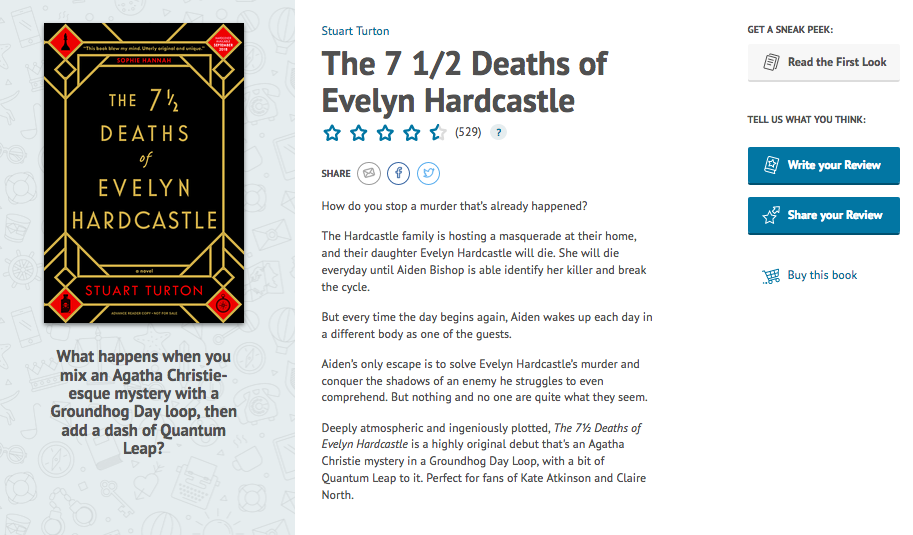
You ran a raffle on BookishFirst for The 7 ½ Deaths of Evelyn Hardcastle. What insights did you learn from or about the consumers who participated in that raffle?

More than half of the people who participated bought more than 20 print books per year, which tells you that BookishFirst has tapped into avid readers.

I did learn that there were definitely some librarians on that list, which is great! I had a couple of librarians approach me at a trade show and tell me that they’d tried to get a copy of 7 ½ Deaths of Evelyn Hardcastle through the raffle, and that they were disappointed when they didn’t win. It’s great to see how excited readers are to win a book through this offering.

Overall, I think the raffle is really brilliant. Since readers have to read an excerpt of the book before they request to enter the raffle, you know that you’re reaching the right reader for your book. The raffle is also especially helpful because BookishFirst really makes sure that the people who receive the books go and send in a review, which we love.

The reporting we received from BookishFirst was very helpful. It was great to know that more than half of the people who participated bought more than 20 print books per year, which tells you that BookishFirst has tapped into avid readers. And most avid readers are mini-influencers; they tend to be the people who tell their friends what books to read next, For this book in particular, a lot of readers had a very strong interest in YA, which is not something we would have thought about on our end. It’s always fantastic to learn information that can help you target a new audience.  


Interviews have been edited for clarity and length.

Read the rest of our case studies here for more successful strategies.

Bio: Valerie Pierce is the marketing director, retail marketing and creative services, at Sourcebooks, an independent publishing company. For the past 8 years she has helped lead the Sourcebooks marketing team, doubled the size of the retail marketing staff, worked directly with Indie booksellers, initialized email marketing campaigns, helped relaunch imprints, created trade show strategies, and managed title plans across all imprints. She has worked on bestsellers and Indie Next Picks such as The Readers of Broken Wheel, The Paris Architect, The Only Woman in the Room, and The Radium Girls. When she is not promoting books, Valerie can most likely be found reading them.


Divider

Beyond the Book with Women’s Media Group

How Authors, Publishers and Agents are Developing New Revenue Streams

To help their authors make a splash and to stay financially viable, publishers are on the hunt for additional revenue streams. They’re launching ad-supported podcasts with authors as experts, teaching online courses, partnering with brands, and more. And last week in Penguin Random House’s Maya Angelou Auditorium, Women’s Media Group gathered several heavy hitters who have track records helping authors in this arena. The panelists discussed developing content that audiences want while maintaining an authentic feeling of connection. Here’s a taste of what they covered:

Pay attention to your audience at all stages

Christy Fletcher, founder of Fletcher & Company, described her approach to creating new revenue streams for her author clients as creating a “noisy, robust launch while listening closely to the audience.” This means paying attention to what platforms they are using, what questions they are asking, and what other media they are consuming. Then, she is better able to amplify the work her authors are already doing and give that audience new material that they will enjoy.

Kathy Doyle, VP of Podcasts at Macmillan rigorously researches before committing seriously to a new venture. Before she started working with Ellen Hendricksen on what would become The Savvy Psychologist, Doyle and her team had already conducted a study to determine that psychology was of interest to their pre-existing audience. With that audience insight in place, she was able to confidently launch a new project with the assurance that there was an audience waiting for that content.  

But the research doesn’t stop there. Doyle advised the audience to keep track of podcast appearances or online tutorials in a marketing and publicity calendar so that when publishers see a spike of interest, they can better trace it back to specific timing and strategy and replicate it in future efforts.

Scaling intimacy

During the Q&A, audience member Leah Siepel, founder of Leah Siepel Courses asked the panel about scaling intimacy with larger online courses. She told the audience that in her own work building online courses for clients, courses with higher degrees of contact between the educator and the audience led to higher course completion rates. She wanted to know how to build bigger audiences without sacrificing the personal attention that leads to greater end-user satisfaction. The panelists all agreed that this is a challenge when growing audiences, and that successful online courses must be more engaging than a video of someone talking for 30 minutes.

Christy Fletcher described how she and Gretchen Rubin tackled this issue for The Happiness Project Experience, an immensely popular year-long course with a waiting list. They created smaller groups of participants within the wider course, using a cohort-based model with monthly modules and live call-ins to help members feel more connected to each other and to Rubin. Moderator Stephanie Bowen suggested filming lessons in front of a live audience to help viewers feel more like a part of an active learning community. Bowes suggested working with a company like Creative Live. Joan O’Neil, Vice President at Skillsoft Books, incorporates visuals to give online courses more of a Ted Talk feel. With options like live call-ins, production companies creating live lessons, and more, it’s possible to create truly dynamic and engaging online courses that resonate with viewers.

Podcast revenue model changes

Kathy Doyle described the changes that are happening in podcast advertising. Currently, most podcasts use live-read ads where hosts read ad copy for a product. This method capitalizes on the intimacy that podcast listeners feel when they hear a host speaking directly into their ears. Ads read by hosts feel like recommendations from a friend. However, as Doyle noted, the process of matching podcasts to products to create natural-sounding ads is both highly manual and highly time-consuming. Plus, podcast listeners are quick to recognize when an ad doesn’t sound natural or doesn’t fit with the host’s brand. Podcasts are beginning to go the way of digital advertising more broadly, which is to say programmatic. Increasingly, brands will be able to buy podcast audiences rather than listeners to a specific show. Programmatic advertising is show-agnostic, meaning that it will be able to, for example, target young urban parents who are likely to purchase a meal kit subscription rather than all listeners of The Racist Sandwich.

With any effort to build in new revenue streams or platforms for authors, the key is to listen to what their audience wants and to provide an engaging and authentic experience.

Speakers

  • Kathy Doyle, Vice President, Podcasts, Macmillan Publishers
  • Christy Fletcher, Founder and CEO, Fletcher & Company
  • Joan O’Neil, Vice President, Skillsoft Books
  • Moderator: Stephanie Bowen, Senior Manager, Publishing Development & Author Platforms, Penguin Random House

Women’s Media Group, founded in 1973, is a New York-based nonprofit association of women who have achieved prominence in many fields of media. Their 250-plus members, drawn from book, magazine, and newspaper publishing; film, television, online and other digital media, meet, collaborate, inform and support one another as well as mentor young women interested in publishing careers. They seek to advance the position of all women through the power of communication and media. Find out about their upcoming events here.

Divider

Developing a data strategy with the DIKW Model

We all know that data matters. But for publishers looking to become more data-savvy, it can be hard to know where to start, especially when we are often dealing with qualitative data. Which metrics are important? How do you incorporate data collection and analysis into your workflow? Finding yourself with a glut of data and no real way to interpret or incorporate it isn’t much better than no data at all.

Frameworks for data collection and analysis can help. They provide structuring principles to guide publishers who are developing a data strategy. One that we’ve been thinking about since we attended the Firebrand Community Conference is the DIKW model.

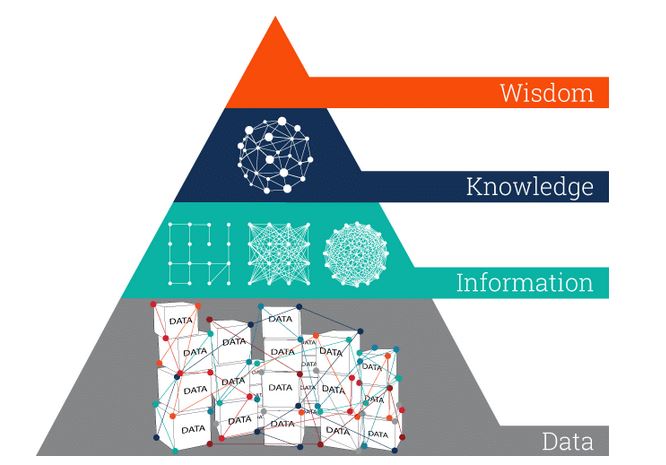
DIKW stands for Data, Information, Knowledge, Wisdom. The pyramid structure represents a process of refining raw data into actionable insight.

Data refers to information in its raw form. This broadest and lowest tier of the pyramid represents the whole glut of information that’s available to you. In this system, data has no context, but is readily available. It needs to be interpreted.

Information begins the interpretation process by putting that information in context. This might mean answering the who, what, when, where, and why’s of the data from the first block of the pyramid.

Knowledge puts the information you have in context. It might link the information you’ve already gained earlier in the pyramid to other pieces of information or take into account trends or events that happened around the same time as the pieces of information were gathered. This block of the pyramid looks at how the information you have fits into a more global view of a project or an industry.

Wisdom, at the top of the pyramid, is what you do with the knowledge you have. Wisdom determines the path forward given the ways you have interpreted the data. Ultimately, when publishers say that they want to be data-driven, they mean that they want to get to this point of the pyramid, where their next steps are guided by data insights.  

Let’s see this in action with a famous literary example.

  • Data: 031544
  • Information: This is a date – March 14, 44 BCE
  • Knowledge: There was a prophecy (at least in Shakespeare’s Julius Caesar) to “beware the Ides of March.”
  • Wisdom: If you’re Caesar, consider calling in sick to the Senate.

Now, let’s put it in terms of the information available to publishers within their NetGalley accounts.

  • Data: 589, 82018, 2304, 011819
  • Information: 589 and 2304 are impression counts for two different titles, Title A and Title B. 82018 and 011819 are the dates that each of the titles went live on NetGalley. Title A went live on August 20, 2018 and Title B on January 18, 2019.
  • Knowledge: Both titles were listed as Nonfiction (Adult) and Biographies & Memoir in NetGalley. The publisher booked an eblast for Title B that went out to all NetGalley members who are interested in the Nonfiction category.
  • Wisdom: By comparing two similar titles that fared differently on NetGalley, we can see two differences immediately. Title A was put on NetGalley in the end of summer when many members are on vacation, meaning that they might be less likely to be at their computer requesting new titles to read. The publisher might consider putting titles up earlier in the summer so that members can read them on vacations, or later in the fall when business-as-usual has resumed. Additionally, we can see that booking an eblast seems to have had a huge effect on impressions, which can help the publisher determine where to best spend ad dollars in the future.

The DIKW paradigm isn’t the end-all, be-all of data-centered decision making. Some critics have pointed out that the pyramid is too rigid and hierarchical. We certainly see their point, and recognize that flexibility is a crucial aspect to successful decision-making.

DIKW is best thought of a starting point – a structure that can be tweaked. It’s a way to begin to think about what data points you as a publisher need to be collecting, what context will help make those data points meaningful, and how you can take that information with you into the future. For publishers who are in the process of asking themselves what it means to be data-driven, the DIKW pyramid is a great place to start.

Divider