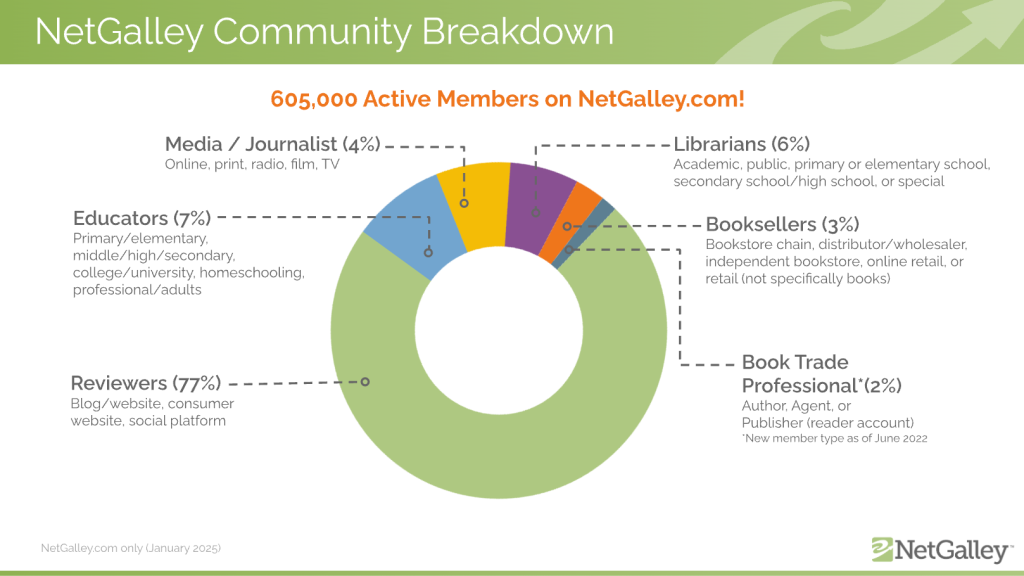
Update: 680,000 active members, as of October 2025.
Unless otherwise noted, all information is based on the Annual NetGalley.com Member Survey, conducted January 2025.
Each year we ask NetGalley members to tell us more about their reading habits and preferences, and this year more than 11,000 highly-engaged reviewers, booksellers, librarians, educators, media/journalists, and book trade professionals answered the call. We are thrilled to share the latest update with you, and invite you to view the full report, which includes tips for engaging with specific segments of the community.
When we say NetGalley’s 605,000 active members are highly engaged, we mean it! NetGalley.com saw a record-breaking 11 Million pageviews in January 2025 alone, representing a 4% increase YOY, and all stats from Requests to Feedback submitted have grown by the thousands.
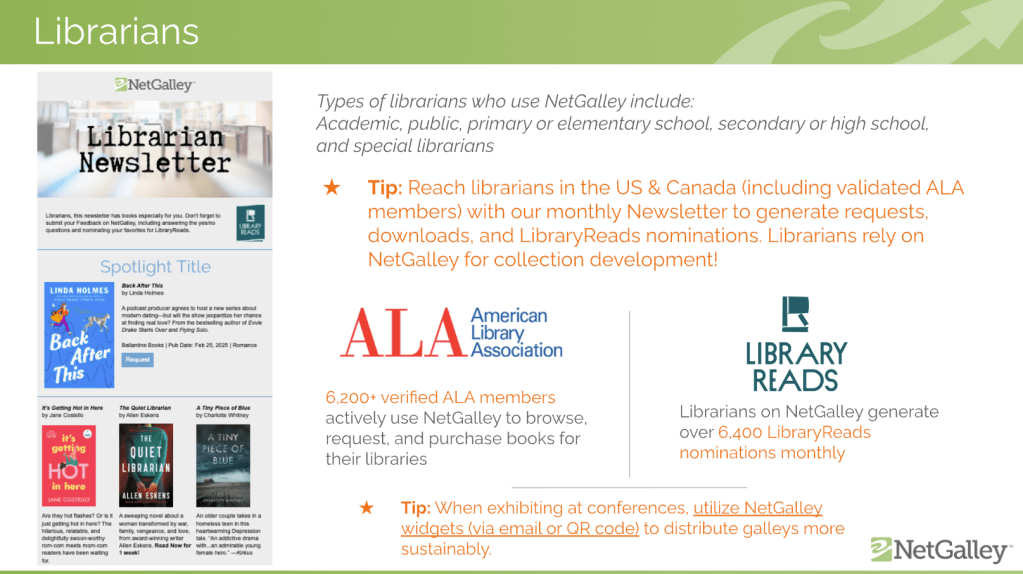
BooksellersMedia/JournalistsLibrarians
Activity on NetGalley is a funnel, which means that the more Impressions a book has, the more overall activity it will receive. Once members submit Requests, it’s up to the publisher to Approve requests so they can start to read. Depending on how many requests the publisher approves, a portion of them will result in Feedback.
Audiobooks continue to have an extremely strong Feedback Rate! 59% of members approved to listen also submit Feedback via NetGalley.
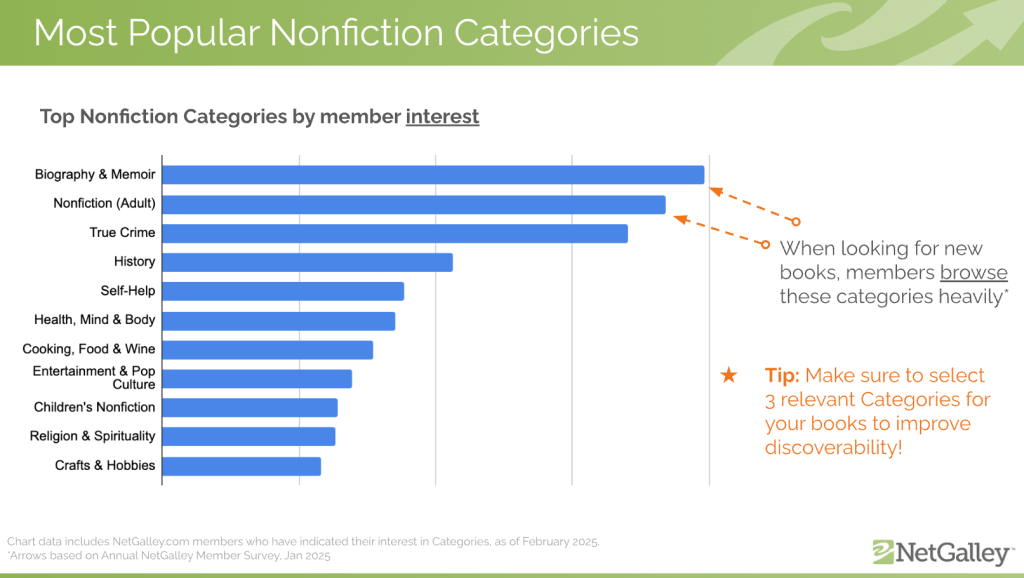
Click through on the images above to see more detail about the most popular Fiction and Nonfiction Categories that NetGalley members browse!
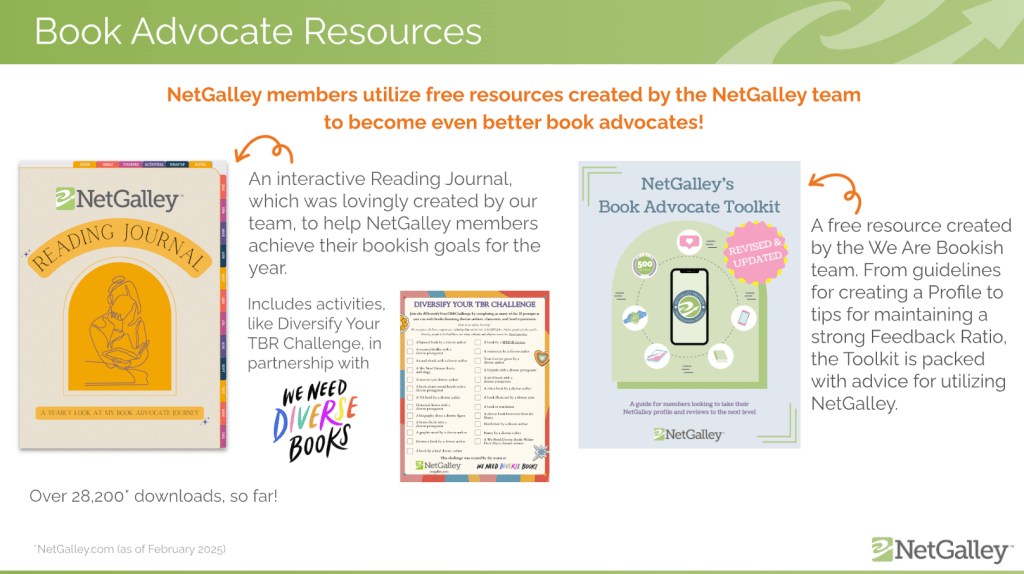
NetGalley’s Community Growth & Engagement team is always hard at work encouraging NetGalley members of all types to become even stronger advocates for publishers’ books. Free resources like NetGalley’ Reading Journal and the Book Advocate Toolkit give members the tools they need to track their reading, submit valuable Feedback, and spread the word about the books they’re reading. Browse all of the resources, including Book Club Kits, on NetGalley.
Sustainability has long been a hot topic in the book industry. With an environmentally savvy consumer market and labor force composed of people who want to make the world a better place, it only makes sense that publishers would lead the charge on sustainable practices. Sadly, this has not always been the case. Now, with rising costs of production, looming tariffs, and much uncertainty in the market there is no better time to face challenges head on and look for solutions wherever they can be found.
Those solutions are often found globally. The Green Book Alliance (GBA), a collaboration across Book Industry Communication (BIC) in the U.K., BookNet Canada, and the Book Industry Study Group (BISG) in the U.S., has been sharing sustainability resources and findings for five years. Brian O’Leary, executive director of BISG, told us “Environmental issues don’t know borders. As the largest publishing market in the world, what happens in the U.S. has an outsized impact on the industry and the world.”
Photo by Katrin Bolovtsova
No doubt geographic and geopolitical disruptions will continue to impact the book world this year. Publishers and partners will be discussing ways in which they can reduce costs, speed up production, and align with environmental solutions. NetGalley will be tracking these discussions at conferences and, importantly, demonstrating at least one proven and reliable way to help publishers and book professionals reduce their carbon footprint: Digital Review Copies.
For a book community that has been hungry for strong voices and authentic commitments to save the planet, perhaps this is the year we are ready for real leadership. We’ve all seen the industry slip backward into pre-pandemic practices of sharing physical ARCs instead of digital or audiobooks, all while regarding conference galley rooms with a bit of dismay.
“We as publishers need to push them to realize that this is a problem not only for the environment, but for the supply chain as well… It is a not good for bookstores, publishers or authors (who don’t earn a royalty from third party sales) that these pre-market [print] copies are out there.”
“One of the most impactful ways to improve sustainability is to NOT print ARCs or galleys. Digital galleys are just fine, and in fact, better for the system overall. During the pandemic, many reviewers were accepting DRCs, and we were really hopeful that that would stick. Unfortunately, many reviewers are reverting to their old systems of stacks of ARCs on their desks or in the galley room, instead of cataloging DRCs. We as publishers need to push them to realize that this is a problem not only for the environment, but for the supply chain as well. Those printed ARCs get picked up by the third party sellers on Amazon, who sell them for less and win the buy button. It is not good for bookstores, publishers or authors (who don’t earn a royalty from third party sales) that these pre-market copies are out there.”
Environmental impact at various moments throughout the supply chain is urgent for publishers to continuously acknowledge and make effort to minimize. O’Leary points out, “BISG’s work helps show how actions in one part of the supply chain play out across the industry. Content creation has become fundamentally digital, but we’re not always taking advantage of the opportunities digital provides.”
With a proactive commitment to LCP, a brand new NetGalley Reader, and audiobook early-listening solutions, NetGalley is a proven alternative to print review copies. It’s not just about amplifying our own product. It’s about providing answers to practices that are not only out of fashion, but out of step with our industry’s values. Not only are book files safe and secure thanks to the most up-to-date technology, publishers also benefit from fast, easy tools to distribute digital review copies far beyond the typical reach of print.
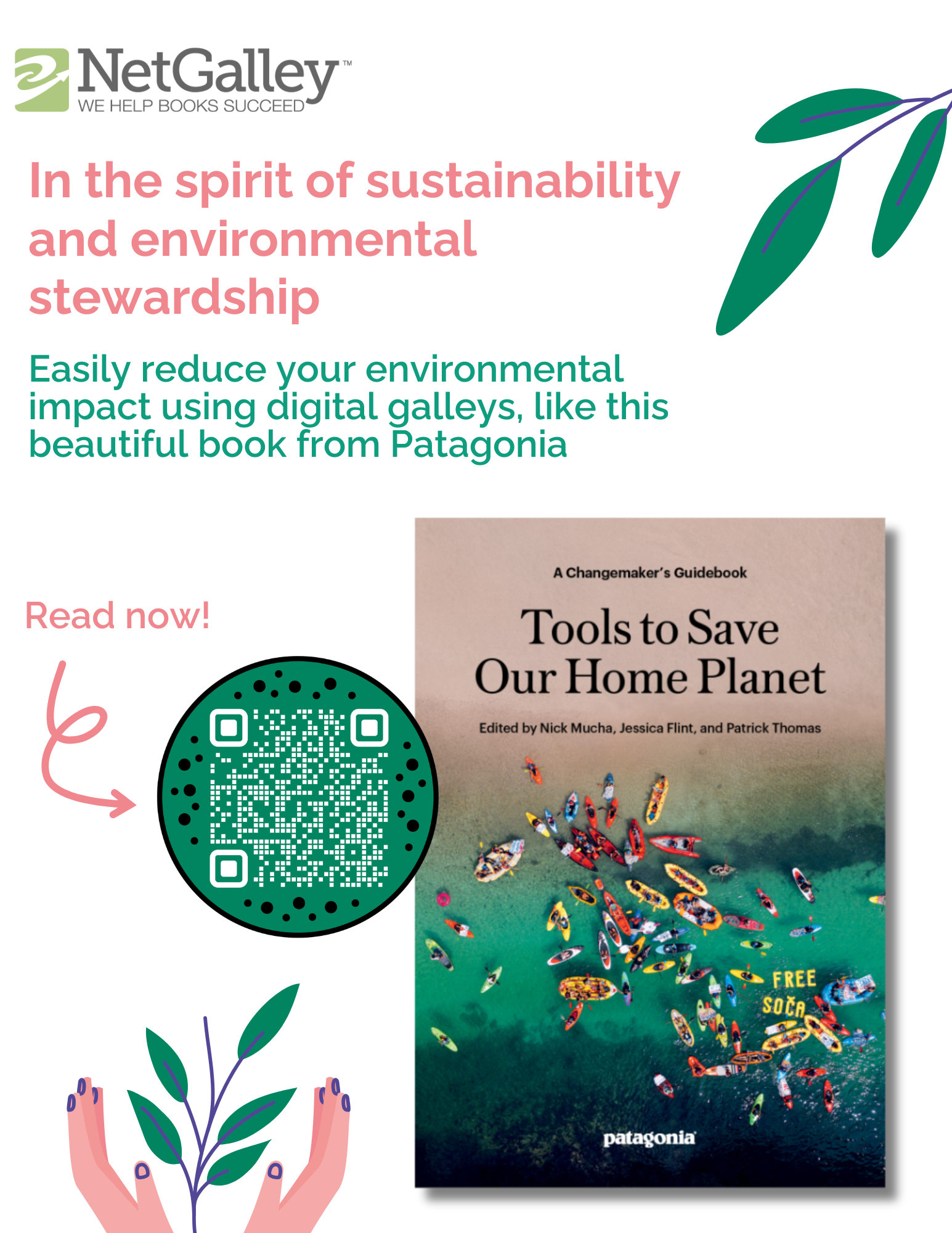
Let’s take a chunk out of the galley room and replace tables lined with paper, ink, and cardboard boxes with QR codes and directions for how and where to access digital review copies and audiobooks. We’re here to help!
With a proactive commitment to LCP, a brand new NetGalley Reader, and audiobook early-listening solutions, NetGalley is a proven alternative to print review copies. It’s not just about amplifying our own product. It’s about providing answers to practices that are not only out of fashion, but out of step with our industry’s values.
This article will be updated during the 2025 conference season with feedback from reviewers, publishers, and partners.
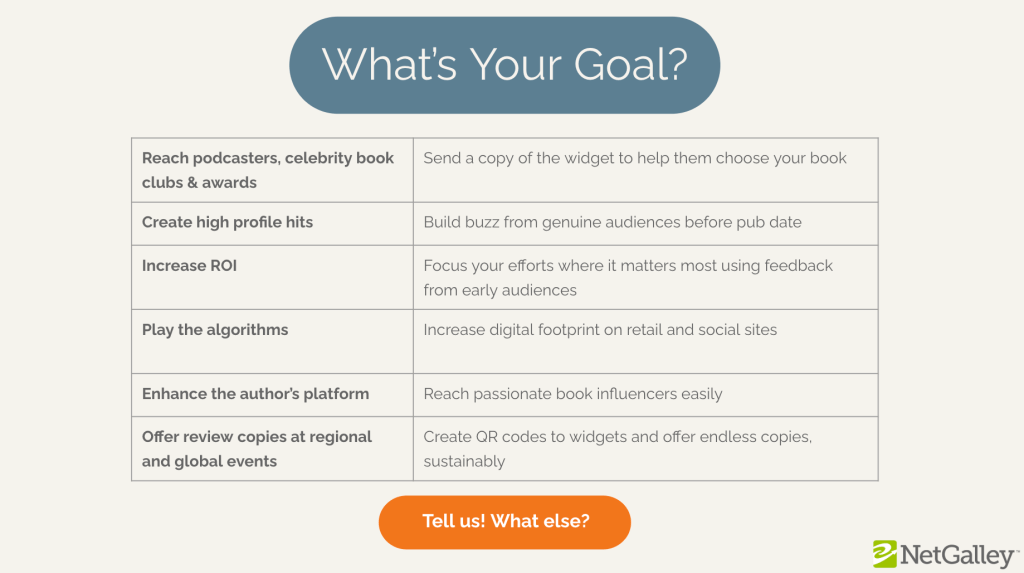
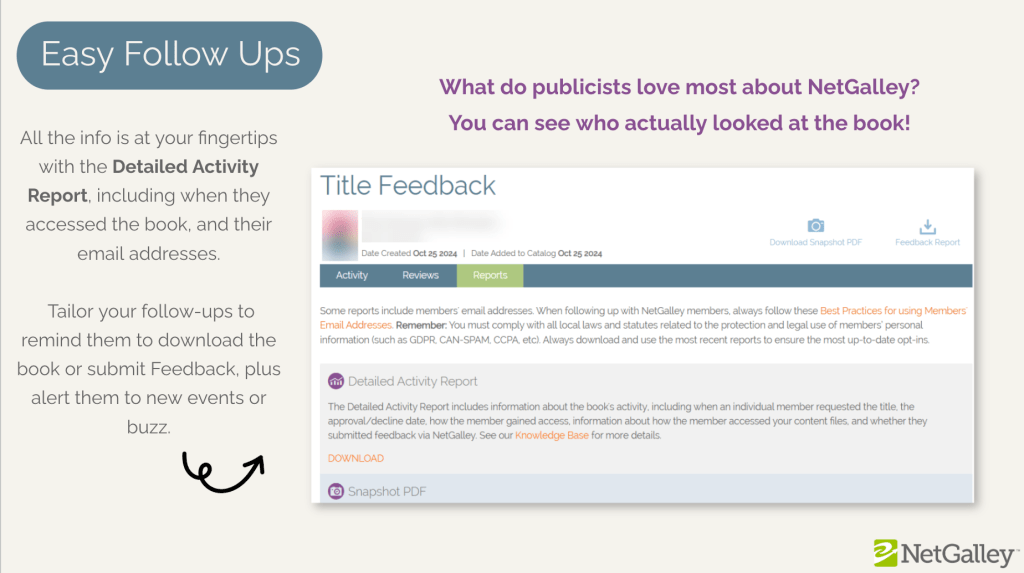
Check out our Tips for Publicists for actionable strategies, from pitching to follow-up to reporting, designed to increase the efficiency and effectiveness of the work you already do!
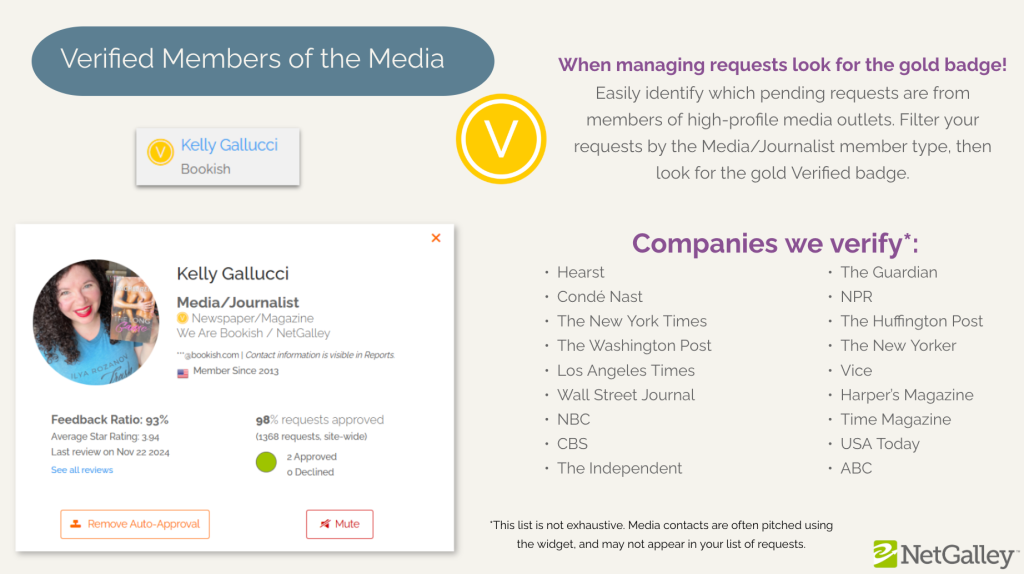
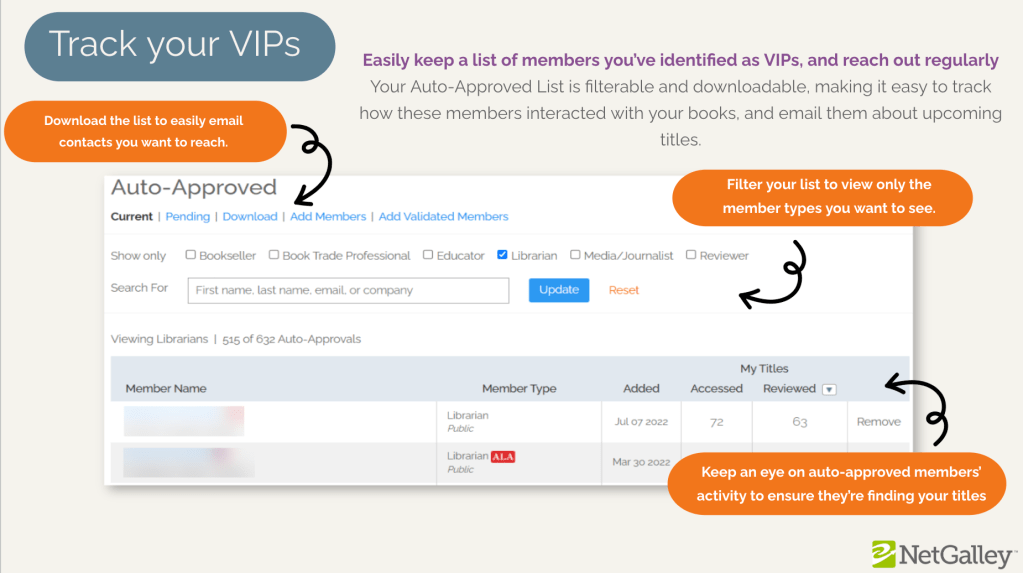
Verified Members of the MediaTrack Your VIPsEasy Follow Up
Plus, watch the 2-minute video, Influencer Marketing & Beyond, for 3 quick ways to incorporate NetGalley into your efforts, no matter where you find your audience.
Newburyport, MA (January 29, 2025)—NetGalley, LLC—the industry-standard digital galley and marketing platform, and a strategic part of the Firebrand Group collection of companies owned by Media Do International (MD-i)—announced today a major upgrade to its Reading Options, which includes the launch of the new proprietary NetGalley Reader and introduces LCP-protected downloads to the NetGalley platform. The global upgrade is now live across all NetGalley domains in the United States, United Kingdom, Germany, France, and Japan.
The new NetGalley Reader, built by NetGalley’s in-house engineering team, offers industry-best digital content protection on the web. Utilizing a proprietary digital content protection system designed by seasoned DRM researchers at NetGalley, it combines sophisticated cryptography techniques to lock digital content to specific users and devices, with a front-end UI layer to restrict attackers’ abilities to lift decrypted content from the browser.
Providing a quick and secure reading experience in web browsers with a single click, the NetGalley Reader is the fastest possible way for NetGalley members to start reading their approved books—with no need to leave the NetGalley website, download any files, or use an external device. At launch, the NetGalley Reader supports ePub- and PDF-formatted ebooks. Members will continue to use the free NetGalley Shelf app (iOS and Android) as the exclusive way to listen to audiobooks.
As part of ongoing security efforts, NetGalley has also made adjustments to the “Download” Reading Option, replacing the older Adobe DRM with EDRLab’s Readium Licensed Content Protection (LCP). NetGalley files have been protected with LCP in the NetGalley Shelf app since it was launched in 2020, but with this upgrade, NetGalley members can now download and read files on any LCP-supported device or app.
“We’re committed to making books easily and securely accessible to NetGalley members, however they like to read,” said Firebrand Technologies and NetGalley, LLC Chief Technology Officer Tom Shawver. “This major upgrade expands our Reading Options to allow for a seamless in-browser reading experience, while also strengthening our partnership with EDRLab to offer portable, Readium LCP-protected downloads. We’re thrilled to pull from our extensive experience to create a simple and convenient reading platform for our community, and a first-of-its-kind content protection solution for our publishers.”
About NetGalley, LLC NetGalley helps publishers and authors promote digital review copies and audiobooks to book advocates and industry professionals. Hundreds of thousands of members rely on NetGalley’s secure, sustainable, and easy-to-use platform to discover books, share reviews, and champion literacy. The NetGalley team coordinates closely with publishers on targeted promotions, and provides training, strategy, and consultation for incorporating NetGalley into overall marketing and publicity efforts. NetGalley is a strategic part of the Firebrand Group collection of companies owned by Media Do International (MD-i) which together provide leading software and services to help publishers succeed. To learn more, visit netgalley.com/tour.
About Media Do International (MD-i) Media Do International (MD-i) owns the Firebrand Group, a collection of companies including Firebrand Technologies, NetGalley, LLC, and Supadu Ltd. that provide leading software and services to help publishers succeed. MD-i is itself the US-based subsidiary of Japan’s Media Do Co. Ltd, one of the largest ebook distribution companies in the world retaining the largest share of Japan’s ebook market. Media Do Co. Ltd.’s mission is to make more content available for more people. To learn more, visit mediado.jp/english.
Guest post by Emily Lyman, CEO & Founder of Branch & Bramble
As book communities grow and develop, their expectations for publishers evolve with it. According to the 2025 Edelman Trust Barometer, overall trust has declined significantly, particularly trust in businesses. With people increasingly distrustful, this makes cultivating brand trust difficult, yet more important than ever before.
Luckily, the key to achieving trust and preventing backlash or boycotts is simple (but definitely not easy): empathetic marketing. This approach is a complete game changer with how you engage with readers, ensuring you stay relevant and achieve your sales goals.
What is Empathetic Marketing?
At its heart, empathetic marketing recognizes, understands, and appeals to the role that emotions have in the decision-making process. Neuroscientist Antonio Damasio famously said, “We are not thinking machines that feel; rather, we are feeling machines that think,” so it only makes sense that emotions would drive our buying behavior. However, too often, marketers across industries overlook the emotional motivators and focus solely on data—instead of effectively marrying the two.
For publishing, this means readers don’t just expect quality books—they expect publishers to align with their values, show transparency, and engage authentically. Book communities are vocal and interconnected, and they’re going to speak the loudest for brands that share their ideals. Publishers who cannot meet these expectations risk losing trust and their ability to remain competitive across widespread demographics. By practicing empathetic marketing and connecting with readers on an emotional level, publishers make genuine relationships that create lifelong fans.
Emotional Motivators for Connection
At the heart of empathetic marketing lies a deep understanding of emotional motivators. Readers aren’t just here for the books—they’re looking for an experience that resonates with them on a deeper level. They’re not reading dragon books just because they want a pet dragon—they also long for the relationships, community, and self worth the main characters develop along the way.
Knowing this, publishers can craft marketing campaigns that feel personal and purposeful. For example, instead of focusing solely on a book’s content, a campaign might highlight the themes of found family or the immersive setting of the story. An in-person activation is a great way to bring books to life in ways that are meaningful and marketable.
Putting Empathy into Action
Empathetic marketing isn’t just a concept—it’s a practice that publishers can start implementing right this minute. Start by listening to your target audience. Pay attention to reviews, social media conversations, and content that resonate most with your audience. Studies show that even the best marketers can have empathetic blind spots, so it’s important to view this as more than data gathering. It’s about understanding the values and emotions that drive their decisions.
Next, shift the focus of your storytelling throughout your marketing materials. Instead of centering your marketing around a book, share what kind of reading experience your audience can expect to have with the title. How will this story make them feel? How does it reflect their experiences or open their eyes to completely different points of view? If a reader can see themselves in your messaging, they’re more likely to connect, engage, and ultimately convert.
Finally, make engagement simple and meaningful. Whether it’s through a preorder incentive, an interactive newsletter, or a community-focused event, give readers clear and compelling ways to connect with your brand in a manner that will mean something to them. Forget a cheesy tchotchke (although everyone still loves bookmarks) and instead cultivate an experience that aligns with values data you’ve collected. These engagement efforts don’t have to be big to build trust—even small actions cultivate profound loyalty.
With BookTok and other marketing channels hanging in the balance, practicing empathetic marketing is crucial for publishers who want to survive and thrive. By recognizing the power of emotions in decision-making, aligning with reader values, and building meaningful connections, publishers can build trust that lasts and sells books.
Emily Lyman has spent a decade working in-house with global publishers such as Penguin Random House and Simon & Schuster managing both corporate and title marketing initiatives. Today, she is the CEO and Founder of Branch and Bramble, an award-winning marketing agency for lifestyle brands.
Emily’s specialty is in blending data with heart and values to create meaningful audience connections for my brand partners which include Patagonia and Paramount. She’s worked with companies with household names to individual authors just trying to get their books out in the world.
Publishing professionals from across the industry descended on Nashville, TN at the end of September to attend the Publishing Innovation Forum, hosted by the Firebrand Group. This premier in-person event was designed to unite individuals from various segments of the book publishing industry to share insights, explore new trends, and discuss strategies to adapt to a rapidly evolving publishing landscape. With approximately 150 participants, the forum encouraged collaboration and innovation, ensuring attendees gain valuable knowledge and connections to drive future success in the industry. Expert keynote presentations, and three dedicated breakout tracks for Business, Technology, and Marketing, resulted in lively conversation and important takeaways. For our audience at NetGalley Insights, we have collected some key themes and tips from the highly experienced speakers.
Attendees at the inaugural Publishing Innovation Forum, 2024
Session: Innovations in Book Promotion: Publicity Trends That Move the Needle
Speakers: Kimberly Sneed (Digital Media Director, PR by the book) and Marika Flatt (Owner, PR by the Book)
Kimberly Sneed and Marika Flatt of PR by the Book kicked off this session by explaining that the goal for publicity efforts is to drive author and book recognition, visibility, and overall exposure. The wider the name recognition in the world, the greater chance that book and that author have to build and grow. Exposure is extremely important in early promotional efforts because you are planting seeds for a long trail that follows, even into the backlist. Some important avenues for modern publicists to focus on include:
Podcasts: There are hundreds of thousands of podcasts available. Find the right ones in both subject matter and audience for your individual authors.
NetGalley and other platforms: Maximize title pages on every platform to include assets like videos, advanced praise, author pages or social media, etc.
Social Media: Both presence and promotion matter. Identify and engage with niche, micro audiences, prioritize authenticity, align your messaging with their values.
Immersive Storytelling Techniques: Design “expert” pages for your authors, create additional materials like exclusive content, serialized content, short videos, and adjacent narratives to drive engagement and customize media outreach.
One size does not fit all in book marketing and publicity. Step outside the box and don’t be afraid to try something new! No matter what, always connect and build on what you have. Sneed’s and Flatt’s approach is centered on flexibility, experimentation, and working closely with authors to tailor strategies to individual needs and audiences.
Session: Influencers vs. Community: Strategic Activation for Your Book Campaigns
Speakers: Sarah Walsh (Brand Strategist, Branch & Bramble) and Hallie Fields (Social Media Assistant Manager, NetGalley)
Each speaker presented two distinct yet powerful marketing approaches: Sarah Walsh highlighted influencer campaigns, while Hallie Fields emphasized community-driven campaigns.
Walsh showcased how partnerships with influencers can boost brand awareness, leaning on examples like #marcreadsabook and HarperCollins’ #shelvesinthecity. These examples demonstrated the importance of personalized and trend-focused initiatives. It’s important to note that these campaigns were certainly in the high-budget realm; however, there are lessons to be learned from these exciting campaigns that even a publisher with a smaller budget should keep in mind:
Jump on trends and interact with followers as part of the community, not an administrator or organizer.
Consider the best type of influences to engage. Micro influencers can have big engagement numbers.
Give influencers time and opportunity to tell their stories. Bring them to beautiful spaces, or give them Instagrammable assets.
Form ongoing partnerships, not just one-off posts, which allows the influencer to create ongoing content that is more organic and authentic.
Fields focused on examples from Camp NetGalley, a community-based challenge campaign, and #MyNetGalleyYear, an annually recurring checkpoint campaign. These examples encourage user-generated content (UGC) by asking audiences to complete a task and share it with their followers. These campaigns allow you to engage with, and unite, the entire community, and allow you to secure your brand’s place in a recurring social landscape.
Know your community. At NetGalley, we know our members love fun, nostalgic, interactive experiences, so we built Camp NetGalley with that in mind.
Prizes can be simple and digital! In the case of Camp NetGalley, it was a digital badge members can share, and which appear in their NetGalley accounts. For #MyNetGalleyYear, a template we created for them makes it easy for them to brag about everything they’ve read.
UGC is excellent to share back to your community, help them feel involved, and take some load off your own content creation.
Consider creating campaigns that can be recurring, which gives the community something to look forward to.
Both strategies – influencer campaigns and community engagement – underscore the importance of creating meaningful, relatable experiences that resonate with audiences, while maintaining authenticity and connection.
Session: Book Marketing at Any Budget
Speakers:
Kim Lauber (Vice President of Marketing at Abrams)
Ashley Marie Mireles-Guerrero (Director of Sales and Marketing at Familius Publishing)
Allison Marie Pond (Director of Marketing at Mad Cave Studios)
Jin Yu (Director of Marketing at Berkley/PRH)
It was exciting to see these top leaders from across the publishing spectrum in one space, delving into practical approaches for maximizing impact in the marketing, publicity, and advertising spaces. The collective in-house wisdom from publishers large and small, who publish across many diverse categories, was too vast to fully cover in this short article, but here are a few key points:
Know your audience: Identify where the niche is, where and in what format they will buy, speak to them directly, customize your metadata to reach them.
Maximize metadata to boost discoverability, and feed the search engine with more content – announcements, bumpers, reviews – which will expand your reach.
Not all marketing involves advertising, and not all marketing has to be expensive.
When you do advertising, consider self-serve ads where you can control where the spend is placed. If you do have an ad budget, consider Amazon ads which one speaker said “are expensive, but are worth it.”
Events are a good way to connect with your community. Library and bookseller communities are especially relationship-based. Be sure to identify what you want to get out of it before deciding to attend since they can be expensive.
Virtual events have lower cost and can work if you’re creative on how you approach them.
Give out QR codes or offer to include items in grab-bags, like bookmarks or other items, which are a great way to stimulate interest.
PR is a lot of effort, make the most of it. Continue to utilize the results and keep it updated, making sure to leverage any media hits by letting additional outlets know it’s being talked about.
Session: Building Brand Trust: The Role of Empathetic Marketing in Publishing
In this popular and engaging session, Lyman emphasized that understanding audience values and emotions is key to creating impactful marketing campaigns. By analyzing consumer patterns in reviews and social interactions, publishers can tailor their messaging to resonate with their audience, and shift from transactional hooks to more meaningful communications.
Our values drive our emotions, which drive our decisions.
Make small shifts toward empathy, like altering email subject lines to be more engaging vs. a flat statement or sales hook.
Example from Alleyoop: Their customer feedback popup doesn’t ask what kind of makeup they like, or why, but rather asks the consumer about themselves and what issues they want to solve. For instance, one response is “I can only spend 5 minutes on my makeup.”
To maintain authenticity as you move into more empathetic language, start shifting your hooks to focus on the consumer. Stop making statements like, “Available now!” and shift to how readers will benefit from it. Questions are a great way to do this. A more empathetic subject line would be, “Need more time with your family?”
Bottom line: Empathy strengthens the connection between brands and consumers.
Session: Challenges in Audiobook Marketing and How to Overcome Them
Barto began this session by pointing out three main audiobook audiences: those who want, need, or happen to discover audiobooks. She emphasized that each of these audiences listens to audiobooks for their own reasons and that marketers should keep each of them in mind when considering their marketing language and campaigns–your approach can and should be slightly different when promoting to people who love the audio format, versus those who need to listen to audiobooks due to lifestyle or accessibility constraints. And never forget about those listeners who don’t yet know that they will love audiobooks! A few tips from Barto:
Think about audiobook marketing holistically. Integrate audiobooks into the broader marketing efforts through all aspects of the launch and ongoing campaign efforts. Start by educating authors that the audiobook will be available and is just as exciting and desirable as the hardcover. Make sure you update audio metadata at the same times as you update the other formats’ metadata.
Incorporate audio-specific keywords in metadata. Keywords like “dual-narrator” or “full cast recording” are important.
Market the production process. Listeners romanticize the publishing and in-studio processes. Lean into this!
Encourage narrators to be part of the promotion. Offer them announcement assets to share, ask them to record in-studio content, and leverage their audiences.
Create custom content (bonus chapters, interviews, music, bloopers, etc). If you’re going to pitch bloopers as a fun, custom bit of content to media outlets, be sure you’ve asked the studio not to discard or cut these bloopers during the recording process.
Barto pointed out that some publishers still seem to hold on to the notion that audiobook sales will somehow cannibalize print sales, but there has been no evidence of this! If anything, consumers will seek out the format they want. Make it easy for them to find. Audiobooks are more likely to be an “in addition” purchase than they are to replace a print sale.
Overall Themes
As you can see, themes of audience-centric and empathetic messaging ran throughout all of these marketing-focused sessions. Our expert speakers encouraged a shift from pushing books at people and, instead, connecting with readers.
Remember that not every influential reader is a celebrity, and they won’t all ask you for thousands of dollars to promote your books. Identify your core micro influencers, niche communities, and those who are passionate about the types of books you publish. These are the influencers that will drive word of mouth for your books most effectively and authentically.
Don’t be afraid to experiment! Get creative. Find fun ways to engage with your audience. Try new advertising techniques and assess whether they work for you. Adjust as needed.
We are thrilled that the inaugural Publishing Innovation Forum was received so positively by attendees, who told us they were inspired and leaving Nashville equipped to try out some of the strategies outlined above. We hope to see you at another Publishing Innovation Forum in the future!
– The NetGalley Team
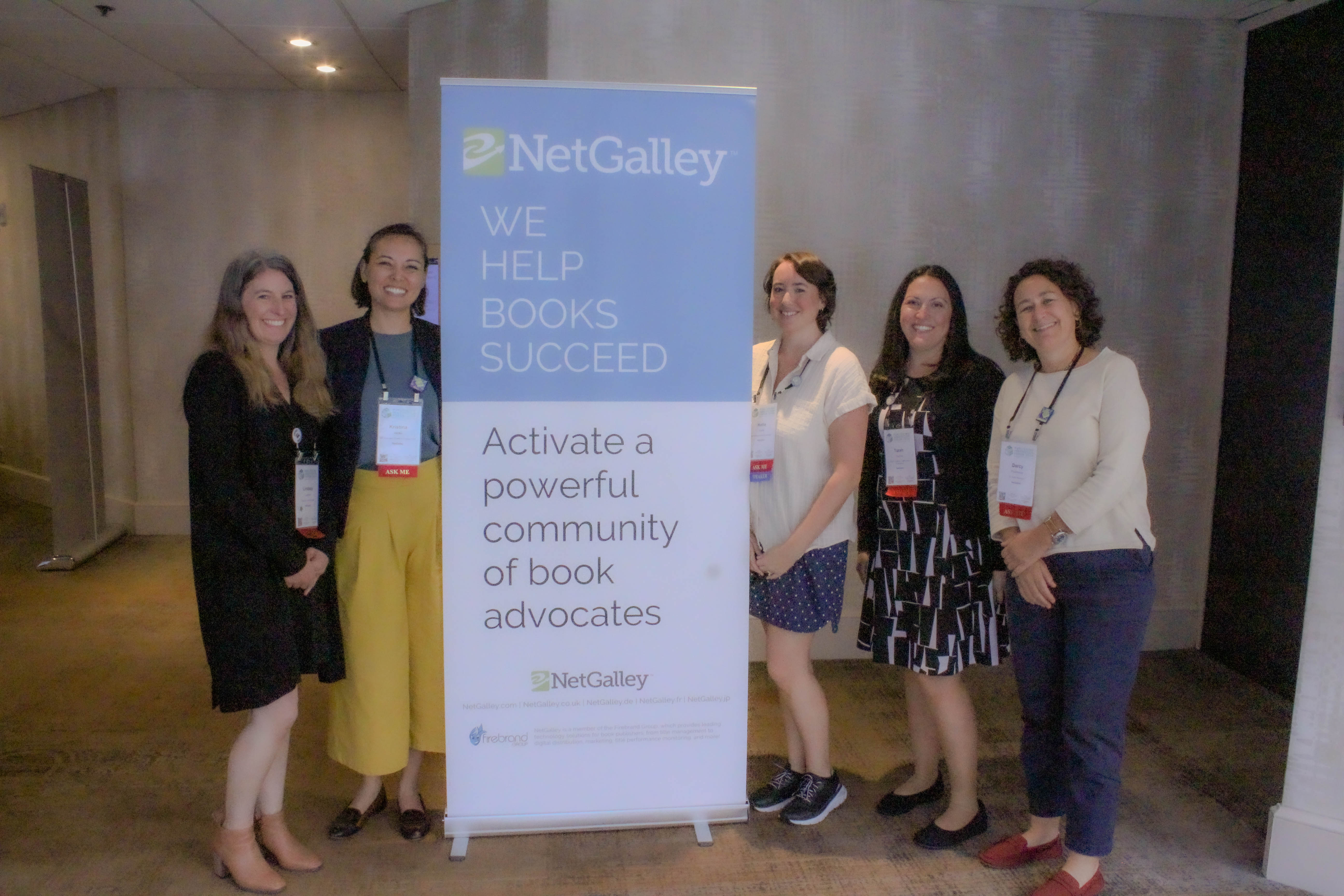
NetGalley team members at Publishing Innovation Forum, 2024: Lindsey Lochner, Kristina Radke, Hallie Fields, Tarah Theoret, Darcy Piedmonte