Technology Confidential with BISG

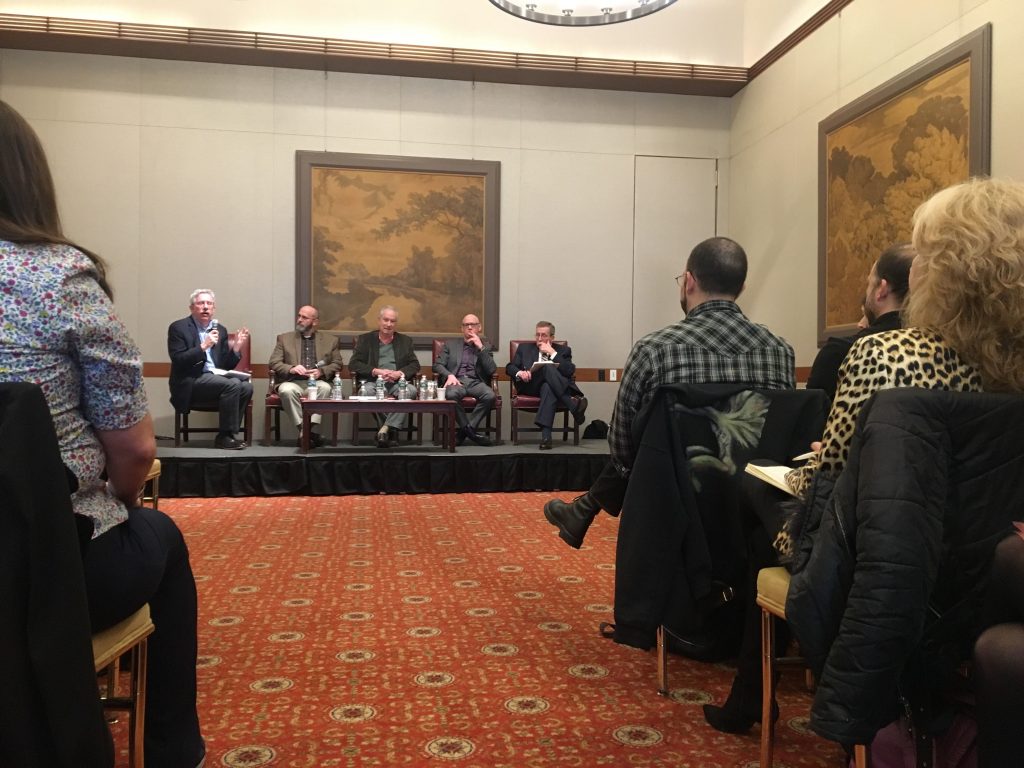
On Tuesday, Feb. 5, we attended BISG’s Technology Confidential program. The panel included Rod Elder of Virtusales, David Hetherington of knkPublishing, George Logan of Klopotek, and Rob Stevens of Firebrand Technologies. Of course, we’re happy for any opportunity to cheer on our colleagues from Firebrand, but we were also there to hear from other panelists and attendees across the industry who are focused on using technology to help publishers get their books into as many hands as possible.

Virtusales, knk, Klopotek, and Firebrand all provide software to help publishers manage multiple aspects of the publishing process from title management to ONIX delivery to rights across multiple divisions and throughout a title’s lifecycle.

The panelists talked about the perils of customization, challenges of changing publishers’ workflows and implementing new technologies, and the importance of clearly-defined strategies at all levels of a company.
Configuration, not customization

The panelists lamented the challenges of leaning too heavily on customizations. While at first it might seem like customization can streamline workflow and tailor software to the unique needs of a specific publisher, all of the tech experts on the panel cautioned against it. The panelists uniformly recommended configuring software instead of customizing. Configuration keeps the basic structure of a software while shaping it to the style specifications and some of the unique needs of an individual company. Customizing requires new code whereas configuring does not.

Customization can make it more difficult for the software to communicate with other softwares, and can make system updates more difficult, resulting in patched solutions upon patched solutions. David Hetherington noted that heading down a road of customization is a road that will ultimately be longer, harder, and more expensive.

This is why publishing-specific software are so important. Rod Elder of Virtusales acknowledged that publishers have unique needs compared to businesses in other industries. The solution is to use publisher-specific software rather than customizing software that is meant for a different industry to make it work for publishing. Publishing-specific software can be specific enough for the unique needs of book publishers so as not to require huge amounts of configuration, but still flexible enough from a UI perspective to fit the quirks of an individual house.  

Consider the costs

David Hetherington gave the audience an acronym for thinking about workflow and technology updates: TCO – Total Cost of Ownership. It forces you to ask: What is the cost of doing things the way they’ve always been done, versus adopting a new technology to solve the problem?

Say a publisher workflow includes manually and frequently enter data in multiple databases for a single title. The publisher should consider both the literal cost of employee hours spent doing repetitive administrative work and keeping a big IT team to deal with bugs, plus the more abstract cost of an employee’s intellectual or creative energy that is left on the table when so many hours of their day are taken up with data entry. The TCO for this workflow might be high enough to necessitate a change in the status quo, either by internally streamlining or by introducing new software to make the process less manual and less repetitive.

Publishers tend to think about implementing new technologies only in terms of the cost of the new software and the time it takes to integrate it into daily operations. But the panelists reminded the audience that there are real costs to consider in these calculations related to maintaining the status quo.

Articulate the “Why”

Rob Stevens of Firebrand reminded the audience how important it is to ask why you and your team do what you do. Why do you fill in that box? Why do you enter data in a specific place or at a specific time? Why does your team need that report? If the reason is “that’s the way we’ve always done it,” you might want to consider dropping that task from your to-do list, which we’re sure is already long enough!

Asking why a company needs certain pieces of data can also help technology solution providers determine the best way to help meet a company’s needs or solve a particular problem for them, and can even drive development on the technology solution provider’s end.

Clearly articulating the “why” can also help ease some of the growing pains of implementing new software and workflows. If all members of a team know why they are being asked to change their day-to-day operations, they are more likely to adopt the new tools and use them successfully. The success of new technologies in a publishing house largely depend on the enthusiastic adoption and experimentation by the people who are using them on a daily basis.


BISG works to create a more informed, empowered and efficient book industry. Its membership includes trade, education, professional and scholarly publishers, as well as distributors, wholesalers, retailers, manufacturers, service providers and libraries.

For more cross-industry knowledge and events, follow BISG on their website, where you can see all upcoming events. You can subscribe to their newsletter here.

And, keep up to date with industry news, trends, and best practices by subscribing to NetGalley Insights.

Divider

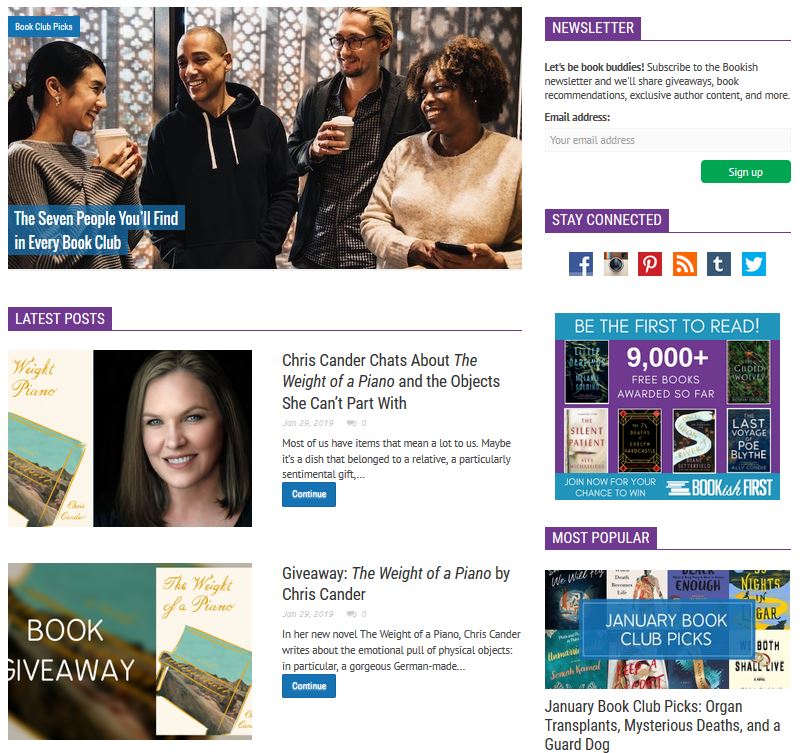
How to Pitch: Kelly Gallucci, Executive Editor of Bookish.com

Kelly Gallucci is the Executive Editor of Bookish.com, where she oversees Bookish’s editorial content, offers book recommendations, and interviews authors like Colleen Hoover, Leigh Bardugo, V.E. Schwab, and Julie C. Dao.

As the editor of this popular site, she gets pitched a lot of books to consider for features, interviews, inclusion in lists, and the like. Below, she shares some tips about how to approach pitches, based on her experience receiving them.

Give us a sense of the volume of pitch emails you receive. How do these fit into your overall workflow and help you build your editorial calendar?

My inbox is my personal Everest. I’d estimate that I receive roughly 100 emails a day, give or take, though not all of those are pitches. There’s definitely an ebb and flow depending on the day of the week and the season of the year.

Our editorial calendar is first shaped by recurring features (such as our book club recommendations, monthly Bookish bingo, and our seasonal roundups). The next step is to fill in any features that our team wants to work on. While writing those in, we leave room for articles inspired by publicity pitches, such as interviews and author guest posts.

Sometimes books pitched to us will fit into features we’re already crafting (a romance book pitched while we’re writing a holiday romance listicle), or they’ll inspire features we want to work on in the future. I also like to leave room for author guest posts, where authors share a short essay or a list of book recommendations. This gives our readers more insight into the author and their work, and lets us profile their book more directly.

What are the most successful ways that people have contacted you with a pitch? What are pitfalls that might make a pitch less successful with you? Feel free to include specifics.

The best pitch emails are the ones where a publicist shares an idea for an author guest post or predicts the kind of content the book would be best suited for. This makes it easier to envision where the article would fit into our calendar.

As for pitfalls, the big one is pitching us for content we don’t feature. For example, I receive a lot of pitches asking for us to review a book, but we don’t do book reviews on Bookish. Similarly, I receive a lot of requests for interviews. Interviewing authors is one of my personal favorite parts of my job, but they can be tricky for our audience. You have to work twice as hard to motivate a reader to click into an interview with an author they’re unfamiliar with. If an author has a strong online community, we can tap into that. If not, I’ll often see if the author is available for a different type of feature instead. A lot of this depends on the author’s availability, but I always appreciate publicists who are willing to think outside of the box with me when it comes to how to feature books.

Describe the relationships you have built with publicists and authors who regularly pitch you. How have publicists been able to earn your ear and your trust?

I’ve had the pleasure of working with so many brilliant and talented publicists over the years. Their creativity and drive never cease to amaze me.

The ones I rely on most are the ones who take the time to truly understand Bookish. They read our articles. They know the content we do and do not cover. They pay attention to the genres we feature most frequently. Basically, they do their homework. As a result, their pitches are refined and reflective of the content that does well for Bookish. When I see an email from them in my inbox, I know the book they’re pitching will be a good fit for us.

I also always appreciate the publicists who ask questions, especially if we haven’t had the opportunity to work together for long. I’m always happy to hop on the phone or fire off an email that can explore in detail the kind of content we cover, what does and doesn’t perform well, who our audience is, and more. When I receive a pitch, I’m never just thinking about the book. I’m considering all of those other factors too.

When digging through your inbox, what kinds of subject lines catch your eye? What details are important right up front?

I think the best subject lines are concise and direct. In my inbox right now, there’s an email with the subject “Cover Reveal for Bookish.” That’s excellent. I know exactly what I’m clicking into, and it alerts me to the fact that this is a more time-sensitive email. Another one I’ve spotted is “February’s Most-Anticipated Read” followed by the book title and author name. I now know the book, the time frame, and the angle.

On the other hand, I see a lot of emails that try to offer too much information upfront. An example from my inbox at the moment would be “New Standalone Novel From NYT Bestselling Historical Fiction Author” and the rest of the subject (the book title, author’s name) are cut off. The lede is buried here, and at first glance all I really know is the genre.

How do you feel about follow-ups from publicists? Is there a timeframe that works well for you if they haven’t heard back? What is important to you in a follow-up from a publicist?

My inbox is a dragon and it hoards emails like they’re gold. Follow-ups often work really well for me because they help to bring the email back to the top of my inbox.

The ideal timing varies. I don’t mind if a publicist follows up on a time-sensitive email the following day. For general pitches, following up a week or even weeks later is helpful, particularly if the pub date is still a healthy distance away.

A longer time between follow-ups also means that there’s more potential for new information to have come out, and that’s something I’m always looking for in those emails. Has anything changed since the first pitch (news, reviews, blurbs, etc.)?

What is one pet peeve (or pet pleasure!) that you have about pitch emails?

My pet peeve is definitely when emails don’t contain enough information. It’s most helpful for me when the author, book title, genre, and pub date are as up-front and clear as possible.

I’ll also add, and this isn’t related to pitches, that it’s extremely helpful when authors list their publicist on their website. It’s one of the places we check if we’re looking to contact a publicist we haven’t worked with before, but most authors only list an agent.

As for pet pleasure, it’s always a joy to open an email where a publicist references projects we’ve worked on in the past, books I’ve enjoyed from them, and other personal touches. To be clear, I’m all for form emails. Publicists are juggling multiple books and authors, and I support anything that makes their lives a bit easier. But personal touches at the beginning of those emails are always just a nice thing to see during my day.

Follow Bookish on their website, and on Facebook, Twitter, and Instagram.

Divider

Introducing a New, Premier Level of Service: NetGalley Advanced

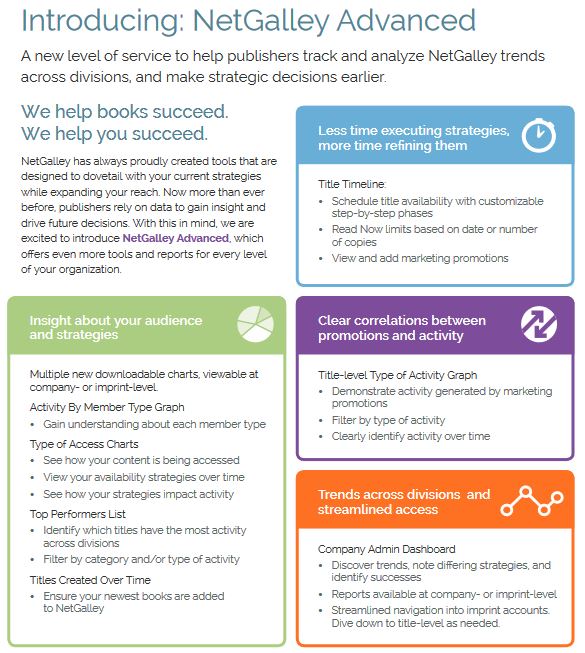
Today we are excited to announce the launch of NetGalley Advanced! This new, premier level of service is now available as an upgrade*, offering new reports to help publishers track activity within NetGalley, and new tools designed to reduce manual effort and time for staff.  With more insight and flexibility, NetGalley Advanced will help you analyze your data so you can make strategic decisions earlier and anticipate trends before your books go on sale.

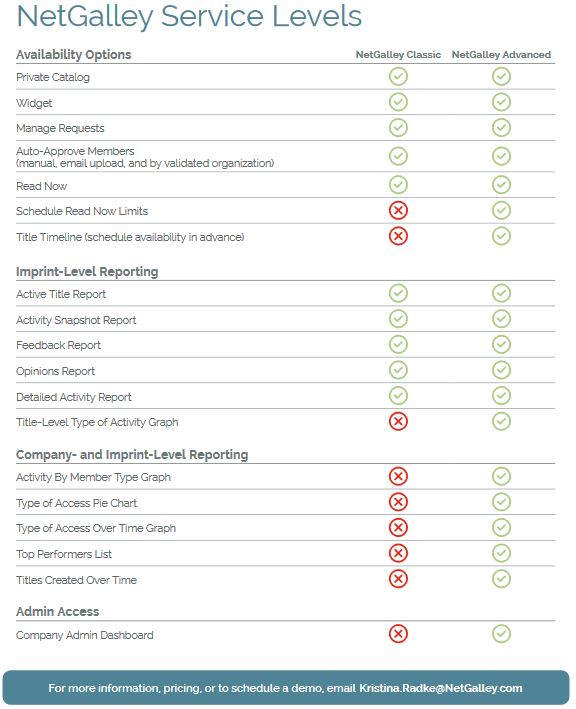
All of the existing features in NetGalley will still be available, while NetGalley Advanced will continue our ongoing strategy of implementing new features to address publishers’ needs and goals. Take a look at the information below to see how NetGalley Advanced compares to what we’re now calling NetGalley Classic.

Join our webinar on January 30, at 1:00pm ET for a demo of the new features and to ask questions.

We look forward to continuing to help publishers of all sizes promote a wide variety of titles to early influencers, and continuing to grow and evolve to meet your needs.

Read the NetGalley Advanced press release here!

*NetGalley Advanced is currently available for publishers in North America, and will be made available to publishers in other territories at a later date.

Divider

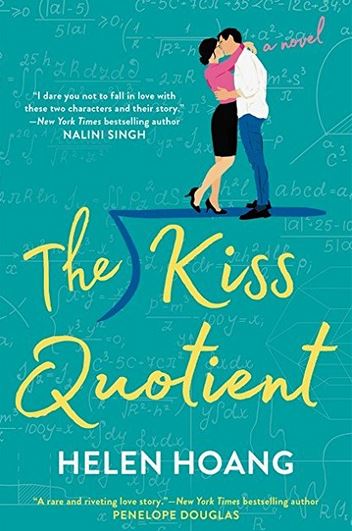
Case Study: The Kiss Quotient

How Berkley turned a debut novel into a smash hit using social influencer marketing

On NetGalley Insights, we highlight the successes of NetGalley publishers and authors, and share some of their strategies. Today, we’re talking with Jessica Brock, Senior Publicist & Digital Media Strategist at Berkley about The Kiss Quotient.

Published in May 2018, this modern romance featuring a heroine with Aspergers has been both well-reviewed and enthusiastically embraced by readers. And, it even has a movie deal!

One place that The Kiss Quotient really resonated was on social media. BookTubers posted video reviews and Bookstagrammers placed it in aesthetically pleasing shots. Jessica knew that putting The Kiss Quotient into the hands of social media influencers was going to be an important part of building its buzz. And, she even used the campaign as an opportunity to build her network of social media influencers! Learn more about her strategy in the interview below.

Tell us about your strategy for getting influencers excited about The Kiss Quotient.

Immediately upon finishing The Kiss Quotient I knew it was going to be something special. The first step for me was determining how to shout “READ THIS BOOK!” to the widest audience possible. This story isn’t just for traditional romance readers and I wanted to make sure people knew that. The campaign began with a cover reveal and excerpt on Bustle, hitting a key, younger female demographic. The cover popped, Helen’s personal stake in the story intrigued readers, and the excitement began.

After that, my main goal was growing steady interest in the book among bloggers, Bookstagrammers, and bookish influencers. Providing early galleys and e-galleys was a big part of that, as well as continual coverage on Berkley Romance’s social media platforms. This is a perfect example of “Oh, I’ve seen that!” publicity awareness. In my outreach to influencers, I talked about The Kiss Quotient like I would with a friend, with delighted squeals, OMG’s, and BAE’s included. I also specifically asked that they “help me tell the world about this book” via Twitter, Instagram, Goodreads, and Facebook. I didn’t have a platform preference because I wanted to reach as many readers as possible. I do think that Bookstagram played a major part though as the cover is quite ‘grammable. On a visually driven platform, The Kiss Quotient stands out beautifully.

How do you build relationships with influencers as a publisher?

One of my main responsibilities at Berkley is communicating and cultivating relationships with media contacts and influencers, in particular those who focus on romance. Romance bloggers are the backbone of the online romancelandia community and I absolutely love working with them. I send out two curated monthly newsletters to romance-focused bloggers and media contacts, chat with people on Twitter and Facebook, and generally try to keep up with what folks are reading, because romance bloggers are ravenous readers. We do our best to get them galleys as early as possible with the hope they will read and love our books and ultimately share reviews around the release dates.

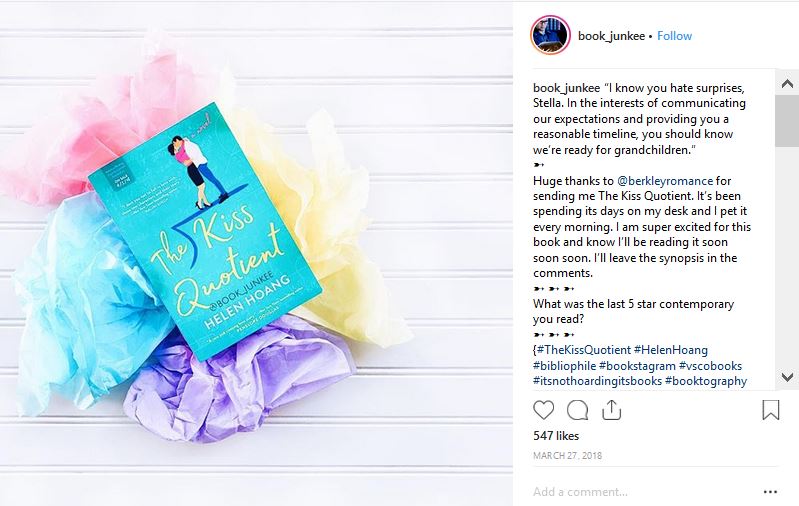
Instagram – @book_junkee

How did you let influencers know about The Kiss Quotient and how did you give them access to read it? What was your balance between proactive outreach and responding to requests?

I sent pre-approved NetGalley widgets to a large list of media contacts and influencers. [Widget invites accounted for 26% of all members with access on NetGalley, so this strategy was highly effective!]. I also sent out a number of print galleys in fun packaging (I love color coordinating!) that I hoped would encourage them to share images immediately on their social platforms, mainly Instagram as it is so visual. I knew the “Look how pretty” appreciation at the beginning would morph into the “Omg this book is amazing” attention as soon as they began reading and that they would share those thoughts on their social media as well.


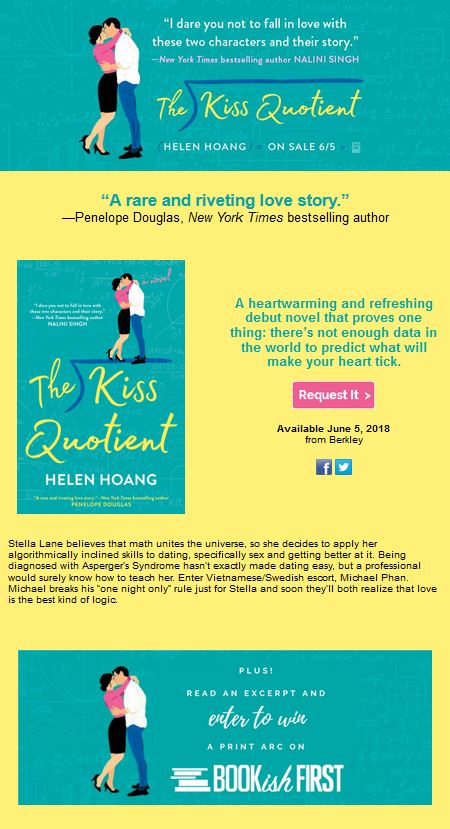
Custom eblasts sent to NetGalley and BookishFirst members drew requests on NetGalley and previews on BookishFirst.

I also dedicated a lot of time to responding to requests for the book. There were numerous BookTubers and reviewers who requested The Kiss Quotient that I had never worked with before. Granting them access to the book and getting to know their channels and sites has been a great way to start successful working relationships with many of them. And I would be remiss if I didn’t mention the benefit of some light internet stalking! If someone posted about The Kiss Quotient on Instagram, I would check the comments to see if they were from other influencers that I could also approach for review or feature coverage and I did the same with Goodreads. Twitter searches also proved very useful as the title of this book is pretty unique so I could easily see who was talking about it without having to filter through a lot of non-book related posts.

Aside from working with social media influencers, what other strategies did you employ for The Kiss Quotient?

I secured a lot of mainstream media attention, including The New York Times, Entertainment Weekly, and Buzzfeed, which piqued other outlets’ interest in the book and Helen’s personal story. I highlighted The Kiss Quotient’s strengths, joined the excited conversations with early reviewers, and reached out to other authors whom I thought would love Helen’s book as much as I did. Support from fellow authors can make a significant difference in reader awareness and publicity opportunities.

Jessica is a Senior Publicist and Digital Media Strategist at Berkley who manages the romance social media accounts and works with authors like Helen Hoang, Jasmine Guillory, Alexa Martin, Samantha Young, Uzma Jalaluddin, and more. A self-proclaimed Slytherpuffenclaw, she loves to read YA as well as romance and dark-and-twisty thrillers.


Interviews have been edited for clarity and length.

Check out the rest of our case studies here!

Divider

Pre-Publication Tips for Authors: Writing Outside Your Book

In the book marketing world, getting your name out there is crucial. If someone casually browsing for their next read recognizes your name, they’re far more likely to take a closer look, and hopefully purchase.

Since writing is your craft, one of the best ways to get your name noticed is to write. So, write! It’s natural to want to write exclusively about your book as a way to promote it, but you should also consider writing about topics related to your book. For example, if you write Civil War romances, pitch a column on a women’s cultural interest website about the hidden histories of women in the United States in the 19th century. You can access a wider audience than you could otherwise, and demonstrate your expertise about your chosen field of interest.

You can also write in more casual settings; like a blog or a newsletter. Many authors and cultural critics send out periodic newsletters that describe what they are reading, listening to, and thinking about. Newsletters and blogs are a way to stay top-of-mind for your audience, and to help your readers develop a more personal relationship with you and your work.

This kind of tactical writing can increase your visibility and the visibility of your titles in the marketplace. But, as with all kinds of marketing efforts, quality is more meaningful than quantity. First and foremost you should write and pitch content that you would be interested in reading, and the readership will follow.

Divider
Divider